




The Surgeon India Forgot: Why Every Indian Medical Institution Must Honour Maharshi Sushruta
- In History & Culture
- 12:20 PM, Jun 25, 2026
- Dr Ryan Baidya
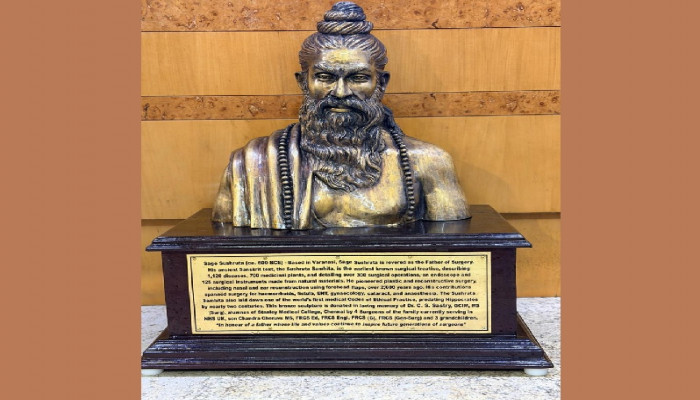
On June 19, 2026, the Royal College of Surgeons of Edinburgh in the United Kingdom unveiled a bronze sculpture of Maharshi Sushruta, the ancient Indian surgeon widely remembered as the Father of Surgery. I came across this news a few days later, and it made me pause. It drew my attention not only outward, toward Edinburgh, but inward, toward India and toward myself: how much do I really know about Sushruta, and why do I know so little?
What I found was sobering.
We Indians know far too little about the great contributors of our own civilisation. More troublingly, we were given very little opportunity, encouragement, or institutional framework to learn about those who contributed to humanity from this soil. We are taught many names from Europe's scientific and medical history, and rightly so. But where, in the consciousness of the Indian student, is Sushruta? Where is Charaka? Where are the physicians, mathematicians, astronomers, grammarians, metallurgists, philosophers, and knowledge creators of Bharat?
The irony is painful. A premier surgical institution in Edinburgh can honour Sushruta with confidence. The Royal Australasian College of Surgeons in Melbourne installed a marble statue of Sushruta in 2018, noting it in its own annual report. Yet in India, among roughly 1,500 medical, Ayurvedic, and public-health education institutions, only a small number visibly honour him. Most of our campuses remain silent. This silence is not a small decorative omission. It is a symptom of civilisational amnesia.
This is not merely an omission. It is a mirror.
I found a handful of documented examples in India where Maharshi Sushruta is on display
|
Institution / Campus |
Location |
Evidence |
|
Amrita Institute of Medical Sciences & Research Centre (AIMS) |
Kochi, Kerala |
A 40-foot statue of Sage Sushruta was unveiled there in 2016.) |
|
Mysore Medical College & Research Institute (MMC&RI) |
Mysuru, Karnataka |
A Maharshi Sushruta statue was unveiled at the Academic and Library Block in 2023. |
|
Patanjali Yogpeeth |
Haridwar, Uttarakhand |
A Sushruta statue is documented there by World History Encyclopedia. |
|
Raj Bhavan, Goa |
Dona Paula, Goa |
The Vice-President commissioned statues of Charaka and Sushruta at Raj Bhavan in 2025. |
Maharshi Sushruta is associated with ancient Kashi, today's Varanasi, and with the Sushruta Samhita, one of the foundational texts of Ayurveda and one of the world's earliest systematic works on surgery. Modern scholarship often describes him as a pioneering figure in surgical history, especially in plastic and reconstructive surgery. Britannica identifies Sushruta as an ancient Indian surgeon known for pioneering operations and for the influential Sushruta Samhita, a major source of knowledge on surgery in ancient India.
The Sushruta tradition described surgical training, instruments, wound care, reconstructive procedures, rhinoplasty, and ethical responsibilities of physicians long before modern European surgery matured. To honour Sushruta is not to reject modern medicine. It is to recognise that the history of medicine and surgery is not the exclusive property of Europe. India, too, has a deep and serious place in that history.
Then why has India been so hesitant?
Part of the answer lies in colonial inheritance. Indian medical education was shaped through institutions, syllabi, and intellectual frameworks inherited from the British. Students learn Hippocrates, Galen, Vesalius, Harvey, Lister, Pasteur, and Fleming. They should. These figures belong to the global history of medicine. But Sushruta belongs there too. When Indian students are not introduced to him with the same seriousness, the result is not modernity; it is imbalance.
Another reason is the false divide between modern medicine and Ayurveda. Because Sushruta is associated with Ayurveda, many modern medical institutions hesitate to honour him, perhaps fearing that it may appear unscientific. This is a grave intellectual mistake. A bust of Sushruta in a medical college does not instruct surgeons to abandon anesthesia, antisepsis, antibiotics, imaging, clinical trials, or evidence-based medicine. It simply tells students that the human search for surgical knowledge had an Indian chapter, and that chapter deserves to be remembered.
India must learn to distinguish between historical recognition and clinical prescription. Honouring Sushruta is not a medical protocol. It is an act of intellectual honesty.
There is also a deeper cultural weakness. India builds countless statues of political figures, but very few of scientists, physicians, mathematicians, astronomers, grammarians, philosophers, and knowledge creators. A civilisation that forgets its knowledge ancestors becomes dependent on others to validate its own greatness.
That is exactly what has happened. When Edinburgh or Melbourne honours Sushruta, Indians feel pride. But why should India wait for Edinburgh or Melbourne? Why should Indian medical institutions awaken only after external validation?
To be fair, some Indian institutions have begun to respond. Amrita Institute of Medical Sciences in Kochi unveiled a large Sushruta statue in 2016. Mysore Medical College and Research Institute unveiled a Maharshi Sushruta statue in 2023. Raj Bhavan, Goa commissioned statues of Sushruta and Charaka in 2025. These are welcome steps. But they are too few, too late, and too scattered for a civilisation of India's depth.
Every medical college in India should display a bust, portrait, plaque, or historical panel on Maharshi Sushruta. Every surgical department should teach a short module on the global history of surgery, including Sushruta's contribution. Every Ayurveda college should present him not merely as a traditional figure, but as part of the broader intellectual history of medicine. Every public-health institution should connect students to India's knowledge traditions with maturity, evidence, and confidence.
This should not be done through empty nationalism. It should be done through disciplined civilisational memory.
India does not need myth-making. It needs memory. It needs evidence. It needs institutions that are not embarrassed by their own inheritance.
A simple national goal can begin this restoration:
|
By 2030, every medical, Ayurvedic, dental, nursing, and public-health institution in India should visibly honour Maharshi Sushruta, Acharya Charaka, and other foundational figures of Indian medical knowledge. |
This is not merely about statues. It is about intellectual self-respect.
A young medical student walking through a campus should know that surgery has many ancestors. Some came from Greece. Some came from Europe. Some came from the modern laboratory. And one of the great ones came from Bharat.
Maharshi Sushruta does not need India's recognition to become great. He already is.
But India needs to recognise Sushruta to become whole again.
References for Further Reading
- Royal College of Surgeons of Edinburgh. "The Cheruvu Legacy: The Launch of the Cheruvu Professional Development Grants." June 2026.
- Consulate General of India, Edinburgh. "Consul General unveiled the bronze sculpture of Sage Sushruta, revered as the Father of Surgery, at the Royal College of Surgeons of Edinburgh." June 22, 2026.
- India in Scotland (@IndiaInScotland). "Consul General unveiled the bronze sculpture of Sage Sushruta..." X, June 19, 2026.
- Royal Australasian College of Surgeons. Annual Report 2018. Melbourne: Royal Australasian College of Surgeons, 2019.
- Encyclopaedia Britannica. "Sushruta." Last modified May 29, 2026.
- Dave, Tapan, et al. "Sushruta: The Father of Indian Surgical History." Plastic and Reconstructive Surgery Global Open 12, no. 4 (2024).
- Gandhi, Mahesh A., et al. "Sushruta: The Father of Surgery and Ancient Medical Innovations." Cureus 16, no. 10 (2024).
- Natarajan, K. "Surgical Instruments and Endoscopes of Susruta, the Sage Surgeon of Ancient India." Indian Journal of Surgery 70, no. 5 (2008): 219-223.
- Amrita Vishwa Vidyapeetham. "Sage Sushruta Statue Unveiled at AIMS, Kochi." February 6, 2016.
- "Maharshi Sushruta Statue Unveiled at MMC&RI." Star of Mysore, March 25, 2023.
- Press Information Bureau, Government of India. "Focus on Alternative Medicine, Says VP." May 22, 2025.
- Public Health Foundation of India. "Indian Institutes of Public Health."
- National Commission for Indian System of Medicine. "List of Ayurveda Colleges."
Disclaimer: The opinions expressed within this article are the personal opinions of the author. MyIndMakers is not responsible for the accuracy, completeness, suitability, or validity of any information on this article. All information is provided on an as-is basis. The information, facts or opinions appearing in the article do not reflect the views of MyindMakers and it does not assume any responsibility or liability for the same.



 Loading...please wait
Comments