




The Strategic Cost of Trust Deficit between US and its Allies & Impact on India
- In Military & Strategic Affairs
- 09:29 PM, Aug 23, 2026
- Lt Gen L N Singh (Retd)
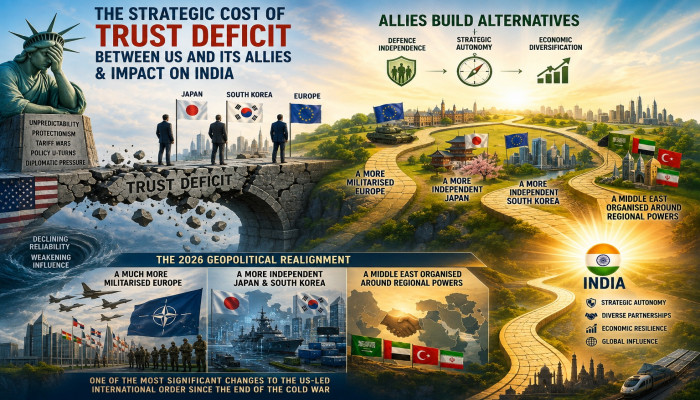
Recently, the US has been exhibiting an increasing trust deficit with its allies. What is being seen in 2026 is more than a collection of diplomatic quarrels between the United States and its traditional allies. Beneath the diplomatic tensions that the US has with Europe, NATO, Canada, Japan, South Korea and countries in the Middle East, lies a deeper and potentially more consequential shift in the way Washington views alliances.
For decades, the traditional American approach was that ‘alliances are strategic assets. The emerging approach is increasingly transactional, which says ‘allies must demonstrate their value to the US’.
Several forces are driving this change. Amongst others, the important ones are – the American military is overstretched, there is growing challenge from China, the rising cost of maintaining global commitments, long-standing concerns about European defence spending, and Washington's desire to concentrate more resources on the Indo-Pacific.
There is a legitimate strategic objective behind much of this pressure. The United States has long been carrying out a disproportionate share of the defence burden within the Western alliance system. European countries and Canada have benefited enormously from the American security umbrella while spending considerably less than the United States.
However, the problem here is not necessarily the demand from the US for the allies to do more. The problem is the way this demand is being communicated. Instead of simply saying, “We need stronger allies and a stronger European pillar of NATO,” Washington appears to be saying: “If you do not do what we want, then we may not protect you.” This difference could have enormous long-term consequences.
The Five Things Washington Is Doing
1. Demanding That Allies Pay More for Their Own Defence. The basic argument of Trump is: why should America spend so much defending wealthy countries that can afford to defend themselves? There is a reasonable argument, as Europe and Canada have historically spent considerably less on defence than the United States, while they are benefiting from the American security umbrella.
This pressure has produced some results. NATO allies have agreed to a 5% of GDP defence-investment target by 2035, while European allies and Canada substantially increased defence expenditure in 2025. In that sense, Trump has achieved something previous administrations struggled to accomplish - it has forced allies to take the burden-sharing question much more seriously.
But there is a difference between burden-sharing and burden-shifting. If allies increase their defence capabilities because they would want to strengthen the alliance, then the alliance becomes stronger. On the other hand, if they do so because they no longer trust America to protect them, the result could ultimately be very different.
2. Europe: America Is Effectively Saying, “Defend Yourselves.” For roughly 80 years, Europe's security model was based on - Europe & United States combining their military to strengthen the ‘NATO defence’. However, the emerging model looks increasingly like- Europe is primarily responsible for conventional European defence, while the United States provides the nuclear umbrella and selective strategic support.
This may not be necessarily bad for Europe. Indeed, Europe is finally being pushed toward something that should have begun decades ago - developing greater independent military capability. A stronger European defence capability could make NATO more resilient and reduce the burden on Washington.
But there is a psychological problem.
European governments are increasingly asking themselves – “if the US can reduce its commitment whenever they become unhappy with us, can we really build our long-term national security strategy around America?”
This is a dangerous question. Hence, the issue is therefore not simply whether Europe spends more. The question is whether Europe spends more to be a stronger American ally or as preparation for a future in which America may no longer be fully dependable.
3. NATO: The Biggest Issue Is Not Spending—It Is Trust. Ironically, Trump's approach may strengthen NATO on one hand, but weaken it on the other. Higher European defence spending strengthens the alliance's military capabilities. But uncertainty about America's commitment can weaken NATO's psychological foundation.
The impact of an alliance on the potential adversaries ultimately depends on deterrence. An adversary must believe that if it attacks one member, the other members—particularly the United States—will respond.
If Russia begins wondering: Would Washington really risk a major war with Russia for Estonia, Latvia or Poland? Then deterrence becomes weaker. And if Poland, Germany or France begin asking the same question, then the European governments have an incentive to prepare for a future in which they cannot assume a guaranteed adequate US response.
This is why the current debate is about much more than defence budgets. It is about strategic confidence.
4. Canada: A Remarkable Strategic Shift. Canada is a particularly interesting case because it is not simply another American ally. Canada is the only northern neighbour of the US. Their relationship has been traditionally something deeper than a conventional alliance, including economic integration and enormous people-to-people ties. Yet tariff pressure and increasingly confrontational rhetoric from the US have introduced something that once seemed almost unthinkable: Canada is beginning to consider strategic diversification away from excessive dependence on the United States.
If Ottawa concludes that it cannot assume Washington will always treat Canada as a trusted strategic partner, then Canada has an incentive to deepen relationships with – Europe, Japan, Australia, ASEAN and even China.
Canada is already participating in the wider NATO rearmament effort, and has substantially increased its defence expenditure.
The paradox is striking. American pressure may produce a more militarily capable Canada while simultaneously reducing American influence over Canada's future strategic choices.
5. Japan: Perhaps the Most Consequential Case. Japan's post-World War II security architecture was built around a simple premise that the US protects Japan. Because of this security guarantee, Japan deliberately maintained a comparatively restrained military posture for decades. But now, Tokyo is increasingly forced to ask: what happens if the US becomes less reliable?
The situation involving South Korea is particularly significant because Japan is watching Washington's decisions very carefully. If the US can reduce major military activities with South Korea because of disagreements over costs or foreign policy, Japanese strategists naturally have to consider whether similar logic could eventually apply to Japan also.
That could encourage Japan to develop a genuine Plan B. Such a development could result in a larger and stronger Japanese military with longer-range missiles, greater naval capability, stronger missile defence and potentially start a more serious domestic debate about nuclear weapons.
The paradox is profound. For decades, the US has had an interest in preventing Japan from becoming a fully independent military power. A weakening perception of American reliability could accelerate precisely that outcome.
South Korea: An Extraordinary Test of the New Approach. South Korea provides perhaps the clearest illustration of the emerging American approach. South Korea is one of America's most important military allies. Yet military cooperation has increasingly become entangled with broader questions involving Iran policy, financial contributions and Washington's relationship with North Korea.
The reduction in military exercise participation has caused anxiety in Seoul because such exercises are not merely symbolic. They maintain interoperability, readiness and the ability of two militaries to fight together.
And there is another potentially historic consequence. If South Koreans begin concluding that the US might not always defend them against North Korea, then the argument for an indigenous nuclear deterrent becomes considerably stronger. This would represent a fundamental transformation in the security architecture of Northeast Asia.
The Middle East: The Breakdown of an Old Assumption. The Middle East may present an even more dramatic example. For decades, Gulf security operated on an implicit understanding that the US would provide security while the Gulf states provided bases, energy cooperation and strategic alignment.
The Iran War has exposed weaknesses in that arrangement. Gulf countries have discovered an uncomfortable reality that hosting American forces does not necessarily mean that Washington will protect every Gulf interest under every circumstance.
Iran's threats against Gulf infrastructure create a difficult dilemma for Saudi Arabia, Qatar, the UAE, Bahrain and others. As Washington becomes more coercive in its demands, Gulf states have greater incentives to hedge. And hedging is precisely what major powers generally do not want their allies to do. The emergence of alternative regional security arrangements is therefore strategically significant.
Saudi Arabia, Pakistan and Turkey's mutual-defence arrangements called the Mecca Joint Defence Agreement, also known as the Mecca Agreement, were signed on 7 August 2026. The Mecca Agreement enshrines a collective security arrangement directly modelled on Article 5 of NATO. This is an indication that regional states are increasingly interested in security structures that do not depend entirely on Washington.
Oman: Many smaller states are closely watching happenings in Oman as a revealing example. Oman has historically been one of America's most useful diplomatic partners in the Gulf and has played an important intermediary role between Washington and Tehran.
Yet American pressure on Oman during the Iran conflict has sent a broader message to smaller states that even if you are a useful American diplomatic partner, you cannot assume that Washington will shield you from political pressure. This encourages hedging. And once the allies begin hedging, the traditional hierarchy of influence starts to change.
Why Is Trump Doing This? There could be four major motivations behind this approach.
1. “America First”. The ideological argument is that America should stop subsidising the security of wealthy countries that can afford to defend themselves. Trump genuinely believes that the United States has carried too much of the burden for too long.
2. China. This may be the most strategically important factor. The United States cannot indefinitely maintain overwhelming military commitments simultaneously across Europe or the Middle East, while also preparing for a potential major confrontation with China. The US increasingly wants Europe to take greater responsibility for European defence so that American resources can be concentrated on the Indo-Pacific.
In simple terms - Europe has to defend Europe, while the US concentrate more resources on China and the Indo-Pacific
The 2026 US National Defence Strategy's emphasis on greater burden-sharing reflects this broader strategic direction.
3. American Military Exhaustion. This factor is becoming increasingly important. The United States has expanded enormous quantities of missiles, interceptors and other munitions through multiple military commitments. It raises concerns about America's ability to simultaneously supply its own forces and support several theatres. The old assumption that America can fight everywhere simultaneously is becoming less credible. This makes the current situation different from Trump's first term.
4. Unpredictability as Leverage. Perhaps the most controversial element here is the belief that uncertainty itself can produce leverage. The logic appears to be that it makes the allies nervous and they become more dependent on negotiations with Washington, where they are likely to concede more.
This strategy can work in the short term. But it contains a potentially serious unintended consequence. Allies may eventually stop being dependent on America.
The Central Strategic Danger: Allies Learning to Live Without America
Imagine Japan, Europe, Saudi Arabia, South Korea and Canada all independently reaching the same conclusion - we need the US, but we cannot depend exclusively on the US. Thus, they do not necessarily leave the US camp; instead, they begin hedging. Japan strengthens its military. Europe develops independent defence capabilities. Saudi Arabia deepens relationships with Turkey, Pakistan and China. South Korea considers greater strategic autonomy. Canada diversifies its economic and strategic relationships. India maintains strategic autonomy. ASEAN avoids choosing sides.
The result may not necessarily be an anti-American world. It is something subtler- a less hierarchical and more multipolar alliance system.
The Biggest Potential Winner May Be China. This perhaps could be the most important strategic consequence. China does not necessarily need to defeat the United States militarily. It simply needs America's allies to become less confident in the US. Just imagine Japan saying, “We need to cooperate with China economically.” Or South Korea saying, “We need some accommodation with China.” Or Saudi Arabia saying, “China should be an additional security and economic partner.” Or Europe saying, “We need strategic autonomy.” Or India saying, “We will not join an American bloc.”
If these tendencies become stronger, Beijing achieves something enormously valuable without firing a shot. It weakens America's network. And America's network of alliances is one of its greatest geopolitical advantages.
Russia Benefits Too
Russia has an obvious interest in weakening NATO cohesion. A divided NATO is less threatening than a unified NATO. Russia is already deepening military cooperation with North Korea, making developments on the Korean Peninsula particularly significant. Whenever Washington creates uncertainty within its own alliance system, Moscow gains strategic breathing space.
That does not mean Russia suddenly becomes stronger than the United States. It means that the cost of confronting Russia becomes more complicated when America's allies are less certain about Washington's commitment.
But Is the US Really Destroying Its Alliance System? That would be an overly simplistic conclusion. The United States still possesses extraordinary advantages. It has the world's largest military, nuclear capabilities, an enormous intelligence network, dollar dominance, a huge technology ecosystem, the world's most capable blue-water navy, extensive overseas bases, alliances with NATO, Japan and South Korea, strong relationships with Australia, the Philippines and major Gulf countries. And the allies are not actually abandoning Washington. Indeed, the European defence spending is rising dramatically, partly because of American pressure. So, Trump has accomplished something previous presidents struggled to accomplish - he has forced America's allies to spend more.
But the real question is whether Washington has extracted that additional spending at the cost of strategic trust.
The Great Paradox.
Here, two opposing factors are operating simultaneously. The US could become stronger in one dimension as the allies spend more and the US carries less burden. Thus, resources become available for tackling China. But the US could become weaker in another as allies’ trust in the US has reduced. Hence, as the allies hedge, the US political influence declines.
This is the central contradiction of the current transformation. Washington may be strengthening the material capabilities of its alliance system while weakening the psychological confidence that holds that system together.
Why India's Position Is Becoming Increasingly Valuable
India occupies a particularly interesting position in this changing geopolitical environment. India does not have a defence treaty with the United States. This gives us something Japan, South Korea, Canada and NATO members do not possess to the same degree that is strategic flexibility.
India could simultaneously cooperate with the US against China, purchase Russian military equipment, maintain relations with Iran, engage Saudi Arabia and the UAE, participate in BRICS, work with the QUAD, maintain relationships with Europe, deepen ties with Japan and also work with Russia
In a world where America's traditional allies are increasingly seeking strategic insurance, India's autonomy becomes an asset. India could increasingly become a country that everybody wants on its side, but nobody can control completely. That is an extremely powerful geopolitical position.
The Emerging Order: This is not necessarily the collapse of the American alliance system. It is more accurately a transition from the US-led, relatively hierarchical alliance system toward US-led but increasingly autonomous regional security systems. Europe will increasingly defend Europe. Japan will increasingly defend Japan. South Korea will increasingly defend South Korea. Gulf states will increasingly develop regional security arrangements. India will remain strategically autonomous. The US will possibly concentrate its highest-value resources on North America and the Indo-Pacific, particularly on the challenge posed by China. Seen from this perspective, much of what currently looks like chaos may actually contain strategic logic.
Conclusion: Emerging Consequence. The greatest danger is not that Japan, South Korea or Europe will suddenly “leave the US.” They probably will not. The danger is much subtler. They may stop assuming that America is an indispensable power. Once that happens, countries begin building alternatives. And once an alternative emerges, the US influence becomes harder to exercise.
That is why the current tensions could prove far more consequential than ordinary Trump-style diplomatic confrontations. The US may be forcing its allies to become stronger and simultaneously be teaching them how to live without America. That is the paradox at the heart of the 2026 geopolitical realignment.
If this trajectory continues, the next five to ten years could see three simultaneous developments. A much more militarised Europe, a more independent Japan and South Korea and a Middle East increasingly organised around regional powers rather than American guarantees.
Together, these developments could represent one of the most significant changes to the US-led international order since the end of the Cold War.
Disclaimer: The opinions expressed within this article are the personal opinions of the author. MyIndMakers is not responsible for the accuracy, completeness, suitability, or validity of any information on this article. All information is provided on an as-is basis. The information, facts or opinions appearing in the article do not reflect the views of MyindMakers and it does not assume any responsibility or liability for the same.



 Loading...please wait
Comments