




The Soul of Civilisational Sanatan Bengal Awakens: A Journey of Gratitude, Sacrifice, and the Dawn of Dharma
- In Current Affairs
- 01:43 PM, May 06, 2026
- Souptik Mukherjee
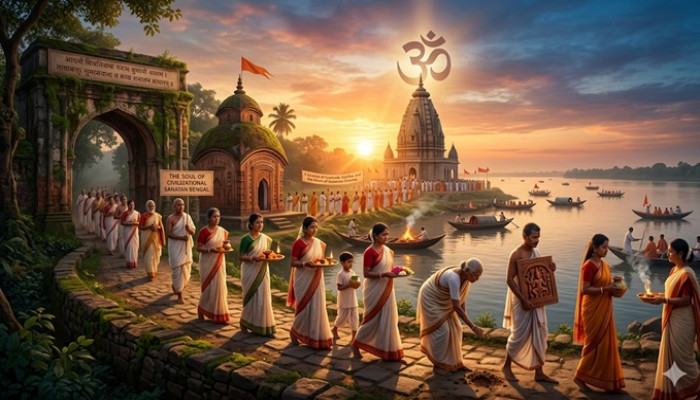
While we are celebrating the re-emergence of Hindu rule in Bengal—whether one sees it as the first such moment since Independence, or since the days of Lakshman Sen nearly 800 years ago, at the time when Bhaktiyar Khilji had invaded Bengal—I find myself, above all, filled with gratitude.
Gratitude to those countless souls who held our hands when there was no one else. Through trials and tribulations—especially over the last decade, but rooted in a century of upheaval—our people endured. Be it in West Bengal or across the border in Bangladesh, the accumulated pain, plight, sacrifice, and silent resilience of generations and accumulated tears through countless silent genocides have found expression in this mandate.
For years, when hope seemed distant, Hindu brothers and sisters across the world stood by one another. In that shared struggle, bonds were forged that no force could break. Bengal remembers. Hindus in Bengal are grateful.
And today, we believe—firmly and without hesitation—that a Hindutva rooted in Bengal can once again become a lighthouse for Hindus across the world.
For this is not new to Bengal.
Even when shackled—politically, socially, and psychologically—the spirit of Sanatan Dharma in Bengal continued to produce giants:
Rishi Aurobindo, who envisioned Bharat not merely as a land, but as a living, divine Mother—a Shakti destined to guide humanity toward higher consciousness.
Bankim Chandra Chatterjee gave the nation—its immortal cry of awakening through Vande Mataram, a song that transformed devotion to the Motherland into a sacred national resolve.
Swami Vivekananda, who declared that for fifty years, the worship of the Motherland must be our highest calling, and that through that devotion, Bharat would rise to greatness.
Acharya Prafulla Chandra Ray, who, even under British rule, reclaimed India’s scientific heritage through works like A History of Hindu Chemistry - from the Earliest Times to the Middle of the Sixteenth Century AD with Sanskrit Texts, Variants, Translation and Illustrations, proving that knowledge and civilisation could not be colonised.
Dr. Syama Prasad Mukherjee, who ensured a homeland for Hindus in Bengal and ultimately laid down his life for the unity of Bharat.
And in the darkest of hours—during the horrors of the Great Calcutta Killings—Kshatriyas like Gopal Mukherjee stood as protectors, ensuring that fear did not turn into complete exodus, that Kolkata's Hindu presence did not vanish under terror.
Even under Islamic rule, Raja Pratapaditya, Rani Bhawani and Pran Narayan stood up as proud Hindu Khatriyas defending the Hindus of Bengal and Chaitanya Mahaprabhu, through his Bhakti Movement, prevented mass conversions and enabled Ghar Wapsi too. And under British colonial rule, when chains sought to bind both body and mind, Bengal demonstrated something extraordinary: the seamless intertwining of science and spirituality, of rational inquiry and civilizational pride. Hindutva in Bengal was never narrow—it was expansive, intellectual, and deeply rooted in the eternal.
And even after Independence, the spirit did not fade.
A. C. Bhaktivedanta Swami Prabhupada carried Sanatan Dharma from the soil of Bengal to the farthest corners of the world, turning a regional inheritance into a global movement.
The soul of Bengal has always been Sanatan—craving for one Hindu, united Hindu. A people capable of being technologically strong, economically prosperous, yet firmly rooted in the ancient, and destined to lead humanity.
Then came decades where those links to the past were weakened—where ideological currents sought to disconnect Bengal from its civilizational roots, even as forces across borders and within continued to challenge its identity. The echoes of this struggle have been visible for years, and particularly in the last decade.
And yet—here we stand.
At the threshold of possibility.
It is deeply moving to imagine what Bengal, as a free and confident people, can offer to Hindus and humanity across the world. Not merely political change—but a model: of strength without fear, of identity without apology.
In this moment, the words of Rabindranath Tagore resonate more than ever:
“Where the mind is without fear and the head is held high…”
That is the Bengal we aspire to rebuild.
This is not the end of a journey—it is its beginning.
And if there is one truth that must guide everything that follows, it is this:
The future we build must stand on the foundation of gratitude.
Gratitude for those who endured.
Gratitude for those who protected us.
Gratitude for those who believed—when belief itself was an act of courage.
Whether we are present to witness its full flowering or not, that foundation will determine what Bengal becomes.
And what it gives to Sanatan and the world in the times to come.
For certain, I am missing out on many others who have contributed immensely. Please send out Gratitude for their selfless service to the Hindus of Bengal and Bharat Mata.
Bharat Mata ki Jai!
Vande Mataram!
Disclaimer: The opinions expressed within this article are the personal opinions of the author. MyIndMakers is not responsible for the accuracy, completeness, suitability, or validity of any information on this article. All information is provided on an as-is basis. The information, facts or opinions appearing in the article do not reflect the views of MyindMakers and it does not assume any responsibility or liability for the same.



 Loading...please wait
Comments