




The Sky Warriors: Operation Sindoor Unveiled
- In Book Reviews
- 01:09 PM, May 25, 2026
- Venkatesh Kikkeri
Amidst the barrage of Bharat’s missiles striking at the heart of Pakistan from 01:05 AM on 07th May 2025 till around 88 hours thereafter, sensationalism and cacophony ruled the roost in most of the English and Hindi television news channels. While fighter jets and armoured tanks made a dramatic entry into the chaotic news studios, many high-decibel journalists even declared the capture of Pakistan’s Karachi, the port city, which, as we all are now aware, was never the reality.
However, one defence journalist at New Delhi Television (NDTV) was a class apart. His dispassionate reportage, as always, was separating the chaff from the grain. If a unique algorithm existed which helped disseminate information in the vicious world of disinformation, especially at the time of a war, it had to be this defence journalist. His reportage ever since the 1990’s till date has covered many a war from Iraq to Ukraine, Libya to Afghanistan and from Operation Vijay in Kargil to Operation Sindoor.
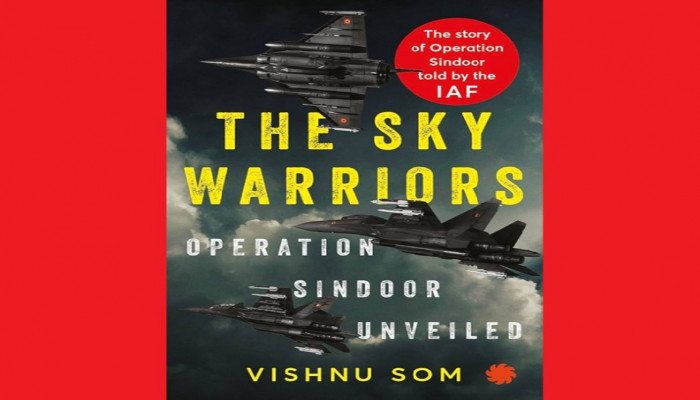
He is none other than Vishnu Som, a veteran at NDTV and an expert par excellence in matters defence, military, military aviation and weapon platforms. His debut book, “The Sky Warriors – Operation Sindoor Unveiled”, published by Juggernaut Books, provides a gripping account mainly of the offensive air operations by the Indian Air Force (IAF) in Operation Sindoor and the intense air battle that ensued in the now-famous 88-hour war.
Vishnu Som’s book is backed by firsthand “accounts from the cockpit” of several IAF Officers who either pressed that dreaded pickle button over the throttle of their respective fighter jets to destroy targets deep inside Pakistan or were guiding an array of offensive/defensive weapons from the ground/air as a part of the Integrated Air Command and Control System (IACCS) to counter Pakistan’s response and guarding Bharat’s airspace during Operation Sindoor.
Apart from his own excellent research, the insights penned by the author from his interviews with the IAF personnel, including the personnel from the top echelons of the IAF, forms the crux of his book.
This book by the author can be considered as very significant for two critical reasons.
First, the official military history of Bharat post 1947 is scarce. Chronicling is in itself a major lacuna. However, excellent books authored by several veterans, strategic experts and defence historians are available in the form of autobiographies, biographies, memoirs, detailed accounts of combat operations, military campaigns, battles and wars. But these works fail to capture the ‘moment and the immediacy of the eras’ which they attempt to chronicle. Putting it in simple terms, the ‘as it happened phenomenon’. The works have been published belatedly, sometimes the delay spanning even decades. Because of this inordinate delay in chronicling, the authors may be prone to the bias of hindsight or being influenced by shifts in policy or political thinking. To quote some prominent works:
- “My Years with the IAF”, the memoir of Air Chief Marshal P. C. Lal, who retired during January 1973 was published posthumously in 1986
- “On the Wings of Destiny: An Autobiography” by Air Chief Marshal Dilbaugh Singh was published posthumously in 2010
- The book on the 1965 Indo-Pak Air War titled “The India-Pakistan Air War of 1965” and authored by P V S Jagan Mohan and Samir Chopra was published in 2005
- “Eagles Over Bangladesh: The Indian Air Force in the 1971 Liberation War”, chronicling the air campaign of the Indian Air Force during the 1971 Indo-Pak War was published in 2013
In the above context, Vishnu Som’s book, published just before the first anniversary of Operation Sindoor, is a significant milestone.
Second, the author was provided access to interview the IAF personnel who actually played a part in Operation Sindoor. Though critical operational details have not been revealed during the interviews, the author has managed to access enough information to provide a broad understanding of how the operation was carried out, which, in many of the earlier operations, was not at all available. This is a major departure by an institution when compared to earlier times. It may be noted here that Operation Sindoor is paused and not yet concluded. Thus, his work can be termed as a semi-official account of the air battle during Operation Sindoor, published before the operation’s first anniversary, which is a coup of sorts by the author. Another important reference point for the reader to understand the significance of the author’s work is that we still have very little information let alone authoritative work on the 2019 Balakot Air Strike by the IAF that destroyed the Jaish-e-Mohhamed terrorist camp on Jabba Top and the subsequent air battle which led to the downing of an F-16 of the Pakistan Air Force by a MiG-21 of the IAF piloted by Wing Commander Abhinandan.
Coming to the book per se, the narration runs linear, commencing from the description of the brutal, tragic and unfortunate terror attack on innocent tourists at Pahalgam on the 22nd April 2025 and concludes with the gripping account of what happened on the 10th May 2025, which led to the Pakistani DGMO desperately calling the Indian DGMO begging for a ceasefire.
The author, with his impeccable research, stitches together the reasons for the destruction of Pakistan’s multiple Air Force bases involving precision strikes by the IAF using standoff weaponry. Through his expertise on weapons and weapon platforms, the author gives the reader a good indicator of what weapons may have been used and the platform from which they would have been likely launched. The IAF has to date not indicated or acknowledged the weaponry used either by the target or generally. There is an entire appendix on the weaponry and the platform used by each side during the 88-hour war. One can also get to know how modernised the IAF is and visualise how future wars on the sub-continent may look. As we are aware, it took just 88 hours for the IAF to degrade the Pakistan Air Force, inflicting enormous damage to its air bases and air defence, loss of air assets like fighter jets and electronic aircraft etc. This also has a huge financial impact on Pakistan, for it involves considerable cost to rebuild for an economy which is already in doldrums.
The author’s discussion with the IAF personnel gives the reader a peek into the peak of professionalism, which is imbibed in the IAF air warriors through continuous training and practice, whether it be in maintaining secrecy or operating in a need-to-know environment or conducting business as usual without letting out an iota of doubt on an impending operation of the magnitude of Operation Sindoor. The author also cites a few incidents of emotions of the air warriors as well as those of the normal citizen towards the armed forces. As one can understand from the book, every single individual who fought for Bharat shared a common trait of dedication with an emotion of determination, passion and optimism. These emotions drive them to deliver their best for the cause of the Nation.
The author’s conclusion - “While Operation Sindoor demonstrated that limited conventional war between nuclear-armed states is possible, it also proved something else: the threshold beneath the nuclear umbrella is real, but precarious. Pakistan’s nuclear threats didn’t deter India. India’s conventional superiority forced Pakistan to seek a ceasefire. But the underlying tensions – terrorism, territorial disputes, nuclear brinkmanship – remain unresolved” – is objective and logical.
The book is engrossing and at times, evocative. In this age of social media and OSINT, where information travels faster than light and truth will be the casualty even faster, the author manages to arrest the reader through his truthful account. Though small and compact, the book certainly delivers a punch through its racy narrative. However, the photographs carried in the book could have been much clearer and stacked together as a separate section.



 Loading...please wait
Comments