




The SDMA and the Question of an “Islamic NATO: Implications for India”
- In Military & Strategic Affairs
- 11:33 AM, Mar 07, 2026
- Harsh Sinha & Dr. A. Adityanjee
Introduction
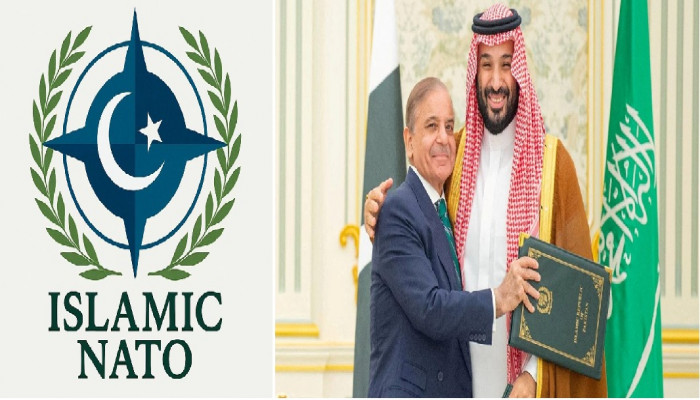
The signing of the Strategic Mutual Defence Agreement (SDMA) between Pakistan and Saudi Arabia in September 2025 started an imaginative debate about a possible new security group involving Pakistan, Saudi Arabia, Turkey and possibly other Islamic countries. This group is often referred to as an Islamic " NATO". This name is very attention-grabbing, indeed. It makes people think about a unified group of Islamic countries working together, defending each other, and even sharing geopolitical, cultural and religious values. We need to think carefully about as to what this new military group really means instead of hastily jumping to rushed conclusions.
This Strategic Mutual Defence Agreement makes official a de facto bilateral defence relationship that has been going on for decades. Pakistan and Saudi Arabia have been working together on military training, sending advisors and coordinating security efforts. It has been alleged previously that the Kingdom of Saudi Arabia bankrolled Pakistan’s nuclear weapons program in exchange for off-the-shelf ownership of some of these nuclear weapons developed by Pakistan. Deliberations at the Manohar Parrikar Institute for Defence Studies and Analyses suggest that this agreement is more about making these pre-existing relationships stronger and more formal instead of creating a whole new security system. We do not know all the details of this Strategic Mutual Defence Agreement. It is clear as to what Saudi Arabia and Pakistan want to achieve. Saudi Arabia wants to work with Islamic countries to keep itself safe and secure instead of its sole reliance on Western countries. Pakistan wants to be part of a group of countries that work together on mutual defence and give it additional strategic strength to deal with India while acknowledging Pakistan’s strategic assets and military might.
Background Information
In this newly proposed Islamic security bloc, Pakistan is in an important position. It is the only Muslim country that has nuclear weapons and delivery systems and has repeatedly threatened to use them at a low threshold. Having nuclear weapons, both strategic and tactical, gives a country a lot of strategic influence, even if it is not very big or rich. Stephen Walt's Balance of Threat theory (1987) says that countries form military alliances because they feel threatened, not because of how powerful another country is. If Pakistan is part of a defence bloc or military alliance, it might have more influence in international relations even if its military strength does not change.
Turkey's possible involvement in this defence bloc adds a layer of strategic complexity. As a longstanding member of NATO, Turkey is part of one of the established military alliances of countries that work together on defence, security and strategic issues internationally. NATO has a strong system of working together, sharing information and defending each other. Turkey has also been working to make its domestic military industrial complex stronger in areas like drones, ships and missiles. This means Turkey has adequate capacity and control over its own defence needs and is less dependent on other countries. Modern Turkey, under the current leadership of Recep Tayyip Erdogan, has a clear, overt, and stated Caliphatic ambition and may indulge in dalliance with this compelling idea without sacrificing its existing relationship with NATO.
Islamic NATO Concept: Potential and Pitfalls:
This concept of an Islamic NATO equivalent is strategically seductive and eye-catching, indeed. The combination of Pakistan's weapons, Turkey's defence industry and Saudi Arabia's money is why some people think this group might be the start of a new military alliance. When countries work together and share their strengths, it can be the start of an alliance. Glenn Snyder's work suggests that alliances often start small and grow over a period. Therefore, the idea of an Islamic “NATO" might not be a fully formed group, but it could be the start of something more nascent.
However, we should be careful not to get too excited. NATO is not just a name; it is the result of decades of countries working together. The agreement between Saudi Arabia and Pakistan does not have the level of cooperation and shared defence plans as NATO, despite professing an Article 5-like posture. There is no treaty that says these countries will defend each other. Reports about Turkey's involvement suggest that these are preliminary talks only. No formal agreement has been made. For an alliance to be strong, the countries involved need to agree on what mutual threats they face. Pakistan is mostly worried about India. Saudi Arabia is concerned about stability in the region and Iran. Turkey has a lot of security concerns, including the Eastern Mediterranean and its responsibilities as a NATO member. When countries do not agree on what mutual threats they face, it is hard for them to work together effectively. John Mearsheimer’s theory opines that alliances are a way for countries to balance power. They often do not work well if the countries do not share the same security concerns.
Saudi Arabia’s economic ties with India also affect its relationships with countries like Pakistan. Saudi Arabia and India have a partnership in areas like energy, trade and investment. India is one of the customers of Saudi Arabia’s energy. Trade between the two countries is growing, implying Saudi Arabia is unlikely to take a strong military stance against India, a rising regional power, even if it is working with Pakistan and Turkey. The current situation in the world also supports this view.
The 2022 NATO Strategic Concept says that the world is becoming more competitive and that many countries are trying to increase their influence. In this situation, countries like Saudi Arabia, Pakistan and Turkey are trying to work with partners to increase their autonomy and security. This is not the start of a rigid alliance but rather a flexible way of working together.
Implications for India
For India, this situation has multiple strategic implications. First of all, it affects how India is seen and perceived as a deterrent. Even if there is no agreement for Pakistan, Saudi Arabia and Turkey to defend each other, the fact that they are working together might make India more cautious. In deterrence theory, how countries perceive each other’s strength and intentions is very important.
Secondly, it affects the geopolitical situation in the maritime domain. Pakistan's location on the Arabian Sea, Turkey’s naval expansion and Saudi Arabia's control of sea lanes create a maritime arc near India's western coast. While there is no naval agreement, cooperation between these countries could change the strategic situation and maritime threats in the western Indian Ocean. India needs to keep investing in its capabilities and awareness of the sea to maintain its maritime security.
Thirdly, it affects the regional challenges and security situation in India’s near abroad. Taming Pakistan's nuclear posture is crucial for strategic stability in the Indian subcontinent. India’s Operation Sindoor has indirectly exposed the preponderant and overwhelming Nuclear Posturing and stark differences in the actual reality of Pakistan. While there is no visible sign of nuclear-sharing agreements, consultation between Pakistan, Saudi Arabia and Turkey could affect how future crises are managed. The risk is not that these countries will share nuclear weapons but that their closer military relationship could make it harder to reduce tensions.
India’s Response
However, it would be wrong to see these strategic developments as a sign of a conflict between India and a rising Islamic bloc. The current situation is more about some Islamic countries working together based on their security interests than forming rigid military alliances. As day by day, the nations are losing trust in the UN as a neutral body for arbitration, alternative arrangements are being sought eagerly. Overreacting to this situation could lead to escalation, while underestimating it could lead to complacency.
Thus, India's strategic response should be careful and measured. Therefore, a balanced outlook of ‘जागृतम् अहर्निशम्’ (alertness coupled with calmness) is the need of the hour. India needs to have balanced causal modelling considering all three x,y and z parameters and all possible permutations and combinations of them in different realms at the sub-surface and surface level. Diplomatically, India should keep talking to Saudi Arabia and Turkey. Economically, India should try to reduce its dependence on any one country for energy needs. Militarily, India should focus on making its defence-military-industrial complex and counter-intelligence systems stronger and more integrated. India must focus on increasing its capabilities in research and innovation with more budgetary allocations than the present paltry 0.6-0.7 % of the budget spent on R & D. This will help India maintain its deterrence credibility with a solid perception warfare of narratives. India should have a clear idea and operational plan about faultlines in different theatres (both intra and inter-country perspectives) without escalating the conflict situation.
Critique of the Islamic NATO Concept
The recent war in West Asia, with the US and Israeli attacks on Iran and its counterattacks on GCC countries, has demolished the strategic notion of an Islamic NATO in its infancy. What may be possible in future is probably not an Islamic NATO but a SUTO (Sunni United Treaty Organisation) as there are deep sectarian faultlines in the Islamic world. The lofty concept of the universal ummah being responsible for mutual security and defence of each Islamic nation is a non-starter.
Even in the post-World War II era, we have witnessed nationalistic wars among Islamic nations, e.g. Pakistan and Bangladesh, Iran and Iraq, Iraq and Kuwait, Saudi Arabia and Yemen, Libya and Chad, Indonesia and Malaysia, Pakistan and Afghanistan, etc. The unresolved intra-state conflicts between Islamic countries have led to fissiparous tendencies. The Kurdish insurgency spans over five Islamic countries. Similarly, both Iran and Pakistan are unable to crush the separatism of Baluch nationalists. Currently, we don’t see Pakistan rushing to the defence of Saudi Arabia in the recent ongoing war in West Asia. Nor do we see the Kingdom of Saudi Arabia coming to the defence of Pakistan in its open war with Afghanistan.
Conclusions
The Strategic Mutual Defence Agreement and the possibility of cooperation between Pakistan, Saudi Arabia, Turkey and other Islamic nations are developments in a world where strategic alliances are fluid and changing. They do not yet form a stable strategic alliance, like NATO, but these feeble attempts should not be ignored either. Security alliances often evolve based on mutuality of intent and commonality of purpose. For India, the best approach is to be strategically patient and continue to build capacity and enhance capabilities. Continued threat perception, threat assessment and capacity building with ongoing defence modernisation will make the nation adequately prepared and vigilant as it navigates this changing situation.
References
- Manohar Parrikar Institute for Defence Studies and Analyses (MP-IDSA), “Report of the Monday Morning Meeting on Saudi Arabia–Pakistan Defence Agreement,”
- Stephen M. Walt, The Origins of Alliances (Ithaca: Cornell University Press, 1987).
- North Atlantic Treaty Organisation (NATO), NATO 2022 Strategic Concept,
- Glenn H. Snyder, Alliance Politics (Ithaca: Cornell University Press, 1997).
- MEMRI, “On the Way to an Islamic NATO? Turkey Advances Towards Membership in the Saudi–Pakistan Defense Pact,” https://www.memri.org/reports/way-islamic-nato-turkey-advances-towards-membership-saudi-pakistan-defense-pact
- John J. Mearsheimer, The Tragedy of Great Power Politics (New York: W.W. Norton, 2001)
- Stockholm International Peace Research Institute (SIPRI), “Military Expenditure Database,” https://www.sipri.org/databases/milex.
Disclaimer: The opinions expressed within this article are the personal opinions of the author. MyIndMakers is not responsible for the accuracy, completeness, suitability, or validity of any information on this article. All information is provided on an as-is basis. The information, facts or opinions appearing in the article do not reflect the views of MyindMakers and it does not assume any responsibility or liability for the same.



 Loading...please wait
Comments