




The Paradox of Partnership: Tushnim Yuddha and the Asymmetric Containment of India to Defend the US Dollar
- In Military & Strategic Affairs
- 12:38 PM, Jul 28, 2026
- Shashank Davanagere
Abstract
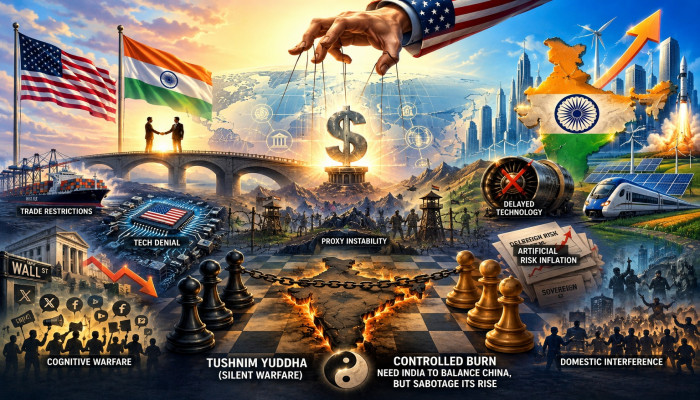
Mainstream geopolitical analysis frames the United States-India relationship as an integrating alliance built to counter China. This paper challenges that consensus, arguing that public diplomatic partnerships obscure a macroeconomic shadow war designed to protect the hegemony of the US Dollar. Analysing historical case studies of financial enforcement (Iraq, Libya), this research establishes that defending the unipolar currency system is the ultimate red line of American foreign policy. Applying a six-domain warfare matrix (Trade, Tech, Capital, Geopolitics, Cognitive, Military), this paper demonstrates that the US cannot use open warfare against a massive, nuclear-armed ally. Instead, the US utilises Tushnim Yuddha—"Silent Warfare" or asymmetric containment. By deliberately delaying critical technology (e.g., GE F404/414, engines, AI chips, etc), artificially inflating India's sovereign risk via proxy border instability, and funding domestic cognitive interference, the US traps India in a cycle of dependency. The United States engages in a "controlled burn" strategy: it needs India to balance China, but actively sabotages India's capacity to achieve the sovereign economic velocity necessary to dethrone the US Dollar.
I. Introduction
Mainstream analysis views the 21st century as a bipolar struggle between the United States and China, with India anointed as Washington's indispensable ally. However, this narrative ignores the foundational pillar of American unipolarity: the US Dollar [Gourinchas, 2019]. The ultimate "red line" for the US is not military expansion but financial independence obtained after the Bretton Woods agreement.
While traditional analysis views the US-India relationship as a strategic partnership, a macroeconomic lens reveals a strategy of asymmetric containment. Because US supremacy relies entirely on the dominance of the dollar [Hudson, 2003], Washington must actively prevent the rise of any self-sufficient economic peer capable of bypassing that financial order. Therefore, the US engages in Tushnim Yuddha (Silent Warfare) against India—utilising technological starvation, engineered border instability, and covert cognitive interference. The US needs India as a counterweight to China, but it cannot allow India to fully succeed.
II. The Mechanics of Dollar Hegemony
The US enjoys an "exorbitant privilege" because the dollar serves as the world's primary reserve and energy currency [Eichengreen et al., 2018]. As modern nations require oil, they are forced to hold US Dollars to trade. This artificial demand allows the US to run massive deficits, export its inflation, and fund its global military apparatus through foreign purchases of US Treasury bonds [Norrlof & Wohlforth, 2019].
The greatest existential vulnerability to the US is a global shift toward bilateral currency trading [Prasad, 2014]. If major economies trade in local currencies, demand for the dollar reduces and evaporates, triggering severe US inflation and a sovereign debt crisis. Protecting this financial structure is the primary directive of US foreign policy.
III. Historical Case Studies in Financial Enforcement
The military interventions in Iraq and Libya demonstrate the violent enforcement of the dollar monopoly [Bresnahan, 2004].
- Iraq (2000-2003): In 2000, Saddam Hussein transitioned Iraq's oil sales from the Dollar to the Euro. By 2003, the US launched a full-scale invasion, executed regime change, and immediately reverted Iraqi oil sales to the USD.
- Libya (2009-2011): Muammar Gaddafi attempted to create a pan-African Gold Dinar to bypass the Dollar for African resources. In 2011, a US-backed NATO intervention fractured the state, resulting in Gaddafi's assassination and the eradication of the Dinar project.
When a mid-sized power threatens the dollar, the US utilises Prakasha Yuddha (open military warfare) to restore financial compliance.
IV. The Modern Challenge: Multipolarity and the India Threat
The geopolitical calculus has shifted. The contemporary threat to dollar hegemony comes from multi-polar, nuclear-armed, civilisational powers that cannot be subjected to direct military intervention.
India presents an unprecedented challenge. Historically, India represented roughly a third of global GDP for much of recorded history [Maddison, 2006]. Today, India is proving the viability of massive, non-dollar-denomination trade corridors due to real geopolitical pressure. Between 2021 and 2024, India-Russia bilateral trade surged from roughly $12 billion to $69 billion, with approximately 96% of this trade settled in rupees and rubles. India is currently clearing large energy volumes outside of SWIFT and maintaining Vostro accounts for 30 partner nations to settle trade in rupees.
This industrial-scale circumvention of the US Dollar is a direct threat to American financial hegemony. Because the US cannot launch a "Hot War" against India to protect its currency, it is forced to deploy a covert strategy.
V. Asymmetric Containment (Tushnim Yuddha)
The US calibrates its warfare based on the specific threat profile of the target across six domains [Dalion, 2021]. As visualised below, while adversaries like China and Russia are managed through open embargoes and proxy exhaustion, India is uniquely targeted via Tushnim Yuddha (Silent Warfare) [Kautilya, 1992].

The United States' SIX-War Geopolitical Matrix (2026)
|
Domain of War |
China (The Peer Rival) |
Russia (The Exhaustion Target) |
European Union (The Regulatory Rival) |
India (The Asymmetric Ally) |
|---|---|---|---|---|
|
1. Trade War |
High Intensity: Massive decoupling and tariffs up to 60%. |
Total Embargo: Complete blockade of Western goods. |
Medium Intensity: Retaliatory tariffs against EU digital taxes. |
Medium Intensity: Tit-for-tat tariffs (e.g., US taxes on steel; India taxing agriculture). |
|
2. Tech War |
Maximum Intensity: Export bans on AI, quantum, and chips. |
High Intensity: Bans on dual-use aerospace and military tech. |
High Intensity: Clashes over tech sovereignty and platform monopolies. |
High Intensity: Denying or delaying generational tech transfers (e.g., jet engines, AI compute, Vaccine Adjuvant). |
|
3. Capital War |
High Intensity: Banning US venture capital in Chinese tech. |
Maximum Intensity: Freezing central bank reserves; SWIFT exclusion. |
Low Intensity: Standard friction between Euro and Dollar. |
High Intensity: Weaponising visas to drain human capital; undermining non-Dollar bilateral swaps. |
|
4. Geopolitical |
High Intensity: Military posturing over Taiwan/South China Sea. |
Maximum Intensity: Total isolation; NATO expansion. |
Low Intensity: Demanding EU "burden shifting" for defence. |
Medium Intensity: Maintaining leverage via strategic ambiguity with India's hostile neighbours. |
|
5. Info/Cognitive War (Tushnim Yuddha) |
High Intensity: Social media bans; massive cyber-espionage. |
Maximum Intensity: Inciting brain drain and domestic rebellion. |
Medium Intensity: Clashes over digital censorship laws. |
High Intensity: Foreign capital funding anti-state NGOs; algorithmic amplification of internal fault lines. |
|
6. Military (Hot) |
Proxy/Deterrence: Arming Taiwan; naval standoffs. |
Active Proxy War: Funnelling lethal aid to Ukraine. |
None: Bound by NATO mutual defence. Claim on Greenland. Withdraw from NATO |
Proxy: Covert operatives arming border militias to artificially inflate regional instability. |
As the table demonstrates, Washington utilises three primary mechanisms to execute this asymmetric containment:
Mechanism A: Technological Starvation (The Dependency Trap)
US Deputy Secretary of State Christopher Landau outlined this strategy in 2026: "We will not make the same mistake with India that we made with China 20 years ago, by giving economic advantages that eventually created a strong competitor" [Landau, 2026]. To prevent India from becoming a peer, the US purposefully stalls generational technology transfers. For example, despite a 2021 contract for 99 GE F404 jet engines vital for India’s Tejas Mk1A fighter, by mid-2026 the US had delivered only seven, citing "supply chain issues." Throttling engines and restricting AI compute mathematically limits India’s technological ceiling.
Mechanism B: Engineered Instability and Capital Flight
To prevent global Foreign Direct Investment (FDI) from aggressively rotating into a stable India, the US artificially inflates India's sovereign risk profile. Geopolitically, this is done by feeding proxy conflicts and maintaining active presences in Pakistan and Bangladesh, ensuring the subcontinent remains volatile.
Financially, this takes the form of direct assaults on Indian equity. The US weaponises bogus reports by activist short-sellers like Hindenburg Research, combined with dubious US Department of Justice indictments against Indian business leaders (such as Gautam Adani), specifically timed to crash the Indian stock market and erode domestic investor confidence.
Furthermore, US intelligence directly targets India's strategic autonomy. Because India refused to sign a one-sided Free Trade Agreement with the USA, refused to act as a regional proxy against China, and continued to buy cheap Russian oil despite American sanctions, the CIA has actively engaged in regime change operations.
Having successfully executed similar operations in neighbouring Nepal, Pakistan, Bangladesh, and Sri Lanka, US intelligence now attempts to replicate this instability within Indian borders to break the momentum of Indian capital markets and trigger capital flight back into the safety of US Treasury bonds.
Mechanism C: Cognitive Warfare and Subversion
A politically fractured India cannot execute the macroeconomic reforms necessary to bypass the Dollar. Therefore, Western capital targets the Indian domestic structure. The explicit pledge of $1 billion by Western billionaire George Soros to combat "nationalism" and destabilise the current Indian government highlights how philanthropic NGOs are weaponised [Soros, 2020].
This foreign capital is actively used to sponsor domestic unrest, most notably the recent, highly orchestrated "Gen Z" protests attempting to unseat the democratically elected government. What began as an organic domestic issue—the cancellation of the 2026 NEET-UG medical exams due to leaked papers—was rapidly co-opted.
Under the banner of the newly formed "Cockroach Janta Party" (CJP), these protests escalated into nationwide riots demanding the resignation of union ministers and calling for regime change. Credible intelligence indicates these movements are being directly funded and amplified by the US deep state.
Furthermore, US President Donald Trump recently revealed that the Biden administration's USAID program secretly allocated $21 million under the guise of "voter turnout" in an overt attempt to unseat the current Indian leadership. Coupled with social media algorithms that amplify domestic fault lines, the US utilises digital and financial infrastructure for deep cognitive containment, weaponising youth grievances to execute Tushnim Yuddha from within.
VI. Conclusion
The geopolitical architecture of the 21st century is dictated by the survival of the US Dollar. While the United States historically maintained financial unipolarity through overt military interventions—as seen in Iraq and Libya—the rise of nuclear-armed, civilisational states requires a new paradigm of warfare. India possesses the demographic and economic momentum to permanently dismantle the dollar’s monopoly via massive, de-dollarised bilateral currency networks. Because India has fiercely maintained its strategic autonomy—refusing one-sided free trade agreements, rejecting proxy roles against China, and bypassing US sanctions to purchase Russian oil—it has become a primary target of the American deep state.
Yet, because Washington desperately needs New Delhi as a geographic counterweight to Beijing, it cannot engage in open conflict. To navigate this paradox, the US relies on Tushnim Yuddha (Silent Warfare). By starving India of critical generational technology, launching coordinated financial attacks on domestic conglomerates to trigger capital flight, and funding intelligence-backed regime change operations via manufactured youth protests, the US enacts a "controlled burn" on the subcontinent. The American strategic imperative is absolute: it must keep India strong enough to balance China, but tethered and internally fractured enough to never achieve the sovereign escape velocity required to dethrone the US Dollar.
References
(Sources directly cited or referenced in the drafting of the paper)
- Clausewitz, C. V. (1832). On War. (M. Howard & P. Paret, Trans.). Princeton University Press. (Original work published 1832).
- Council on Foreign Relations. (2025). Conflicts to watch in 2026. Center for Preventive Action. https://www.cfr.org/reports/conflicts-watch-2026
- Dalio, R. (2021). Principles for dealing with the changing world order: Why nations succeed and fail. Avid Reader Press / Simon & Schuster.
- Department of Defense. (2026). 2026 National defense strategy of the United States of America. U.S. Government Publishing Office. https://media.defense.gov/2026/Jan/23/2003864773/-1/-1/0/2026-NATIONAL-DEFENSE-STRATEGY.PDF
- Gourinchas, P. O. (2019). The dollar hegemon? Evidence and implications for policy makers. Asian Bureau of Finance and Economic Research (ABFER). http://www.abfer.org/media/abfer-events-2019/ampf/AMPF2019_Pierre-Olivier-Gourinchas-pp.pdf
- Kautilya. (1992). The Arthashastra. (L. N. Rangarajan, Trans.). Penguin Books India. (Original work published c. 2nd century BCE).
- Landau, C. (2026, March 5). No China-style mistake with India [Speech audio recording]. Raisina Dialogue, New Delhi, India.
- Maddison, A. (2006). The world economy: Historical statistics. Organisation for Economic Co-operation and Development (OECD) Development Centre. https://www.oecd.org/content/dam/oecd/en/publications/reports/2006/09/the-world-economy_g1gh69e4/9789264022621-en.pdf
- National Investigation Agency. (2026, March). Arrest of US national Matthew VanDyke and foreign nationals in Mizoram. Government of India Press Release.
- RAND Corporation. (2019). Extending Russia: Competing from advantageous ground. RAND Corporation. https://www.rand.org/pubs/research_reports/RR3063.html
- Reuters. (2026, May 24). Trump throws weight behind Japan's Takaichi in meeting with Xi. https://www.reuters.com/world/china/trump-throws-weight-behind-japans-takaichi-meeting-with-xi-yomiuri-says-2026-05-24/
- Soros, G. (2020, January 23). Remarks at the World Economic Forum. Davos, Switzerland.
Bibliography
(Additional texts consulted for macroeconomic context, military strategy, and historical framing)
- Bresnahan, M. (2004). US dollar hegemony: The soft underbelly of empire. Multinational Monitor.
- Eichengreen, B., Mehl, A., & Chitu, L. (2018). How global currencies work: Past, present, and future. Princeton University Press.
- Gautam, P. K. (2022). A comparison of Kamandaka’s Nitisara and Kautilya’s Arthashastra: Statecraft, diplomacy and warfare. Journal of Defence Studies, 16(4).
- Hudson, M. (2003). Super imperialism: The origin and fundamentals of U.S. world dominance. Pluto Press.
- Kamandaka. (1882). The Nitisara, or the elements of polity. (Rajendralala Mitra, Ed.). Asiatic Society of Bengal.
- Norrlof, C., & Wohlforth, W. C. (2019). Is US grand strategy self-defeating? Deep engagement, military spending and sovereign debt. Conflict Management and Peace Science, 36(3), 227-247.
- Prasad, E. S. (2014). The dollar trap: How the U.S. dollar tightened its grip on global finance. Princeton University Press.
- Roubini, N. (2006). The vulnerabilities of the US dollar. New York University, Stern School of Business.
- Sun Tzu. (2003). The art of war. (S. Griffith, Trans.). Oxford University Press. (Original work published c. 5th century BCE).
Disclaimer: The opinions expressed within this article are the personal opinions of the author. MyIndMakers is not responsible for the accuracy, completeness, suitability, or validity of any information on this article. All information is provided on an as-is basis. The information, facts or opinions appearing in the article do not reflect the views of MyindMakers and it does not assume any responsibility or liability for the same.



 Loading...please wait
Comments