



The Next Great Freedom: Why Energy Sovereignty Must Become a Global Mission
- In Economics
- 10:58 AM, Apr 10, 2026
- Dr Ryan Baidya
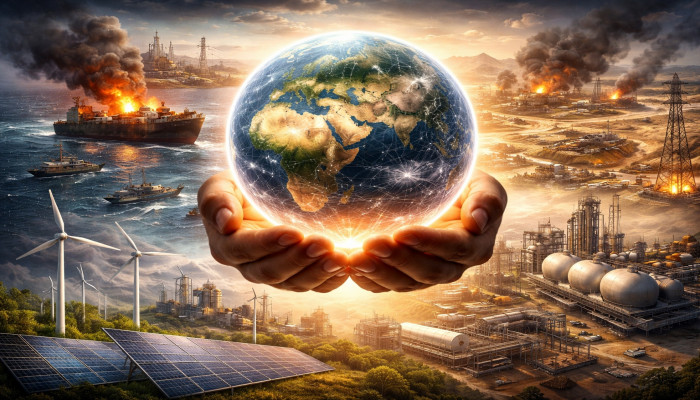
As war, inflation, energy insecurity, and AI-driven job disruption reshape the modern world, nations need a new doctrine of resilience. Energy sovereignty is no longer just an environmental aspiration. It is a strategic, economic, and moral necessity.
The COVID-19 pandemic taught humanity a painful lesson: prevention is wiser than panic and resilience matters more than comforting assumptions. Governments learned to speak more seriously about preparedness, public-health capacity, and the hidden dangers of dependency. The world discovered, once again, that what appears manageable in ordinary times can become catastrophic under stress.
Yet even after that global shock, humanity still has not fully applied the same lesson to another equally foundational condition of modern life: energy.
That is one of the great failures of our age.
For more than a century, the modern world has been built on energy systems that are geographically concentrated, politically contested, militarily vulnerable, and economically destabilising. Oil and gas have powered industry, transport, food systems, military capability, communications, and growth. They have enabled extraordinary material progress. But they have also tied the fate of billions of people to wars, sanctions, chokepoints, unstable regimes, tanker routes, and geopolitical rivalries far beyond their control.
A conflict in one region becomes inflation in another. A disruption in a shipping lane becomes a transport crisis somewhere else. A sanctions dispute among major powers turns into higher food and fuel costs for households in countries that had nothing to do with the original conflict. Families far removed from battlefields end up paying for decisions made in distant capitals.
This is not simply an energy problem. It is a sovereignty problem. It is also a moral problem.
Political independence is not enough
A nation that cannot secure the energy needed to run its economy, move its people, support hospitals, power communications, preserve food, sustain industry, and maintain public life is not fully sovereign in practice, even if it is sovereign on paper. Political independence without energy resilience is incomplete independence.
That is why the world must begin to think in a new way. Every nation should now pursue the highest degree of energy sovereignty it can reasonably achieve.
This does not mean every country can become totally self-sufficient in every form of energy. Geography differs. Climate differs. Resource endowments differ. Population density differs. Technical capability differs. Some nations will rely more on solar power, others on wind, hydroelectricity, geothermal, biomass, storage, nuclear power, efficiency, or regional interconnection. For certain countries, strategic imports will remain necessary.
But almost every nation has more intrinsic energy potential than it is currently using. The sun is free. Wind is abundant. Rivers flow. Coasts, deserts, plains, mountains, and urban infrastructure all create opportunities. The world has alternatives. What it has lacked is seriousness.
Too many governments still discuss energy transition as though it were mainly an environmental aspiration, a diplomatic slogan, or a branding exercise for modern leadership. It is far more than that. Energy sovereignty is a national security doctrine, an economic development strategy, a social-stability project, and a moral necessity.
The hidden cost of the old energy order
The present energy order has repeatedly helped produce fear, manipulation, inflation, corruption, exploitation, and human misery. No serious person should claim that energy sovereignty alone can eliminate these things. War has many causes. Corruption adapts to new systems. Exploitation is not confined to fuel politics. Human suffering cannot be solved by any single policy shift.
But it is equally mistaken to pretend that concentrated energy dependence has not intensified these problems.
For decades, the concentration of fossil-energy resources in a limited number of regions has magnified the strategic importance of certain territories, transit routes, and alliances. That concentration has shaped military doctrines, foreign interventions, naval deployments, sanctions policy, covert influence, and long-term geopolitical calculations. Modern states do not think about oil and gas merely as commodities. They think about them as instruments of survival, leverage, and control.
That is precisely the problem.
When the functioning of industrial civilisation depends on fuels concentrated in relatively few places, those places acquire disproportionate geopolitical weight. External powers become invested in protecting access, influencing governments, stabilising friendly regimes, pressuring unfriendly ones, and controlling transport routes. The result is a world in which energy insecurity is never simply economic. It is entangled with force.
A different energy architecture would not create utopia. But it could reduce one of the major structural incentives for conflict.
A world in which nations generate more of their own power from sunlight, wind, rivers, geothermal heat, storage systems, local grids, and electrified transport would still face rivalry, ideology, greed, and territorial disputes. Yet it would be less dependent on a handful of fragile chokepoints and producer regions. That matters. Peace is not built only by speeches, treaties, and noble intentions. It is also built by changing the material conditions that reward coercion.
Corruption feeds on dependence
The same logic applies to corruption.
Large imported-fuel systems often involve complex procurement chains, opaque pricing arrangements, emergency purchasing, politically connected intermediaries, and public dependence on decisions that are difficult for ordinary citizens to monitor. Where strategic urgency, concentrated money, and limited transparency meet, corruption often flourishes. Entire public systems can become distorted by the politics of access. Citizens carry the burden through higher prices, weaker public services, and declining trust.
A more distributed domestic energy system does not make corruption disappear, but it can reduce some of its most concentrated channels. When power generation is diversified across many regions and technologies, when local infrastructure becomes part of the national energy base, and when public institutions invest in visible, durable assets such as storage, transmission, public electrification, and distributed solar, some of the leverage associated with concentrated import dependence can be reduced.
Energy sovereignty is therefore not only about megawatts. It is about restructuring vulnerability.
The burden always falls on the weak
It is also about reducing exploitation.
The current global energy order often places the heaviest burdens on those with the least power. Poorer importing countries absorb shocks they did not create. Fragile states become trapped in extractive political economies. Households at the margins pay a larger share of income for transport, cooking, heating, and electricity. Rural communities remain dependent on unreliable or polluting energy systems while wealthier sectors debate the future in abstract language.
Even in prosperous nations, lower-income citizens are often the first to feel price shocks and the least able to absorb them.
Energy dependence is not only a matter of trade. It is a structure through which instability spreads downward.
That is why energy sovereignty must be understood in human terms, not merely technical ones. Reliable, affordable, domestic, diversified energy can reduce preventable misery. It can stabilise household costs. It can strengthen hospitals, schools, farms, supply chains, and small businesses. It can improve public health by reducing dependence on dirty fuels and unreliable access. It can make transport more affordable and more stable. It can give states greater room to govern for the public good.
This is not abstract economics. It is about dignity.
The AI era makes the case even stronger
There is now another reason for urgency, and it belongs unmistakably to this historical moment.
Around the world, leaders are increasingly anxious about the social effects of artificial intelligence. AI is rapidly entering business functions, administrative work, communications, logistics, design, customer service, analysis, and even technical decision-making. Many governments, companies, and workers worry that large areas of employment may shrink, change dramatically, or disappear. Much of that anxiety is justified. AI may create new forms of value, but it may also displace large numbers of people, especially in white-collar and routine cognitive roles.
In that context, an energy-sovereignty mission offers something rare: a path of national renewal rooted in the physical economy.
A serious drive toward energy sovereignty requires labour that cannot easily be replaced by AI alone. Solar fields do not build themselves. Transmission lines do not modernise themselves. Storage systems do not install themselves. Buildings do not retrofit themselves. Public transit does not electrify itself. Charging infrastructure, substations, grid reinforcement, civil works, inspection, maintenance, logistics, transport conversion, repair networks, safety oversight, and regional adaptation all require large numbers of workers operating in the physical world.
Even where software, machine learning, and robotics assist, human presence remains indispensable. Engineers, electricians, technicians, construction workers, project managers, line workers, mechanics, inspectors, transport planners, installers, and local coordinators all become part of the mission.
This is not make-work. It is nation-building work.
For that reason, energy sovereignty should also be seen as a labour-market strategy for the age of AI.
Countries now searching for ways to offset technological disruption should understand this clearly. The building of domestic energy resilience can create employment that is regionally distributed, practically valuable, and socially stabilising. It can strengthen vocational training, industrial capability, local enterprise, and public confidence. It can create new forms of work not only in engineering and manufacturing, but in operations, maintenance, public works, logistics, transportation, software support, compliance, and local services.
It can contribute to GDP growth while strengthening the material foundations of sovereignty.
This may prove to be one of the most underappreciated benefits of the energy transition: not only does it change the source of power, but it also changes the structure of employment.
A whole-of-nation mission
The policy implications are profound.
Governments should stop treating energy sovereignty as a side issue divided among disconnected ministries and agencies. It should be approached as a whole-of-nation mission. Each country should begin with an honest mapping of its own energy realities: sunlight, wind corridors, rivers, geothermal zones, storage opportunities, industrial demand centres, transport needs, rooftops, reservoirs, coastlines, degraded land, public infrastructure, and regional strengths.
The next step is strategic alignment. Education systems, technical institutes, vocational programs, universities, industrial policy, public finance, land use, and infrastructure planning should all be connected to the energy-sovereignty project. Storage and transmission should be treated as central, not secondary. Public transport electrification should be treated as a sovereignty issue, not only a climate issue. Clean cooking and rural power should be recognised as matters of dignity. Local manufacturing should be cultivated wherever feasible. Municipal and regional authorities should be made active partners, not passive spectators.
Different nations will follow different paths. That is not a weakness. It is exactly as it should be.
Sun-rich nations should build aggressively with solar. Coastal and wind-rich nations should turn their shorelines and corridors into strategic assets. Mountainous states should evaluate hydro and pumped storage with ecological seriousness. Geothermal nations should use the heat beneath their own soil. Agrarian societies should explore biogas and other localised systems prudently. Small island states should make resilience, storage, and local grids central to survival. Advanced industrial countries should pursue efficiency, electrified mobility, storage, smart grids, and demand reduction with the same seriousness that they once brought to oil security.
The question is no longer whether we know enough
The crucial shift is mental before it is technical. Nations must stop asking whether energy sovereignty is idealistic and start asking why dependency has been tolerated for so long.
History will likely judge this period not only by what humanity knew, but by what it failed to do with what it knew. We already know that concentrated energy dependence creates vulnerability. We already know that renewable and domestic alternatives exist. We already know that cleaner, more distributed systems can be built. We already know that energy insecurity intensifies inflation, political fragility, and social suffering. We already know that the future of work is uncertain and that large-scale physical missions can help societies absorb disruption.
The problem is no longer knowledge. It is will.
The next great freedom
In earlier times, nations fought for political freedom. Later, many struggled for food security, industrial capacity, scientific competence, and strategic dignity. In the twenty-first century, the next great freedom must be energy freedom.
Not because it will solve every human problem. It will not.
Not because it will instantly end war, corruption, or exploitation. It will not.
But because it can weaken the structures that repeatedly nourish them. It can reduce dependence on fragile chokepoints. It can lessen the leverage of external shocks. It can create work in an age of automation. It can reduce preventable misery. It can strengthen dignity. It can give nations a firmer basis on which to govern themselves and a more stable basis on which citizens can build their lives.
The age of energy dependence has lasted too long. It has produced too much fear, too much inflation, too much manipulation, and too much avoidable suffering. The age of energy sovereignty must now begin.
A wiser world would understand that the path away from conflict is not only diplomatic; it is also infrastructural. The path away from corruption is not only moral; it is also structural. The path away from social breakdown is not only rhetorical; it is also economic and material.
Every nation should now begin building its own path.
Disclaimer: The opinions expressed within this article are the personal opinions of the author. MyIndMakers is not responsible for the accuracy, completeness, suitability, or validity of any information on this article. All information is provided on an as-is basis. The information, facts or opinions appearing in the article do not reflect the views of MyindMakers and it does not assume any responsibility or liability for the same.



 Loading...please wait
Comments