




The Massive Cabinet Reshuffle. Part 1: The Ministers that have Resigned
- In Politics
- 01:49 AM, Jul 08, 2021
- Amit Bagaria
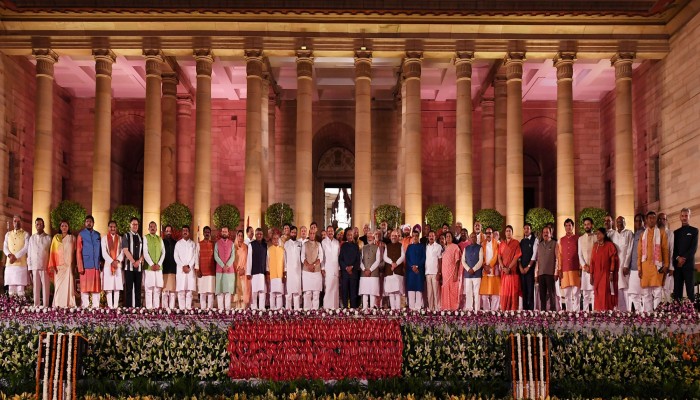
As of July 5, excluding the PM, the second Modi ministry comprised 54 ministers, including 21 cabinet ministers, nine ministers of state with independent charge (“MoS I/C”), and 24 ministers of state (“MoS”). In the last two days, almost one-fourth have been sacked. Of the 12 ministers who have been dropped, as many as six had cabinet rank.
Thawar Chand Gehlot, the first minister who resigned on July 6, was not dropped due to underperformance. On the contrary, he performed quite well. As the Minister of Social Justice and Empowerment since May 2014 when Modi first became PM (“Modi 1.0”), he oversaw the massive enhancement of the Direct Benefits Transfer scheme and the introduction of several new schemes or enhancement of several Congress-era schemes for the economically and socially backward population, and this played a big hand in Modi’s massive election victory in 2019. This was perhaps the reason that he was one of the few cabinet rank ministers who continued in the same ministry from Modi 1.0 to Modi 2.0. I had given him 9/10 in a recent article on the topic of cabinet reshuffle. Gehlot was undoubtedly removed from the cabinet—and made the Governor of Karnataka—because of his age. From his first term itself, Modi has ensured that no minister over the age of 75 is part of his ministry. During Modi 1.0, Najma Heptullah and Kalraj Mishra (both are Governors now) were both dropped at the age of 76. Gehlot is 73.13 years old.
What about the others? Let us look at them in terms of the importance of the portfolio/s (ministry/ies) they had been handling.
Ravi Shankar Prasad was the Minister of Law and Justice (since July 2016), the Minister of Communications (May 26, 2014 to July 5, 2016; and since May 2019), and the Minister of Electronics and Information Technology (since July 2016). This made him the sixth most heavyweight minister. I say this because, in the US, the Attorney General (their Law Minister) is the fourth most important cabinet member, and in the UK, the Lord Chancellor (their Law Minister) is the fifth most important. As law minister, Prasad should have ensured that critical judicial reforms (which I have written about in my bestseller Congress-Mukt Bharat) should have been implemented, but nothing was done on this front. He also failed as the communications minister. India’s 3G and 4G network stability remains pathetic. As IT minister, he was not able to take strict action against Twitter, which continues to defy India’s Intermediary Guidelines and Digital Media Ethics Code brought in February 2021 to regulate content on Social Media and video streaming platforms. Facebook, Google, WhatsApp, YouTube, and Netflix have complied with these rules. I had given him only 4/10 in the same article.
Dr Ramesh ‘Nishank’ Pokhriyal was the Minister of Education (earlier known as Minister of Human Resource Development) since May 2019. I am a bit surprised that he has been dropped. After Modi became PM, the process to formulate a new National Education Policy (“NEP”) started in January 2015 by a committee headed by TSR Subramanian (former Cabinet Secretary of India) which submitted its report in June 2017, but the then minister Prakash Javadekar sat on it for almost two years. The ministry released a draft policy in November 2019 and got it approved by the Cabinet in July 2020. He may have been dropped because the implementation of many of the reforms in the NEP are going slow.
Dr Harsh Vardhan was the Minister of Health and Family Welfare (5½ months in Modi 1.0 and since May 2019), the Minister of Science and Technology (since November 2014), and the Minister of Earth Sciences (since November 2014). Though he handled the first wave of Covid-19 pretty well, his handling of the second wave was pathetic. In addition, government healthcare infrastructure across India (except in top hospitals like AIIMS) is in pathetic shape and needs to be revamped and modernised—similar to what is happening with the Indian Railways, but not much has been done under him. I had given him only 4/10 in the same article.
Prakash Javadekar was the Minister of Environment, Forest and Climate Change (May 26, 2014 to July 5, 2016 and since May 2019), the Minister of Heavy Industries and Public Enterprises (since November 2019), and the Minister of Information and Broadcasting (5½ months in Modi 1.0 and since May 2019). In his favour, corruption has been almost done away with in environmental approvals for large projects and is also happening faster. However, going against him, there is hardly any improvement in the functioning of heavy industries and public (industrial) enterprises. In the I&B ministry, the government’s handling of information dissemination is pathetic. The rampant spread of fake news in print and broadcast media has not been controlled. I had given him only 3/10 in the same article.
DV Sadananda Gowda was the Minister of Chemicals and Fertilizers since November 2018. He has not done such a bad job. The installed capacity of chemicals increased by 8.85% and petrochemicals by 16.5% between 2017-18 and 2019-20. Except in Manipur, Mizoram, and Nagaland, the availability of fertilizers in all states and UTs is more than the requirement. In Modi 1.0, Gowda was the Minister of Railways for 5½ months, then the Minister of Law and Justice for 20 months, and finally the Minister of Statistics and Program Implementation for 34½ months. This was an obvious double demotion, based on the importance of each of the three ministries. He seems to have sheer bad luck, or maybe he has been dropped as three others from Karnataka have been newly inducted into the Modi ministry. Historically, most Indian PMs have balanced their ministries based on state and caste representations.
Santosh Kumar Gangwar was the MoS (I/C), Labour and Employment since September 2017. Under him, the Modi government brought labour reform laws in September 2020. However, these have not been implemented as yet. Lack of jobs has been ranked as Modi’s biggest failure in many polls over the past 4-5 years. In this era of automation, AI, and machine learning, could a 72.7 year-old have done justice to this important ministry? I do not think so. He was a wrong choice.
Sanjay Shamrao Dhotre was an MoS in three ministries: Education, Communications, and Electronics and Information Technology, since May 2019. I am not sure why he has been dropped, except for the fact that the cabinet ministers of all three ministries have also been dropped. Perhaps the PM has held the MoS equally responsible for the failure of the ministries.
Rattan Lal Kataria was an MoS in two ministries: Social Justice and Empowerment (which also had two other MoS), and Jal Shakti, since May 2019. I have no insights about his work or why he was dropped.
Pratap Chandra Sarangi was also an MoS in two ministries: Animal Husbandry, Dairying and Fisheries; and Micro, Small and Medium Enterprises (MSME), since May 2019. This agriculturist and social worker has spent most of his life as a college head clerk in a small town of Odisha. In my bestseller Congress-Mukt Bharat, I had commented that only the PM knows best why he was picked as a minister, especially in the MSME ministry.
Babul Supriyo was the MoS in the Ministry of Environment, Forest and Climate Change since May 2019. He has perhaps been dropped for three reasons: (1) The cabinet minister has also been dropped; (2) Supriyo was not seen to have done any substantial work; and (3) He was fielded in the recent West Bengal assembly elections and lost badly. Even in Modi 1.0, he was removed from the Ministry of Urban Development and Housing after 20 months and shifted to a lesser important ministry.
Debasree Chaudhuri was the MoS in the Ministry of Women and Child Development. She was made a minister because she won the 2019 Lok Sabha election from Raiganj, West Bengal, by a huge margin, and may have been dropped on the recommendation of the cabinet minister, Smriti Irani (who continues in the same portfolio), as she has not performed.
The average age of the 12 ministers who have been dropped is 64.93 years. Based on the average age of the new inductees, we will be able to examine whether one of the reasons for the cabinet reshuffle is to reduce the average age of the overall ministry.
Overall, it is clear that the prime minister has dropped almost all the underperformers.
The idiom “BETTER LATE THAN NEVER” is 635 years old. Finally after 2 years it has been implemented.
My next article will be an analysis of the new ministers and their portfolios, the ministers who have been promoted and their new portfolios, and the ministers whose portfolios have been changed.


 Loading...please wait
Comments