




West Bengal's electoral ecosystem has long been defined by the 'managed booth' — a local culture of voter mobilisation, cadre loyalty, and turnout engineering. The 2026 election may be the last where that culture is even tested.
In the 2021 Assembly election, the TMC won 213 of 294 seats with 47.93 per cent of the vote against the BJP's 38.13 per cent across 77 seats. The Left Front and Congress, contesting in alliance, were wiped out — neither party won a single seat, and their combined vote share collapsed from nearly 25 per cent in 2016 to under 8 per cent. This was a historic consolidation, resting on two pillars: a broad welfare coalition anchored by schemes like Lakshmir Bhandar, and iron-tight cadre machinery at the booth level.
The Two-Phase Compression
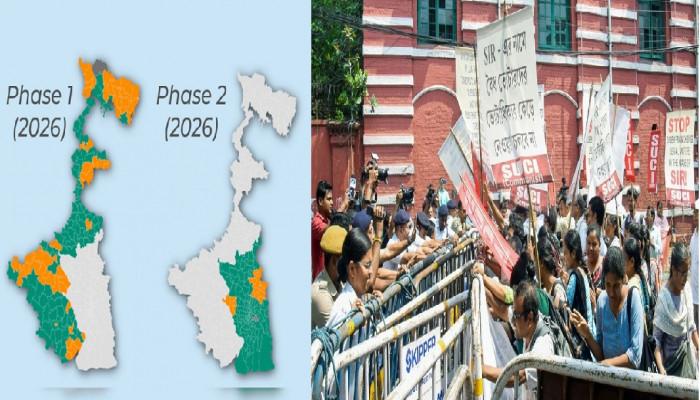
The ECI's decision to compress West Bengal's election from eight phases in 2021 to just two — Phase 1 on April 23 covering 152 constituencies, Phase 2 on April 29 covering 142 — is operationally revolutionary. It enables a density of Central Armed Police Forces (CAPF) deployment per polling booth that would have been administratively impossible across eight staggered phases.
The Union Home Ministry announced the pre-poll deployment of 480 companies of paramilitary forces (CRPF, BSF, CISF, ITBP, SSB), with 500 companies to remain deployed even post-election through counting day on May 4. The ECI has mandated 100 per cent webcasting of all polling booths. The ECI also removed the Kolkata Police Commissioner, the State DGP, and the Chief Secretary in March 2026, replacing them with officers perceived as neutral.
With central forces controlling both perimeters and every booth, and every booth under live surveillance, the 'tactical turnout advantage' that local party machinery normally delivers is sharply curtailed. The organised mobilisation, cadre presence, and informal pressure that characterise polling in highly politicised states — what analysts call the 'managed booth' — becomes a high-risk, low-reward activity when every booth is livestreamed.
"When you neutralise the 'managed booth,' you don't eliminate the political machine — you remove its petrol. What remains is the organic vote. In an anti-incumbency cycle, the organic vote favours the primary challenger."
The Electoral History- BJP's Trajectory in West Bengal
To understand the 2026 stakes, the BJP's electoral trajectory over 15 years must be grounded in verified data:
|
Election |
Year |
Seats / Leads |
Vote Share |
Key Narrative |
|---|---|---|---|---|
|
Assembly |
2011 |
0 seats |
~4% |
Irrelevant; TMC sweeps Left |
|
Assembly |
2016 |
3 seats |
10.16% |
Minor player |
|
Lok Sabha |
2019 |
18 / 42 |
40.64% |
PEAK: led in ~121 assembly segments |
|
Assembly |
2021 |
77 / 294 |
38.13% |
Best-ever assembly result; principal opposition |
|
Lok Sabha |
2024 |
12 / 42 |
~38–39% |
Seats fell from 18; TMC won 29 |
The 2024 Lok Sabha result is the critical corrective to the draft's narrative. The BJP's vote share remained broadly stable at 38–39 per cent, but it lost 6 seats (from 18 to 12) while the TMC surged from 22 to 29 seats. This demonstrates that, as recently as mid-2024, the TMC retained an ability to consolidate its vote base even against sustained BJP pressure. Any projection for 2026 must weigh this organisational resilience against the SIR disruption.
Modelling the Management Deficit
The draft's analytical framework posits a '5% Management Failure' — the assumption that the TMC will lose approximately 5 percentage points of its vote share due to its cadre's inability to mobilise voters in a heavily surveilled, CAPF-saturated, two-phase polling environment. This is analytically plausible but must be presented as a hypothesis, not a certainty.
SCENARIO A — Conservative (20% SIR erosion + 1% BJP swing): New TMC ~38–40% | BJP ~39–40% | Near parity; toss-up across 80–100 marginal seats.
SCENARIO B — Moderate (35% SIR erosion + 5% BJP swing): New TMC ~31–33% | BJP ~43–45% | BJP becomes the largest party across most regions.
SCENARIO C — Aggressive (50% SIR erosion + 5% management failure + INC/Left collapse): New TMC ~26–28% | BJP ~46–48% | BJP potential supermajority. This scenario requires multiple assumptions converging simultaneously.
The honest analytical position is that Scenario A is the ground outcome if the SIR has any electoral effect at all. Scenarios B and C require additional variables — INC/Left fragmentation, ISF expansion in South Bengal, and genuine management deficit — to converge simultaneously. Each is plausible but not guaranteed.
(Contd.)



 Loading...please wait
Comments