




The Kantara of Kerala That Remains Untold
- In Reclaim Indic Festivals
- 07:16 PM, May 15, 2026
- Swetha Iyer
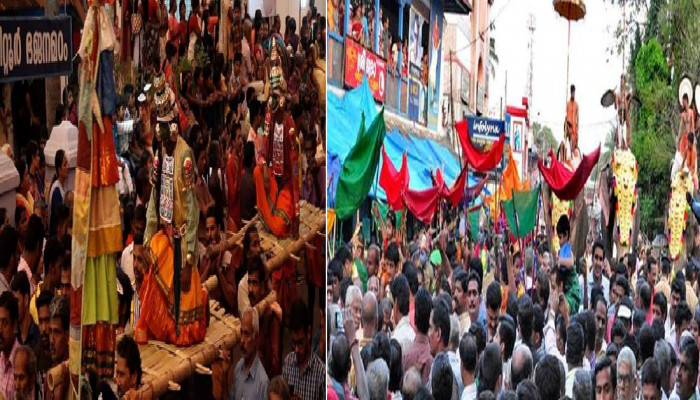
Somewhere in Palakkad, in a town most Indians could not place on a map, a community has been reenacting a war every year for centuries. Here is a goddess who emerged from her temple in battle form and went to war for her people. There is a copper leaf ultimatum whose original is said to still exist. There are toddy tappers who became accidental heroes, and a river whose name may carry the memory of a sword being washed clean after victory. And every February or March, without cameras or cultural tourism budgets, all of it comes alive again.
This is Konganpada. Kerala’s war festival. And if you have not heard of it, you are not alone.
When Rishab Shetty’s Kantara swept through Indian cinema in 2022, it carried images of forest spirits, village deities, ritual justice, and a faith that breathes through the soil itself. Audiences responded with recognition rather than discovery. The story felt known. That is because such worlds have never stopped existing across India. They simply exist without an audience, without a release date, and without a marketing campaign.
Konganpada is one of them.
To understand it, you need to understand the Palghat Gap. For centuries, this natural break in the Western Ghats was the only passable route between the fertile plains of Kerala and the Kongu country to the east, encompassing present-day Coimbatore and parts of Tamil Nadu. Spices, chillies, turmeric, coriander, and areca nut moved westward through this gap on the backs of bullocks and buffaloes. Paddy moved east in return. The town of Chittur, sitting at the western edge of this corridor, was both a trading hub and a border town. Wealth attracted attention. And attention, eventually, brought conflict.
The origin of the Konganpada tradition traces back to a caravan dispute near Chittur. The Kongu ruler of the time, Rajadhi Raja, believed his men had been wronged, whether by the villagers or, as an alternate account suggests, by a flash flood on the Bharatapuzha river that washed away animals and goods and whose survivors chose to blame the Naludesam people rather than nature. The version matters less than what followed. Rajadhi Raja sent an ultimatum on a copper leaf demanding restitution. Local tradition holds that this document is still preserved by the Chittedathu family, in whose custody it has remained across generations.
When the ultimatum arrived at Chittur, panic followed. The people gathered at the Chitturkavu Bhagavathi Temple and placed the copper leaf before the goddess Bhadrakali, seeking protection. According to faith and memory passed down without interruption, the goddess answered. When the Kongu forces crossed the Walayar River, the recognised boundary of Chittur Taluk, the first warning came not from scouts or soldiers but from toddy tappers of the Izhuvan community who were already up the palmyra trees at dawn. They climbed down without removing their tapping gear and ran to alert the four villages. That act of ordinary urgency became part of the festival’s reenactment and has remained so ever since.
What followed, in the tradition of Chittur, was divine intervention. The goddess is believed to have emerged from the temple in battle form, led the Chittur common folk to victory, and upon returning, washed her sword in the Walayar river before retiring to the sanctum. Some accounts hold that the river’s name carries the memory of that moment.
This episode is remembered every year through the Konganpada festival, observed in the Malayalam month of Kumbham, which falls in February or March. The 2026 edition has concluded; the next cycle is expected in early 2027.
The festival opens with Chilambu, a ritual reenactment of the moment the war ultimatum was received and the frightened community turned to the goddess. A flag hoisting the next morning signals readiness. As evening falls, the Velichappadu, the temple oracle dressed in ceremonial silk and carrying a shining sword, leads a torch-lit procession toward the battlefield at Poovathum Kavu. Among those in the procession are participants dressed in traditional toddy-tapping attire, honouring the Izhuvan community whose dawn warning made the defence possible.
The following day belongs to the Kuttikolam, one of the festival's most visually striking and quietly profound moments. Young girls dressed as boy warriors and young boys dressed in the form of the Devi are carried on the shoulders of their fathers and uncles through the streets. It is the community's way of saying, across centuries of practice, that courage and divinity belong to no single form
As dusk settles, the Olavayana takes place: a member of the Chittedathu family dresses as the Kongu messenger and reads aloud the declaration of war, transcribed onto a cadjan leaf, before the goddess. Around ten at night, the mock battle begins at Poovathunkavu, with men on horseback, the sound of percussion, and participants wearing buffalo head masks to honor the animals that perished in the original conflict. Some feign death and are carried back by wailing companions, a detail drawn directly from accounts of the original battle in which local leaders fell and were returned to their families.
On the third day, 101 rounds of the kathinavedi, iron pipe crackers, mark the victory. The festival closes with Devendra Pallu, where members of the Srikandath Panikkar family, the traditional military instructors of Chittur’s warrior households, lead the community in a display of martial arts and physical training. It is the most quietly significant part of the celebration: a living institution acknowledging that the skills used in that ancient defence were never abandoned, only transformed into ritual.
The historical dating of the original conflict remains genuinely contested. Scholars have proposed dates ranging from the ninth century to the seventeenth, with some placing it as late as 1695 C.E. The records are sparse, the oral traditions layered. What this ambiguity reveals is not a weakness in the tradition but its very nature. Konganpada does not survive because historians have agreed on a date. It survives because a community chose to remember, and has never stopped.
Kantara worked because Rishab Shetty trusted his material without explaining it away. He did not simplify ritual for wider acceptance or soften sacred belief for modern sensibilities. He presented it on its own terms. The film’s audiences responded not with curiosity about something exotic, but with recognition of something they already carried.
Konganpada asks for the same trust. It does not announce itself. It does not have a trailer or a press release. It has a copper leaf, a river with a name that tells a story, a predawn warning from ordinary working men, and a goddess who took the warrior form to save her own when the moment required it.
Some stories do not need a screenplay. They just need someone to look.
References and Sources
- Kerala Tourism Board. "Chittur Kongan Pada, Chittur Kavu." Official festival documentation. Palakkad District, Kerala.
- Maddy. "The Kongan Pada at Chittur: A Study." Maddy's Ramblings (blog). January 2019.
- Chittur Kavu Temple Administration. Konganpada Festival: Official Event Brief. Executive Officer, Chittur Kavu, SH25 Anikode, Chittur, Palakkad District, Kerala 678101.
- District Tourism Promotion Council, Palakkad. Festival records and accessibility documentation for Konganpada, Chittur Municipality. Palakkad, Kerala.
Disclaimer: The opinions expressed within this article are the personal opinions of the author. MyIndMakers is not responsible for the accuracy, completeness, suitability, or validity of any information on this article. All information is provided on an as-is basis. The information, facts or opinions appearing in the article do not reflect the views of MyindMakers and it does not assume any responsibility or liability for the same.



 Loading...please wait
Comments