



The Jews of North-East Bharat – Fact or Fiction?
- In Current Affairs
- 11:52 AM, Mar 13, 2026
- Ankita Dutta
A popular theory about the origin of the Chin-Kuki-Mizo tribes of the North-East traces their lineage to Israel and a centuries-long history of slavery and exodus through Persia, Afghanistan, Tibet and China, before they moved to Burma and finally settled in the present-day region of Manipur and Mizoram, all the while adhering to certain Jewish religious practices like circumcision. It was originally propounded by a Christian Manipuri anthropologist and ethnographer, Dr Milui Lenthang Khuplam, who stated that the Kukis belong to one of the ten “lost tribes” – Menashe – of Israel. Several experts and subject-matter specialists are of the opinion that the Jewish Origin Theory of the Kukis is the most authentic, for it bears empirical validity. In this regard, it was in the year 1999 that Hiller Halkin, a well-known American-born Jewish author and journalist who served as the Israel correspondent for many years in The New York Times, presented Dr. Khuplam a scroll “confirming” the Kukis as descendants of Menasseh (the son of Joseph and the 14th King of the Kingdom of Judah) and as one of the “lost tribes” of Israel. After an in-depth investigation, Halkin wrote a book titled Beyond the Sabbath River – In Search of the Lost Tribe of Israel. In 2001, Lars Goran Svensson of Sweden and ‘Sister Angel’, his assistant, met Dr Khuplam. They had come to Manipur for a third time to seek out the “lost tribes” of Israel to bring them back to the ‘Promised Land’. In 2006-07, 300 Kuki families were taken in batches to Israel.
Kuki scholars and academics have even cited DNA tests to further confirm that the Kukis or Manmasis[1] are truly one of the ten “lost tribes” of Israel.[2] Isn’t it mysteriously fascinating? Advocates of the Jewish Origin Theory of the Kukis claim that their traditional religious rituals and ceremonies resembled that of the Jews and that they practised their ancient Jewish traditions for centuries, unaware that they were the descendants of one of the “lost tribes” of Israel. They have argued that the Manmasi (Menashe/Manasseh) people, along with other tribes of Israel, became “lost” more than 2,700 years ago, i.e. around 722 BC when King Shalmaneza of the Assyrian Empire conquered the Northern Kingdom of Israel and exiled the tribes that comprised it. Menashe, whose population at that time was about 32,200, was taken to Assyria as slaves after the destruction of Jerusalem in 70 AD. Assyria was conquered by Babylon in 607 BC, and later by Persia in 457 BC. Persia was conquered by Alexander in 331 BC.
The claim is that it was during this period of Alexander’s invasion that the Manmasis (Menashe) were deported from Persia to Afghanistan and other places. Throughout the entire period, it is said that their Savun Lekhajol or Torah scroll was with them under the possession of the Thempu [priest(s)] and the Lamkai Pipu [elder(s)]. From Afghanistan, their migration continued Eastwards along Central Asia and the present-day area of Kashmir till they reached the Tibetan-Chinese border. Some of their tribesmen stayed back in the areas adjacent to the Bay of Bengal. From there, others continued to wander following the course of the Wei River, reaching Chhinlung in Central China via Mongolia. They settled in China around 231 BC.
What we have been made to believe is that they initially tried to mingle with the Chinese culture and civilisation; however, as time passed, the Chinese, during the reign of Shih Hungtai in the early 17th century, began to persecute and enslave them. They lost everything, including their own writing script called Bulpijem (an animal-skinned scroll consisting of 32 alphabets). In order to avoid any further attacks from the Chinese, some of them escaped and began living in caves (Khul) in the surrounding mountains. Whereas some wandered through the jungles southward into Siam (present-day Thailand) and Burma in South-East Asia. Another section of the escaping group continued to wander till the Indian subcontinent. The whereabouts of those Manmasis who remained entrapped in China were never known. Those who could escape but were left behind continued to live in caves in the wild for about two generations. The wanderers, on the contrary, are said to have wandered along the Chindwin until they reached Mandalay in Burma. At one point in time, they even settled in Laos and Vietnam. From Mandalay, they reached the mountainous region of the Chin Hills. By the 18th century, a section of the wandering Chin-Kukis reached the present-day states of Manipur and Mizoram in North-Eastern India, their kindred having already settled there a century ago.
However, these “historical” claims of the Chin-Kuki connection with Israel are not corroborated by any solid literary and archaeological evidence(s). No historical record of their mass migration due to “religious persecution” has also been found to date. Anthropologists say that as a result of centuries of intermingling with the locals of North-East India, even their DNA is not pure enough to establish their roots now. Doubts have been raised from time to time over the authenticity of the Jewish Origin Theory, with a section of Manipuri scholars and intellectuals even claiming that this is nothing but Church propaganda for creating a fake narrative of “persecution”. Forcible attempts to trace the Chin-Kuki-Mizo tribes’ lineage to Israel and establish their Jewish ancestry on the basis of their traditional songs and chants, feasts, marriage rituals, religious practices such as circumcision, etc. are not sufficient.[3]
Most importantly, what we need to understand is that this Theory was first heard only in the period post-1947, when the North-East had emerged as a fertile ground for conversions. Although there is no official record, the Sabbath Movement is believed to have started in the mid-1950s in Manipur’s Churachandpur district bordering Mizoram. It is widely heard across the region that the belief of a section of the Chin-Kuki-Mizo tribes in a Jewish identity was reinforced in the early 1950s when Mei Chalah, a Mizo priest, dreamt that his people belonged to Jerusalem. It was also in the 1950s when the Judaizing movement started in Mizoram and spread widely to almost all the Chin-Kuki-Mizo inhabited areas of the region by the 1970s. This was when the Jewish connections of the Chin-Kuki-Mizos had become “apparent”, and the Jewish Origin Theory of the Kukis gained ground. By this time, the entire family of these tribes had converted to Christianity, the process having already begun in the 1890s. The British and American missionaries managed to convert most of their population throughout the 18th and 19th centuries. Yet, many of them, Christians and other tribesmen alike, still continue to harbour the belief that they are the descendants of ancient Israel, from where they were exiled about 2,500 years ago by a foreign conqueror and would thus like to emigrate to the “land of their forefathers”.
In the early 1960s, a handful of the Chin-Kuki-Mizos embraced the Sabbath, deviating from the original Christian tradition of observing Sunday as the rest day. They founded the Manipur Jewish Organisation – the first one in North-East India – on May 31, 1972. It soon began establishing contacts with Jews in other parts of India. In October 1974, it was renamed as the United Jews Organisation of North-East India, to unite various Sabbath-observing and Judaic groups across the North-East. In 1976, a person called T. Daniel returned to Churachandpur after establishing contacts with the Israeli Consulate in Bombay. In the beginning, only a few people began practising Judaism after coming to know that they were the Bnei Menashe (Hebrew for ‘the sons or children of Menasseh’). Subsequently, a synagogue was established at Tuibong village of Churachandpur.
By this time, the Naga separatist movement had already established its footprints beyond the borders of Nagaland. It could have been possible that the Jewish Origin Theory of the Kukis was deliberately manufactured by a section of propaganda-peddlers to falsely establish a connection between the Chin-Kukis and the Jews of Israel on the grounds of “persecution”, so that the tide can eventually be turned in favour of Christians and Christianity in the North-East. True to that, the same narrative of ‘Christian persecution’ was being used by many writers, journalists and academics to play the ‘victim’ on behalf of the Kuki Christians during the recent Manipur violence that began in the summer of 2023, so that people’s attention can be diverted away from the real, genuine cultural and civilisational issues.
It is, therefore, not surprising that many devout Church leaders and leaders of insurgent outfits, too, have tried to propagate the Israeli/Jewish origin of the Kukis at different times. Their immigration to Israel is also being greeted with excitement by local evangelical Christian groups, who view it as a fulfilment of the Biblical prophecy, with some even going to the extent of supporting the immigrants with financial assistance.[4] According to veteran Kuki leader P.S. Haokip, President of the separatist Kuki National Organisation (KNO) fighting for a separate Kuki State, all the Kuki tribals are Bnei Menashes with Jewish roots. He claims that “they were brothers and descendants of Manasseh, as God clearly revealed to His servants, Rev. Chomlhum and Pastor Hnamthinkhum, in 2011.”[5]
Is Bnei Menashe a Myth?
On July 7, 1994, a referendum was called by the Aizawl-based Chhinlung Israel People’s Convention (CIPC), a non-religious and non-political organisation of the Chin-Kuki-Mizo tribes. The Declaration, later submitted to the UN in October 1994, mentioned that the people of the Chin-Kuki-Mizo/Chhinlung Chhuak ethnic group, i.e. inhabitants of the Chin Hills and Matu areas of Myanmar, the Chittagong Hill Tracts and plains in Bangladesh, Mizoram, and adjacent areas in Assam, Manipur, and Tripura, are descendants of the same ancestor. The Declaration also says – “We pledge our faith and confidence in the Committee and Code of the United Nations in the proclamation of our basic human rights in conformity with the Charter of the UN. The Kuki-Chin in Myanmar, Lushai in Bangladesh and Mizo in India are the direct descendants of the Biblical tribes of the Northern Kingdom of Israel of the tribes of Menashe and Ephraim, sons of Joseph born in Egypt through his Egyptian wife Asthans – convince that the time has come to declare our true identity that we the Chhinlung/Chhuak are the lost tribes of Israel to the world.”
At present, the tiny Bnei Menashe community of Jews (estimated to be a little more than 9000 members) in North-East India is spread over Assam, Manipur, Mizoram, and Nagaland, and as well as the neighbouring country of Myanmar. While the Jews of Cochin (Kochini Jews), Mumbai (Bene Israel), and Kolkata (Baghdadis) are pretty well-known, this lesser-known community of Jews in the North-East has remained hidden from the country for years. Not much has been written about them yet, except for some scattered stories in a few newspapers and a 28-minute-long documentary – A Prayer for Aliyah – directed by Zorawar Shukla in 2013. The documentary, available on YouTube, focuses on the few thousand Bnei Menashes living in Manipur’s Churachandpur district and a few more in the Langol area of Imphal West district, where they are commonly known and addressed as ‘Kukis’.
The oft-repeated claim is that it was after they were converted into Christianity and started reading the Bible the way Christians did, they could recognise many stories in the Bible from their own traditions that convinced them they actually belonged to the Jewish faith before the advent of Christianity. Soon, the Bnei Menashes identified Manmasi or Menasia, one of their legendary ancestors, as the Biblical Menasseh, the son of Joseph. By adopting Judaism again, they feel their mistake of conversion into Christianity during the British period has been “corrected”.
Elitsur Sheikhogin – a Kuki interviewed in the film says – “Even till the late 19th century, we were simple tribals - animists by religion. In the 1890s, after the British missionaries arrived here, we were converted to Christianity. We lost our tribal culture, but it proved beneficial for us as it brought us in touch with Judaism. Suddenly, we realised that so many rituals and traditions followed in Judaism were already being practised by our forefathers for centuries. Besides, the name of one of our forefathers is the same as that of the man who led this exiled group out of Israel – Menasseh. This is when we realised that we are the lost tribe of Israel.”
However, not all groups of the Chin-Kuki tribes identify themselves with Israel. The ones who trace their ancestry to Jewish traditions follow Judaism and call themselves Bnei Menashe. These include different clans among the Mizo, Kuki, and Paite tribes in particular. In other words, the Bnei Menashes have emerged from the culturally and linguistically linked Chin-Kuki-Mizo tribes scattered across the region, but not all these tribes are Bnei Menashes. They believe in the Old Testament of the Bible and do not accept the New Testament. So far, about 11,000 Bnei Menashes or members of the Jewish community have been identified in the whole of North-East India, out of which 4,000 have already migrated to Israel (considered by them as their “Holy Land” which God chose for their “ancestors”). Interestingly, the remaining 7,000 Bnei Menashes and a few hundred more are concentrated in Mizoram and Churachandpur, the main hub of the Judaising movement in the region. Churachandpur serves as the epicentre of the community in Manipur. A number of synagogues are built in different areas of the district.
As per our studies conducted across different regions of the North-East, Bnei Menashes can be classified into four distinct categories –
- Those who do not consider India as their own country, although proclaiming themselves to love India since they have been born and educated here. Living in India, they feel it is difficult when it comes to observing orthodox Jewish customs and rituals or following all the commandments of the Torah. They, therefore, consider Israel as their religious ‘original home’ or Zion. Since in most of the eateries of the North-Eastern states, pork, being a dietary mainstay of the tribal communities, is easily available, many such Bnei Menashe families have almost stopped going out to eat in local restaurants and have switched to chicken, beef and boiled vegetables. They also avoid buying cooked food from street vendors, fearing their food will get mixed up with pig fat. Their yearning and eagerness to return to their fabled “homeland” is visible. Many in Mizoram say they grew up hearing songs and stories about a faraway homeland, sung softly during family prayers.
- Those who identify themselves as ‘Christians with Jewish roots’, and do not wish to emigrate to Israel. According to them, having Jewish ancestry does not imply that Kukis are refugees in India. Hence, although they believe that they are the descendants of Menasseh, they have no plans to leave India. Depending upon individual faith and conviction, they feel it is not obligatory or necessary to emigrate to Israel as a Jewish descendant, for it is a matter of one’s identity, history and origin. At the same time, they are not opposed to any member of the Kuki tribe embracing Judaism and emigrating to Israel on the grounds of faith and religion. Backed by the Church, they are the forefront of organising festivals where Bnei Menashe tribes from different North-Eastern states and Myanmar, too, are invited. These festivals are aimed at promoting unity among the Bnei Menashe descendants. During the recent Manipur conflict, these people played a key role in propagating the ‘Christian persecution’ narrative in favour of the Kukis. They have also openly advocated the establishment of a separate ‘Kuki State’ out of the present-day state of Manipur, comprising the five hill districts of Churachandpur, Chandel, Kangpokpi, Pherzawl, and Kamjong, which have seen massive demographic changes over the past several years.
- Those who identify themselves as ‘Christians with Jewish roots’, but wish to emigrate to the ‘Land of their Ancestors’. Several memorandums have been submitted by the Manmasi Messianic Council Centre Church in Kangpokpi, Manipur, on behalf of these people to the Israeli Government and Shavei Israel to take them to Israel without requiring them to convert to Judaism. They are rabid Christians but have had intermarital alliances with the Bnei Menashes. Although they follow some Jewish traditions and long to go back to their ‘Promised Land’, they realise that they cannot do so because of their faith in Yeshua (Jesus Christ) and adherence to Christianity.
- Those who have nothing to do with either Christianity or Judaism, and are abandoning Christianity while embracing Judaism in the hope of a better quality of life in Israel.
Even though certain books and scriptures in Judaism do speak of the 10 biblical “lost tribes” of Israel, the Bnei Menashe community of North-East India has no credible historical/literary document to prove its claim. But that has not stopped them from applying for Aliyah – the religious and political permit process of immigration (homecoming) to Israel. For this, they have been practising Orthodox Judaism, learning all the practices of the religion and speaking Hebrew, in the hope of “returning home – the Land of their Forefathers” and “reuniting with their people one day or another”, in other words, gaining acceptance in Israel, a country they have never seen. Their synagogues too, have been giving classes in Hebrew for the past several years to help the Bnei Menashes prepare for a life in Israel.
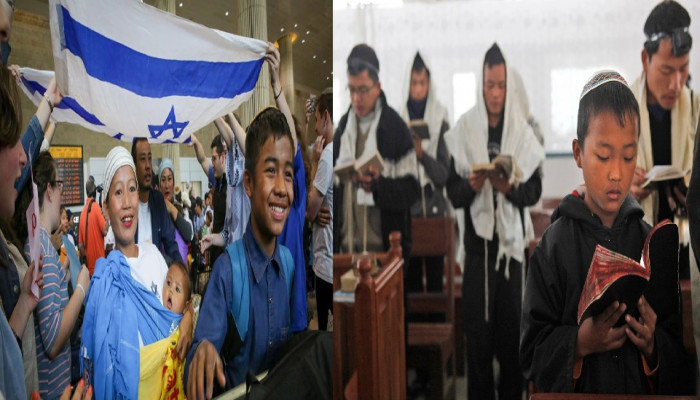
An example here may be cited of the Beit Shalom Synagogue at the Shavey Israel Hebrew Centre in Churachandpur, where Hebrew classes have been continuing for the last 15 years, especially for the children during their summer vacation. It also organises Hebrew learning camps quite often. The synagogue boasts of a small mikveh or ‘Jewish ritual bath’ resembling a pond, used for ritual purification before formal entry into Judaism. Many Bnei Menashes, along with their families, live in its premises. Followers of Judaism, including women and children, offer their prayers here.
A few synagogues can also be seen in the Langol area of Imphal West district, where Kukis reside. A lunisolar Jewish calendar and the Star of David hanging on the wall of their living room, and a mezuzah, or parchment, with verses from the Torah affixed to the front door frame or at the entrance to each of the interior rooms, can often be seen in the houses of Bnei Menashe families. Many males wear the Kippah, which indicates that they are followers of Judaism. Besides celebrating Rosh Hashanah (Jewish New Year), they also recite their prayers in Hebrew three times a day with their eyes facing West towards Jerusalem, and observe the Sabbath on Saturday, in keeping with the faith. There are several Bnei Menashe families in Churachandpur where the elders have embraced Judaism, but the children haven’t yet. The vice versa is also true.
Historically speaking, it was for the first time in the 1980s that the Bnei Menashes began to draw attention from Jewish organisations dedicated to identifying “lost Jews”. In 1979, Eliyahu Avichayil, a Rabbi (Religious Head) from Jerusalem and Chairman of Amishav Hebrew Centre (an institute for learning Hebrew language, Jewish religion and culture located at Republic Veng locality in Aizawl and working on the search for descendants of the “lost tribes”; Amishav meaning ‘Return my People’) initiated the immigration process by contacting the Bnei Menashes, requesting them to send a person to Israel to study Judaism. In 1981, Simeon Gin of Churachandpur became the first person from the tribe to go to Israel. In 1988, 24 people from Manipur and six from Mizoram were converted by Rabbi Dr Jacob Newman under the instruction of Eliyahu. It was for the first time in the late 1990s that groups of Bnei Menashe were brought to Israel in batches, where they formally converted and settled. Reportedly, more than 40 people from Kangpokpi immigrated to Israel between 1997 and 2017 after they accepted Judaism as their religion.[6] Moving across Aizawl, names such as Israel Store and Zion Street became common sights during the 1990s, leaving any newcomer to the State Capital awestruck and wondering if he is roaming around in any part of Israel!
The real breakthrough came in March, 2005 when Israel’s Sephardic Chief Rabbi Shlomo Amar officially recognised the entire community as “descendants of Israel” – a crucial development in securing their “right of return”. In the same year, Bnei Menashes were officially declared as one of the ten “lost tribes” of Israel by the Rabbinic Court of Jerusalem. It seemed as if the most cherished dream of the Jews from the North-East was now realised! After this recognition and announcement, the Aizawl-based Amishav Hebrew Centre was re-christened as Shavey Israel Hebrew Centre. The then Principal of the institute Alenby Sela and his family already migrated to Israel soon after the announcement.[7] This was also the time when Jewish Rabbis began visiting North-East India for purposes of religious education and training.
As per reports, before the mass migration approval in 2005, some Bnei Menashes had gone to Israel as tourists and students. A few had also gone to attend religious training courses; all converted to Judaism later and became citizens of Israel. But the Government of India clamped down on this since it was viewed as conversion. Also, the process was halted by the new Israeli Government’s policy in 2007; however, in July 2011, the Ministerial Committee on Immigration and Absorption agreed to the “return” of the remaining 7,200 Bnei Menashes from the North-East. Shavei Israel, a Jerusalem-based non-profit nationalist religious organisation[8] that reaches out to the descendants of Jews across the world, played an important role in lobbying on behalf of the Bnei Menashes for several years and thereby facilitating their process of “return” to the “Land of their Ancestors”.
In July 2005, the Bnei Menashes of Mizoram completed building a mikveh under the supervision of Israeli Rabbis to begin the process of their entry into Judaism. In that same year, 218 Mizo Christians had embraced Judaism.[9] The first mass emigration of the Bnei Menashes took place in 2006, when 213 members of the community migrated from Mizoram, followed by a second mass emigration of 233 people from Manipur in 2007.[10] Till June 2007, four batches of Bnei Menashe immigrants from Mizoram alone were reported to have settled in Israel since 1994. According to data from Shavei Israel, by December 2017, it was reported that nearly 3,000 Jews from Manipur and Mizoram had permanently left for Israel after formally embracing Judaism, and thousands more were waiting to take the flight. In the same year, a batch of 162 persons from Churachandpur, who were shortlisted in 2014, had moved to Israel, attracting prominent coverage in the Israeli Press.[11] In 2018, a huge number of 432 persons emigrated – 204 in February, followed by another 228 on June 10.[12] As per a report published in the Deccan Herald in December 2020, a total of 252 Jews from the North-East, including infants and the elderly, landed in Israel as immigrants to start a new life.[13]
In Israel, they are provided with a one-year temporary Israeli citizenship and new immigrant status after completing various bureaucratic processes that could take several months. Full citizenship is granted only after they complete basic religious education, besides learning Hebrew and the local Israeli customs. They are also taught about the basic concepts of life in Israel and provided with opportunities for developing their talents and working skills through job placements. Once the citizenship is granted, those in the age group of 18-25 years are enlisted for three-year compulsory military service while those above 60 are provided with an old-age pension.
The periodical migration depends on the Government of Israel and is quite unpredictable. Migration is approved only after the applicant appears for a rigorous interview conducted by a Rabbi. The interview is based on the applicants’ foundation in Judaism and Jewish life. After verifying their ability to recite prayers in Hebrew and observe the tenets of Judaism, the Bnei Menashe Council India, which operates from the premises of the Shavei Israel Hebrew Centre in Churachandpur town, and Shavei Israel, shortlist the names of those who qualify for immigration. Shavei Israel facilitates the entire process of immigration in coordination with the Israeli Government, and also arranges funds for aspiring emigrants. Those shortlisted by Shavei Israel leave India in phases. As the acceptance of Judaism remains a precondition for the Bnei Menashe tribals to immigrate to Israel, Shavei Israel offers various educational options in Israel, including Machon Miriam, the only Spanish-language conversion and return institute in Jerusalem.
For the past 20 years, Shavei Israel has been assisting members of the Bnei Menashe community of North-Eastern India to fulfil their dream of returning to the ‘Land of Israel’. But, the pace of immigration, as well as various other aspects, is decided by the Israeli Government, and not by Shavei Israel, which works only with those Bnei Menashes who observe the tenets of Judaism. Hence, many Bnei Menashes are less sanguine about the issue of return, and feel impatient about the unnecessary delays in the immigration process and the religious and bureaucratic hurdles they feel forced to jump through.
Reports have also suggested that educators from Israel regularly visit Manipur (Churachandpur in particular) to advocate Judaism and its basic practices to the Bnei Menashes before they immigrate to Israel.[14] During the recent conflict in Manipur, to protect the community in the region, Shavei Israel and its Chairman Michael Freund, expressed his intentions to evacuate them from the conflict zones. With reference to the displacement of Bnei Menashes in the conflict and the burning of synagogues, he had referred to the unrest as the ‘gravest crisis’ ever faced by the Bnei Menashes in India.[15]
In the recent times, the “lost tribe” theory has been heard more among the Chin-Kukis of Manipur and Mizoram than any other state. In Manipur particularly, Chin-Kukis identifying themselves as Bnei Menashes have often expressed their right to self-determination or a ‘Separate Statehood’ within India instead of emigrating to Israel. Claims and counter-claims between pro-Jewish and Christian groups have become very common. The Bnei Menashes have often been accused of trying to get a ‘free ticket’ to a country like Israel through a ‘false narrative’. Interestingly, a Kuki woman Yafa Phaltual in the Zorawar Shukla-directed documentary says, “My daughter has not yet started going to school. I want us to migrate to Israel before she reaches that age. I have heard that the schools there are very good. The weather is clean, the roads are clean, even the people there are very clean. I wish to move there as soon as I can.”
A question has often arisen – How is it possible that the Jews of Israel travelled across the Ganges plains, crossed the mighty Himalayas and finally settled in North-Eastern India without anyone knowing or having any record about it in any literature? Therefore, is Bnei Menashe a global propaganda in the war of narratives? If so, then why has it been manufactured and by whom? Are the Bnei Menashes really motivated by religious sentiments or is it the economic prospect of leading a comfortable life in a country like Israel that has attracted them more? Jews exercise significant control over the Western world, from the economy to the media and academia, and cinema, arts and culture. Jews own several top-notch American media conglomerates. Hence, they wield immense influence over the narrative. Even letters have been written to the Prime Minister of Israel on the same issue, leveraging the Chin-Kuki-Mizo narrative of one of the “lost tribes” of Israel. They have also been successfully able to highlight the issue on Islamist and Left-leaning global platforms such as Al Jazeera TV, CNN, and DW News, while the Hindu minorities of North-East India, such as Reangs, Hajongs, Meiteis, Bishnupriyas, etc., still struggle to put across their narrative in the national media, let alone the international media houses.
The Chin-Kukis’ armed combat skills are quite well-known. They are well-equipped in the art and techniques of warfare, especially guerrilla warfare. In Israel, the Government provides the new arrivals with initial financial support, Hebrew language instruction, job guidance, temporary housing, and social welfare programmes, to help them adjust to the new environs. After completion of the basic training in Hebrew and the Jewish way of life, a majority of them are first settled temporarily by the Israeli Government in the war-torn zones along the border with Palestine adjacent to the West Bank, from Sderot on the periphery of Gaza in the South to Kiryat Shmona and Ma’alot-Tarshiha in the North. Several others are also concentrated in Kiryat Arba on the Southern West Bank, Negev and the Jezreel Valley regions, in volatile towns like Afula, Migdal HaEmek, Tiberias, etc. and a few more in the Upper Nazareth Illit and Karmiel areas of Israel, as a part of the Israeli Government’s efforts to strengthen population presence in Negev. For their permanent settlements, they are moved further North to the scantily populated zones so that these regions of the country can be strengthened and revitalised in due course.
Recently, Israel approved a phased plan to absorb nearly 6,000 members of the Bnei Menashe community from Mizoram and Manipur by 2030. Most of these new arrivals from the North-East – primarily from Mizo and Kuki tribes – are expected to settle in the Galilee region of Northern Israel, an area affected by conflict with Hezbollah that has driven many residents away.[16]
Prime Minister Benjamin Netanyahu had described the move as “important and Zionist”, saying it would help strengthen Israel’s North. During the first week of December, 2025, a total of nine Rabbis, along with members of the Jewish Agency for Israel and diplomats from the Israeli Embassy – including the Ambassador to India – camped in the capital city of Aizawl to conduct screenings of potential candidates for the first phase of relocation. Their task was to identify 300 people from Mizoram and another 300 from Manipur for migration to Israel in early 2026. The response was overwhelming.[17] More than 1,000 applicants from Manipur and about 600 from Mizoram turned up for the screening at Thara Resort on the northern outskirts of Aizawl, where the visiting team had set up base. But the raging conflict in West Asia has cast a long shadow over their plans, delaying a journey that many describe not as migration, but as “spiritual return”.[18]
A great deal of time, energy and resources have already been invested by organisations like Shavei Israel to help the Bnei Menashes with their absorption into the Jewish state of Israel. They would not have done so without a definite sense of purpose. It is, indeed, a strange predicament of a people with a contested history. A community which practised Christianity for generations before embracing Judaism now observes major Jewish festivals such as Sukkot, dietary laws, and synagogue traditions in both Mizoram and Manipur. However, since the ancestral claims of the Bnei Menashes are not backed by any credible religious and historical facts and are also rejected by other members of the Chin-Kuki-Mizo tribes, suspicions keep arising.
[1] In Chhothe-Kuki (oldest Kuki tribe of Manipur) dialect, Malmasi/Manmasi meant ‘Ancestor/Progenitor’. However, there is so far no valid proof as to whether Menasseh and Manmasi are the same or co-incidental. The Manmasi National Christian Army (MNCA), a Hmar-Kuki militant outfit, caught attention in 2009 on the charge of forcing Naga Hindus residing in the sacred Bhuvan Hills of Silchar in Assam to convert at gunpoint. The militants desecrated temples by painting crosses on the walls with their blood.
[2] TS Letkhosei Haokip, Ethnicity and Insurgency in Burma – A Comparative Study of the Kuki-Chin and Karen Insurgencies (New Delhi: Educreation Publishing, 2018), pp. 3-4.
[3] Kuki-Chin-Mizo: The lost tribe of Israel, E-Pao, November 8, 2007. https://e-pao.net/epSubPageExtractor.asp?src=manipur.Ethnic_Races_Manipur.Kuki_Chin_Mizo_lost_tribe_of_Israel
[4] More than 7,200 Indian Jews to emigrate to Israel, Deccan Herald, May 4, 2018. https://www.deccanherald.com/world/more-7200-indian-jews-immigrate-2445231
[5] The lost Jews of Churachandpur, The Hindu, December 2, 2017. https://www.thehindu.com/news/national/other-states/the-lost-jews-of-churachandpur/article21244204.ece
[6] https://e-pao.net/epSubPageExtractor.asp?src=manipur.Ethnic_Races_Manipur.Kuki_Chin_Mizo_lost_tribe_of_Israel
[7] Many in Mizoram believe they are lost tribe of Israel, Hindustan Times, April 24, 2005. https://www.hindustantimes.com/india/many-in-mizoram-believe-they-are-lost-tribe-of-israel/story-ovr2S9qlAb9APj5ajBl0DK.html
[8] Shavei Israel, founded in 2004 by Michael Freund, Chairman of Shavei Israel, is at the forefront of the movement to bring back Jews looking to immigrate to Israel. It is the main body that oversees the migration of the Jews to Israel. The organisation claims that it does not proselytise or support any form of missionary activity. But, it does sponsor rabbis and teachers to work among various groups of lost Jews in places as far as India, and in many other countries where the “lost tribes” have been found to be living. Shavei implies that these people are now citizens of Israel.
[9] Mizo Jews learn the Israeli ‘ways’, Hindustan Times, June 26, 2007. https://www.hindustantimes.com/india/mizo-jews-learn-the-israeli-ways/story-iy0VkBOO9vxdRkHE7TF5iN.html
[10] Largest exodus of Benei Manashe Jews underway from Manipur; 432 have left for Israel so far this year, The Indian Express, June 12, 2018. https://indianexpress.com/article/north-east-india/manipur/largest-exodus-of-benei-manashe-jews-underway-from-manipur-432-have-left-for-israel-so-far-this-year-5213828/
[11] The Lost Jews of Churachandpur, The Hindu, December 2, 2017. https://www.thehindu.com/news/national/other-states/the-lost-jews-of-churachandpur/article21244204.ece
[13] 252 Indian Jews from the Bnei Menashe community immigrate to Israel, Deccan Herald, December 15, 2020. https://www.deccanherald.com/india/252-indian-jews-from-the-bnei-menashe-community-immigrate-to-israel-927643.html
[14] Do Kuki diasporas play a role in the Manipur Unrest? The Sangai Express, June 24, 2023. https://www.thesangaiexpress.com/Encyc/2023/6/24/TK-SinghWhile-the-present-disorder-in-Manipur-is-considered-to-be-an-intra-State-conflict-between.html
[15] India’s Bnei Menashe community in crisis as ethnic violence burns synagogues and displaces hundreds, The Jerusalem Post, June 17, 2023. https://www.jpost.com/diaspora/antisemitism/article-746604
[16] ‘Lost’ Jews of Mizoram, Manipur set to return to Israel, The Assam Tribune, November 25, 2026.
[17] Nine Jewish Rabbis conclude weeklong screening of Bnei Menashe in Mizoram, The Assam Tribune, December 11, 2025. https://assamtribune.com/north-east/nine-jewish-rabbis-conclude-weeklong-screening-of-bnei-menashe-in-mizoram-1600811
[18] War stalls Bnei Menashe community’s return to Zion, The Assam Tribune, March 4, 2026
Disclaimer: The opinions expressed within this article are the personal opinions of the author. MyIndMakers is not responsible for the accuracy, completeness, suitability, or validity of any information on this article. All information is provided on an as-is basis. The information, facts or opinions appearing in the article do not reflect the views of MyindMakers and it does not assume any responsibility or liability for the same.



 Loading...please wait
Comments