




The Invisible Architects: Unsung Heroes Behind BJP’s Bengal Breakthrough
- In Politics
- 12:33 PM, May 06, 2026
- Siddhartha Dave
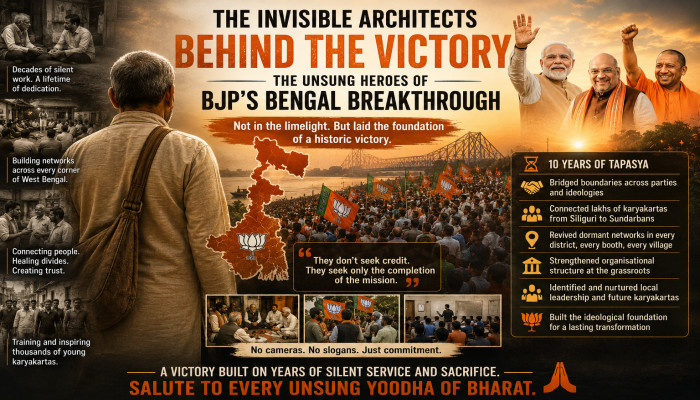
In the afterglow of victory, politics often celebrates faces, not foundations. Crowds gather, slogans rise, and victory images flood public memory. But beneath every electoral triumph lies a deeper story—one that rarely finds space in headlines. The recent electoral success of the Bharatiya Janata Party in West Bengal is no exception. While national figures like Narendra Modi, Amit Shah, Yogi Adityanath, and Himanta Biswa Sarma dominated the campaign, the real story of Bengal’s transformation was written quietly, patiently, and often invisibly—by individuals who never sought recognition.
The temptation in political analysis is to attribute victory to visible factors—high-voltage rallies, charismatic leadership, or institutional mechanisms. Critics may even reduce it to allegations about electoral systems. But such explanations miss the essence of how political change actually takes root. Electoral victories of this scale are rarely manufactured overnight. They are cultivated—through years of groundwork, ideological engagement, and organisational discipline.
At the heart of Bengal’s transformation lies a category of workers seldom acknowledged—the silent organisers, the institutional builders, the long-distance runners of political change. These are individuals who operate away from public glare, whose work is measured not in headlines but in networks, not in speeches but in relationships.
Many among them emerged from the disciplined ecosystem of the Rashtriya Swayamsevak Sangh and its affiliated organisations, dedicating decades of their lives to grassroots organisation. Beginning their journeys in the late 1960s and 1970s, they traversed regions across Uttar Pradesh, Awadh, Gorakhpur, Kashi, and Bundelkhand—training cadres, building ideological clarity, and shaping future leadership.
Yet, one of their most consequential work unfolded far from their original terrains—in West Bengal.
After the 2016 Assembly elections, a strategic decision was taken within the organisational framework to invest deeply in Bengal. The task was not merely political expansion; it was civilisational engagement. Bengal was ideologically layered, socially complex, and historically resistant to the BJP’s rise. It required neither spectacle nor short-term mobilisation—it required patience, persistence, and precision.
What followed was a silent reconstruction.
From Siliguri in the north to Asansol and Bardhaman in the industrial belt, from the dense lanes of Kolkata to the sensitive districts of Murshidabad and Malda, these organisers began stitching together dispersed networks. Former Congress workers disillusioned with decline, Left cadres fatigued by ideological stagnation, grassroots elements within the Trinamool Congress uneasy with governance patterns—all became part of a slow but steady realignment.
This was not recruitment. It was a reconnection.
The approach was relational rather than rhetorical. Conversations replaced campaigns. Trust-building preceded political mobilisation. Networks that had long remained fragmented were gradually brought into coherence.
One of the most symbolic moments in this long process came when Pranab Mukherjee attended the RSS Vijayadashami event in Nagpur in 2018. In Bengal’s socio-political context, where the bhadralok psyche had long been shaped by Left-liberal narratives, this moment carried transformative weight. It was not merely an event; it was a signal—one that softened ideological resistance and opened new channels of engagement.
This was not an isolated development. It was part of a larger recalibration that had been unfolding quietly for years.
These invisible organisers also played a crucial role in bridging grassroots realities with strategic leadership. From establishing communication lines with influential regional figures like Suvendu Adhikari to identifying credible youth leaders, their inputs shaped key decisions. Candidate selection, local leadership cultivation, and constituency-level strategies were informed not just by political calculations but by deep ground intelligence accumulated over years.
But what defines these individuals most is not their influence—it is their anonymity.
They live simply, travel constantly, and remain detached from recognition. There are no public profiles, no interviews, no claims of credit. Their work is mission-oriented, not visibility-driven. Over the past decade, they traversed Bengal’s geography relentlessly—village after village, town after town—reviving dormant networks, building trust, and sustaining ideological momentum even in adverse conditions.
And they did not work alone.
Alongside them stood thousands of young swayamsevaks and karyakartas—engaging communities, countering narratives, and nurturing a long-term presence in a politically challenging environment. These were not years of easy expansion; they were years of resistance, resilience, and relentless effort.
This is what makes the 2026 victory fundamentally distinct.
It is not the product of a campaign cycle.
It is the culmination of a decade-long organisational tapasya.
To reduce it to rallies or rhetoric is to misunderstand the nature of political transformation. Bengal’s shift was not engineered in election months—it was cultivated over years of silent labour.
The narrative, therefore, must expand.
It must recognise the depth of ideological work, the persistence of grassroots engagement, and the discipline of cadre-building that made this transformation possible.
In every victory photograph, there are faces we recognise.
But beneath every such photograph lies a foundation built by those we do not.
They remain unnamed.
They remain unseen.
Yet, they remain indispensable.
Their names may not be remembered in headlines.
But without them, there would be no headlines to remember.
Jai Hind.


 Loading...please wait
Comments