




The Houthis and the Mecca Trilateral Pact
- In Military & Strategic Affairs
- 11:33 AM, Sep 19, 2026
- Major General Harsha Kakar
The US launched Operation Rough Rider against the Houthis, also termed Ansar Allah, from March to May 2025, which involved over a thousand strikes, resulting in the Houthis expending most of their munitions in retaliation. The US had targeted the Houthis in response to attacks on its shipping in the Red Sea since late 2023, in response to the Gaza conflict. The US had targeted Houthi weapon stockpiles. With both sides aware that air strikes alone cannot bring about decisive results, a tentative ceasefire was brokered by Oman, and the Houthis promised not to engage US shipping.
The Houthis’ military power was degraded, and hence they did not join Iran in retaliating to the US-Israel launched Operation Midnight Hammer in June last year. The same was the scenario when war again resumed in Feb this year. Over a period of time, the Houthis rebuilt their stockpiles. Iran meanwhile transferred munitions and advisors to Yemen to ensure that their ability to respond increases.
The Houthis watched as Iran’s shutting down of the Strait of Hormuz in retaliation for US strikes impacted the global economy. They had attempted the same in the Red Sea but with little effect. As Hormuz shut, Riyadh began shifting its oil exports from its Eastern Coast to its Western coast, exploiting the Red Sea and the Bab el-Mandeb Strait. The Houthis now realised that they had the power to impose a similar blockade against Saudi Arabia, thereby impacting global oil prices, if the latter acted against them. A Saudi Arabia-led coalition has been maintaining a naval blockade off Yemen for almost a decade.
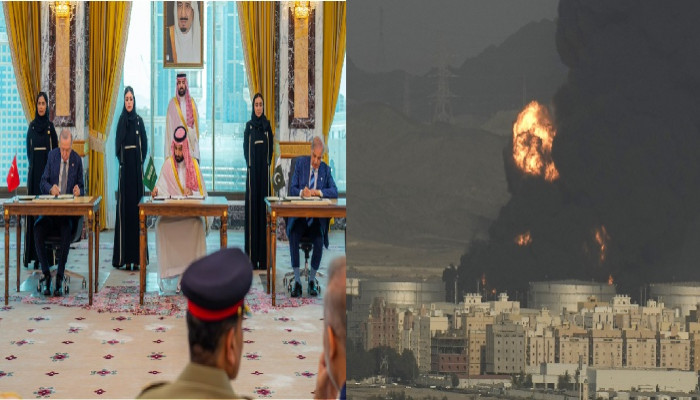
The trigger for the Houthis was the 13 July bombing of the Sanaa airport by the Saudi backed Yemen government to prevent the landing of an Iranian flight, breaking a ceasefire that had existed since 2022. The Houthis claimed the flight was carrying back those who had attended the funeral of the Ayatollah in Tehran, while the reality was that the flight also had Iranian IRGC officials and military equipment. In retaliation, on 23rd July, the Houthis attacked two Saudi oil tankers, closing the straits for Riyadh and entering the conflict. This increased oil prices.
The Houthis are now targeting Saudi Arabia with missiles. Iran-backed militias in Iraq also launched drone strikes on Saudi oil facilities, forcing Saudi Arabia to join the US in airstrikes on Iranian proxies in Iraq at the end of July. Currently, both the militias in Iraq and the Houthis in Yemen are targeting Saudi Arabian infrastructure. The Houthis are demanding an end to the blockade.
To add to Saudi Arabia’s problems, the Houthis have broken through frozen frontlines and seized key locations around the vital Bab al-Mandeb Strait, including the Greater and Lesser Hanish islands and the Red Sea port city of Mocha. This has enhanced their ability to close the Red Sea route.
The scenario is now difficult for Saudi Arabia. Its East-West pipeline, which carries 4% of global oil, was shut down due to a drone strike launched from Iraq. Iran and the Houthis blocked its major oil export routes. To mitigate these contingencies, Saudi pushed through two major pacts, the SMDA (Strategic Mutual Defence Agreement) and the Mecca Pact. The SMDA between Pakistan and Saudi Arabia was inked in Sept last year, and the Mecca Pact included Turkey, was signed on 07 Aug.
However, since attacks began, there has been no response. Only the Pak defence minister, who handles everything but defence, commented on TV that Pakistan is ‘bound by the terms and conditions of this pact, and we will honour them in case there is a need.’ The Foreign Office immediately issued a clarification saying, ‘as of now, there is no discussion of this kind.’
The US alone acted. US CENTCOM convened a closed-door meeting in Germany, attended by senior military officials of Israel, Saudi Arabia, UAE, Bahrain, Kuwait, Qatar and Egypt. The discussion focused on the implications of the Houthi advance and broader security escalations involving Iran. Simultaneously, it has been Israel which has been sharing intelligence with Saudi Arabia on the Houthis through the US.
Meanwhile, Iran has washed its hands of it, claiming the Houthis are acting independently. However, it is evident that the Houthis are embedded with Iraqi militias and are helping them plan their attacks on Saudi Arabia.
Even the US refused to step in to support Saudi Arabia. Trump claimed that the Houthis have contacted them and indicated they do not want to engage the US. Washington, too, has its hands full dealing with Iran, has shortages of critical munitions and does not seek to open a new front. It is also reported that the Houthis, in a meeting with US officials in Oman, have mentioned that they will not attack US, Israeli or commercial vessels, let alone those of Saudi Arabia.
Trump is concerned that as mid-term polls draw close and bond yields hit 5%, pushing up borrowing costs. US diesel prices have crossed USD 6 a gallon.
The scenario took a turn for the worse when the Saudi’s reported that their forces intercepted a Houthi drone near Mecca. The Houthis denied the same, claiming it was a ‘lie and a fabrication.’ In response, Pakistan offered sympathy and support only. PM Shehbaz Sharif tweeted, ‘I condemn in the strongest possible terms the vile and heinous attempt to target the sacred site in Honoured Mecca with a drone attack.’
The Pak DGISPR held a press conference alongside its naval and air force counterparts and stated that the Mecca Pact is only for collective deterrence rather than regional hegemony or complicating ties with Iran. This implies that the pact will not be implemented despite Saudi Arabia facing attacks from the Houthis. The only promise made by Turkey and Pakistan is to pursue diplomatic efforts to stop the conflict. All this despite Saudi Arabia being forced to cut oil exports, the mainstay of its economy. In desperation, Riyadh has approached Beijing to apply pressure on Iran to rein in the Houthis.
On the contrary, it is Israel which offered to support Riyadh militarily, provided it decided to move towards normalisation of ties, though the Israeli military is against engaging the Houthis. In case Riyadh accepts the offer, the Mecca Pact is dead before it even starts, as the only common foe for Pakistan and Turkey, Israel, is now backing Riyadh, which they have refused to do. In case attacks continue, Saudi Arabia will have no option but to turn to Israel for support.
World oil prices have crossed USD 100 a barrel, and unless the war is stopped between the US and Iran, and the Houthis and Riyadh, the global economy would face a backlash. A solution needs to be found soon. The easiest is Saudi lifting the blockade of Yemen. The question is whether it can be pushed enough to do so.
Disclaimer: The opinions expressed within this article are the personal opinions of the author. MyIndMakers is not responsible for the accuracy, completeness, suitability, or validity of any information on this article. All information is provided on an as-is basis. The information, facts or opinions appearing in the article do not reflect the views of MyindMakers and it does not assume any responsibility or liability for the same.


 Loading...please wait
Comments