



The history of Akhadas in India: The deep spiritual connect with Hinduism and the connection with Adi Shankaracharya
- In History & Culture
- 10:14 PM, Aug 03, 2018
- Richa Yadav
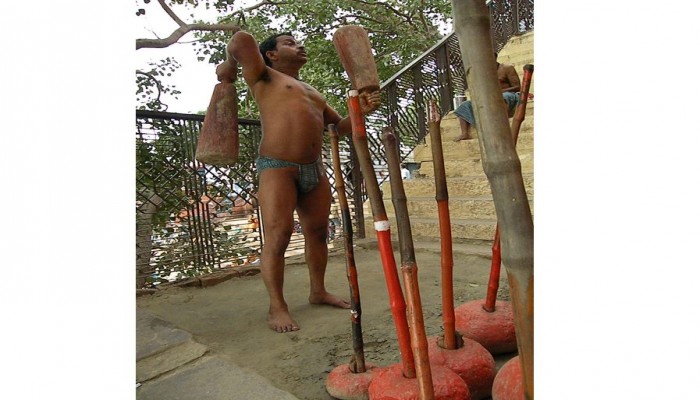
‘Dangal’ has been considered as a one of the most phenomenal, awe-inspiring movies in the history of Bollywood. Undoubtedly, the story had a captivating novelty, but the all-encompassing theme which the movie touched upon is just a short glimpse of a long, unveiled or at least not so well known history of art of wrestling performed in the historical landscape called ‘akahadas’. ‘Akhadas’ emerged as a unit of ‘mathas’ established by Adi Shankaracharya, an 8th century Hindu philosopher during a crucial time in Indian history when an intense need was felt to reawaken and reunite Sanatan dharma and its various sects. Adi Shankaracharya reformed a system of akhadas in order to organize the social and cultural tradition of dharma by calling upon a large number of celibate, bohemian saints, and encouraged them to channelize their physical and spiritual energy for protection of dharma during the time of inner conflicts.[i] Named after the Hindi word ‘akhand’ which means ‘unbroken’ or ‘united’, ‘akhadas’ emerged as one of the strong symbolic representation of unity and power of the upholders of the faith;
‘Kushti’ or wrestling played in these akhadas has been one of the traditional, ancient sports of Hindus. It was established as a main hub for body building and learning the art of attacking the enemy and defending oneself in return. Adi Shankaracharya brought a new life in the community by drawing strength from the vast network of ascetic with a solid spiritual base. Since then these platforms had been an integral part of the cultural canvas of Hindu society However, the root of this art form had been found in ancient India too. The sport has been mentioned in Hindu scriptures like ‘Ramayan’ and ‘Mahabharat’. Hanuman, Bhima, Jarasandha, Duryodhan and Karna are mentioned as one of the greatest wrestlers of that time. It is said that even Goswami Tulsidas, the composer of ‘Ramcharitmanas’ had also established an akahada in Varanasi sometime in the mid-16th century.
The art was not merely known for a grueling training montage; it had a purpose of protection of Dharma. Devotion and self-discipline are two pillars of Hindu life style. Wrestling encouraged certain kind of self-discipline of one’s own body, with the intention of organizing the larger society later. These monks were mostly free beings, minimalist of a kind, who never observed any social norms. Yet, they were able to leverage their devotion and extraordinary discipline and set an example for the common people. In this way akhadas turned to be preserving and reviving ancient Hindu culture, lifestyle and philosophy. The ascetics were encourage to enhance their bodily strength by different types of exercises and were trained to fight like a warrior if some foreign invaders or outsider tried to attack them. These platforms had different names and roots like ‘Avahan akhada’, ‘Atal akhada’. ‘Mahanirvani’, ‘Taponidhi’, ‘Nirmohi’, ‘Panch Naam Avahan’ akhada, ‘Shri Niranjani’, ‘Panchayati akhada’ and several others; each had its own favorite demi Gods, rules, traditions and protocols.
The tradition still continues in several parts of Bharat. The absolutely indigenous ‘AstroTurf’ of akhadas is prepared in a very unique way adding all sorts of exotic ingredients like ghee (clarified butter), buttermilk, mustard oil, a distinct kind of clay called Multani mitti (fuller’s earth), sandal dust, flower petals turmeric that together not only enhances the anti-bacterial properties of the mud but also gives the sacred space a smooth texture which facilitates the sports in multiple ways. It involves lot of intricate movements to gain control over the opponent’s body. All the men are clad in what is locally known as a langot, or an inner wear.
If one closely observes, each small ritual, be it smearing of the face and body with the soil of the akhada right before beginning all sessions, or be it offering prayers to their respective Gods, or even refraining from liquor, smoking, and sour food, everything abounds with and is ingrained in Hindu ideology of seeking treating one’s body as a temple which has to be nurtured and trained to achieve a higher purpose. They aim to live a pure life, building strength and honing the wrestling skills when needed.
The system of keeping one’s body healthy is immensely organic and earthy way. As a sports it is full of vigor and vitality, it exhorts people to come forward and learn the technique of challenging the opponent. The basic idea is to encourage physical strength as a form of worship with a divine purpose. The training of these wrestlers is rigorous, which involves strict diet and body training regime. It includes knee squats, push-ups, pull-ups, and stretches, miles of running, regular oil massage is followed to keep the body supple.
Some cities of U.P like Allahabad, Varanasi, and Haridwar have still kept the tradition of akhadas alive. It is still practiced in several other states of Bharat like Haryana, Punjab, Maharashtra, Karnataka, and Kerala. It remaining strongly anchored in the spirituality, akhadas are like temples of Bharat where wrestling is practiced as a way of living. Despite the glorified history and usefulness, akhadas are slowly losing popularity with the advent of mechanized life style. There is little hope for its revival! But you never know when the history begins to unwind itself, after all evolution is so very cyclic in spirit according to the spirit of Hindu dharma.
References-
Peabody, Norbert. Comparative Studies in Society and History, Vol. 51, No. 2 (Apr., 2009), pp. 372-400 Published by: Cambridge University Press.
Image Credits: By Paratha Sarathi Sahana - https://www.flickr.com/photos/22853208@N05/5111513681/sizes/l/in/photostream/, CC BY 2.0, https://commons.wikimedia.org/w/index.php?curid=17231049
[i] Shambhunath Tripathi
Hindustan Samachar. Special feature on Kumbh parv. Magazine by Bahubhashi Samvad Samiti.
Publisher-- @CVI Chinta mani Road, Allahabad, UP, India, 2010.



 Loading...please wait
Comments