




The Hindutva Paradigm Integral Humanism and the Quest for a Non-Western Worldview
- In Book Reviews
- 12:29 PM, Feb 25, 2025
- Richa Yadav
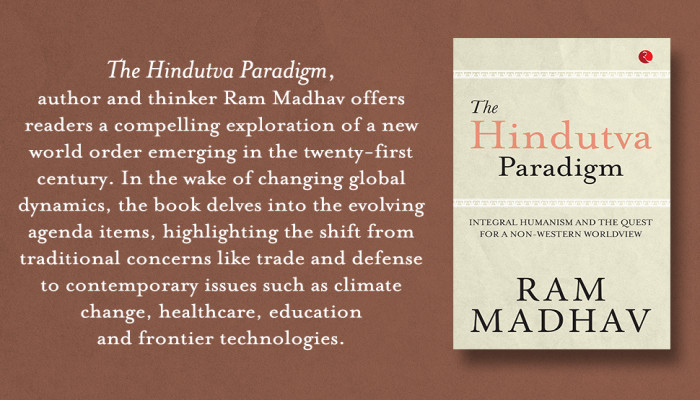
‘Hindutva’ is a form of extremism or the core tenet of a Hindu philosophy that envisions the world as one family inquires Ram Madhav in The Hindutva Paradigm Integral Humanism and the Quest for a Non-Western Worldview
During my recent travels across three continents, this book was my constant companion. I admit that I occasionally hesitated to display it publicly, and this thought of being judged as overly religious, right-wing, or bigoted did flash my mind. However, this didn't deter me from reading it whenever I had the chance. I continued reading it as a ‘constantly cautious public reader’ until I saw a fellow companion reading ‘Hidden Hindu’ during the last leg of my journey. I had a sigh of relief. Times have changed; I smirked as my eyes met with the other reader.
Reading this 2021 publication in 2025 on Hindutva cannot be timelier than now, as it coincides with the RSS's centenary this year.
Few authors possess the breadth of vision to synthesise global observations into a compelling and thought-provoking worldview. Dr. Ram Madhav's book is a welcome surprise in this regard. His writing is remarkably unbiased and appeals to both academic and intellectual audiences. In this book, he provides an in-depth, comparative analysis of major political philosophies over the past two centuries, contrasting non-Western perspectives such as Socialism, Communism, Liberalism and Capitalism with the concept of Hindutva. His analysis is framed within the context of Deen Dayal Upadhyay's integral humanism, a philosophy he introduced in four lectures in 1965 but was unable to develop due to his untimely death in 1968.
Deen Dayal Upadhyay was one of the founding ideologues of the Hindu nationalist political movement that came to be known as Bharatiya Jana Sangh. Later on, it became known as BJP.
Ram Madhav points out that each of these ideologies encountered significant problems when put into practice. Concepts like freedom, liberty and democracy were both embraced and undermined under the banner of liberal democratic nationalism. Even the definition of nationalism itself has shifted- oscillating between the liberal ideals of the Enlightenment (freedom, rule of law, human rights) and more exclusive forms like sectoral patriotism, illiberal or ethnic nationalism. The author notes that the post-World War II era saw the decline of liberal nationalism, its place taken by fascist regimes in Western Europe and communism in Eastern Europe, both of which ultimately proved oppressive and destructive.
Then multiculturalism and globalisation surfaced on the world’s political stage in the latter half of the 20th century, writes Ram Madhav tracing world history. Globalisation did help narrow the gap between developed and developing countries and helped many countries rise faster. (pg.18) Despite earlier predictions, nationalism has returned in the 21st century, (albeit in a more moderate form) as countries are happy to explore international connections but do not want to give up on their own cultural identities and traditions.
While the global stage was undergoing such ideological churnings in the mid-twentieth century, India was rising as an independent country and deciding on the best course to move ahead on the path of progress. The central question was whether the country should encompass the modern Western paradigm of progress or revive its ancient civilisational wealth for guidance. Gandhian and Nehruvian ideas emerged as two different schools of thought, two different developmental models for free India, where Gandhi was tilted towards Indian spiritual and religious values, Nehru leaned more toward a socialist model influenced by Western thought.
This period saw a growing need for an alternative philosophy rooted in Indian wisdom and ingenuity. Leaders within the RSS along with Bharatiya Jana Sangh were discussing their concepts of nationalism centered on the vision of a Hindu Rashtra. Against this backdrop, Deen Dayal Upadhyay began articulating his vision and philosophy for the Jana Sangh, emphasising the foundational principles of India's life and culture.
Deen Dayal Upadhyay began developing a structured ideological framework for the RSS movement started in 1925. His integral philosophy revolved around man, society, nature and the divine. He advocated that the “all-encompassing idea of Dharma” should be the basis for universal good. Being an idealist at the core, Deen Dayal always insisted on value-based, principled politics conducted in the national interest, writes the author. However, as the circumstances developed, he realised the need to integrate different parties; his pragmatism gave way to the emergence of an alliance of different parties to promote non-Congress alternatives to the country.
In this book, Ram Madhav effectively develops Deen Dayal's concept of Hindu nationalism as presented in 1965 through a series of four lectures as a guiding principle for party politics. He clarifies that Deen Dayal's ideas, while rooted in ancient Hindu values, wisdom from Indian scriptures, and traditions, were not limited to any one religion. Going beyond religion, it represented the core of Bharat. “Deen Dayal’s integral humanism proposed that it is an all-encompassing idea of Dharma that should be the basis for universal good.” (pg.53)
Deen Dayal was very clear that while carving out our national identity after independence we should not be confused and therefore mix Western science and Western way of life. While science should be accepted, we do not have to ape the Western lifestyle. India should think of sharing its own wisdom instead of merely following the West. True independence means living by one's own culture. Therefore, from both a national and humanist perspective, we should embrace our Bharatiya culture.
Ram Madhav’s scholarly book articulates some key principles given by Deen Dayal. Firstly, we should look upon life as an integrated whole and we should know that diversity of life is merely an expression of internal unity. Secondly, we need to understand Dharma from the right perspective; an individual is made of body, mind, intellect and soul. They are integral and not separate; together they form the basis of human existence. The body serves as an instrument for fulfilling one's Dharma, and each element is essential for human progress. Thirdly, our Bharatiya essence of society is that it is self-born in a very organic way. (pg.63) Society too has its body, mind, intellect, and soul. Each nation has a soul. It is the core idea that guides the nation.
Deen Dayal referred to this core idea as the ‘Chitti’. (pg. 64) It can work as a guiding force to decide if an action or thought is right or wrong. The strength of Chitti paves the way for a powerful nation. Family, caste, guilds, property, marriage, gurukul, and rishikul - Chitti touches all aspects of life.
In addition, Dharma represents the eternal laws that sustain the Chitti, and as the nation's soul, it transcends all else. It comprises universal and timeless values that guide every facet of societal life. Therefore, a "Dharma Nirapeksha Rajya" (a state indifferent to Dharma) is a contradiction. The state must be guided by Dharma and cannot be indifferent or opposed to it. Finally, Deen Dayal's economic vision advocates using only what nature can replenish, emphasising regulated resource consumption. In essence, all rules and policies should prioritise human happiness, not capital or the state.
The chapter on ‘Rashtram: The Indian Concept of Nationhood’ investigates the deep philosophical foundations of Bharat. A strong proponent of Hindutva, the author candidly states that while the West offers models and solutions through ideologies like Socialism, Communism, Liberalism and Capitalism, India has historically been a source of profound ideas aimed at the betterment of humanity.
Ram Madhav specifies that Hinduism or Hindu and Hindutva are not different concepts. He has strongly contested the argument that “Hindutva” and “Hinduism” need to be seen separately, as both are the philosophical and practical sides of the same idea. We always believed in the Sanatana and the ancient value system of this country which we exposed as Hindutva.
Notably, in an interview Ram Madhav said that ‘Bharteeyata,’ and the fashionable word ‘Indic’ are all equivalent to Hindu as all refer to our scriptural knowledge; they are all wedded to the same core, ancient, philosophical value system of this country. It does not refer to any ‘ism’ or ideology; unlike any isms or ideologies it's not a closed framework but the most liberal, open and inclusive idea of Hindu philosophy!
The West has a very distorted, mutually contradictory understanding of great ideas like liberalism as it leads to fascist thinking rather than anything else. The author transcends mere political discourse, positioning Hindutva beyond the confines of an ideology. Instead, he presents it as a profound idea that deserves global academic recognition as a paradigm shift we need to be aware of and stick to. In this book, Dr. Madhav argues that Hindutva, or Hinduness, is an integral and humanist philosophy, characterised by its continuous evolution, openness and inclusivity.
What should be the basis of nationalism? Common language, ethnicity, kinship, territory, or religion? Deen Dayal identified four elements that constitute a nation- land and people, their aspirations and collective will, Dharma as rules to guide them, and the common ideal of life of the people. There needs to be a sentiment that binds all the people. “According to his concept, nation is a spirit, a feeling, and an emotion.” (pg. 116) it can be coined as ‘Rashtram’ the Indian concept of nationhood. The concept of national soul which Deen Dayal described as Chitti is unique to India and this soul manifests in Rashtram, forming the core of national identity as it is an ethical and spiritual concept.
While Madhav’s political allegiance is evident from the content of the book. His contribution lies in presenting the deeply philosophical ideas of Deen Dayal Upadhyay to the world with the reason and emotion behind it. The scholarship of the book is unparalleled as it not only gives a critical analysis of the world’s major political ideologies but also meticulously quotes the relevant literature to corroborate his arguments. This book can be a starting point for many other books to be written in future on the same lines.
Be it nature, family, interpersonal relationships, education, or economic pursuits- Hindu Dharma offers unique perspectives on each but as an integral whole. This is an opportune time for more writers to explore Indic thought and contribute to a transformation of academic discourse on Hindu Dharma. “The Hindutva Paradigm” may be considered as one of the foundational texts, potentially sparking deeper investigation into the development of Hindutva thought as a paradigm on the world stage. Hindutva should not be seen as an ideology but as a dynamic and evolving concept ripe for further exploration. It is a broad set of ideas and invites more work to be presented in the future in writing.
Such works should be encouraged, as they provide insight into how the "Hindu" spirit is a constantly evolving concept and not merely a buzzword used by fanatics. Ram Madhav’s work invites us to reevaluate our understanding of Hindutva. Whether one agrees or disagrees with its tenets, the book serves as a catalyst for further dialogues, reflections and scholarly engagements.
In summary, Ram Madhav’s endeavour to elevate Hindutva beyond mere ideology into a profound idea deserves attention. He seamlessly blends ancient wisdom with the contemporary challenges of the twenty-first century. Regardless of one's agreement or disagreement with its principles, the book serves as a valuable starting point for thoughtful debates and reflection. The detailed bibliography in the end is noteworthy for future scholars.
Ram Madhav has been a member of the national executive of the RSS and the national general secretary of the BJP. He has also been associated with the India Foundation and has authored several books like “Uneasy Neighbours India and China After 50 Years of The War”, “Because India Comes First: Reflections on Nationalism”, “Identity and Culture, Partitioned Freedom,” to name a few.
Disclaimer: The opinions expressed within this article are the personal opinions of the author. MyIndMakers is not responsible for the accuracy, completeness, suitability, or validity of any information on this article. All information is provided on an as-is basis. The information, facts or opinions appearing in the article do not reflect the views of MyindMakers and it does not assume any responsibility or liability for the same.



 Loading...please wait
Comments