



The Gulf’s New Gravity: MBZ’s Pivot to India
- In Foreign Policy
- 05:06 PM, Jan 25, 2026
- Ramaharitha Pusarla
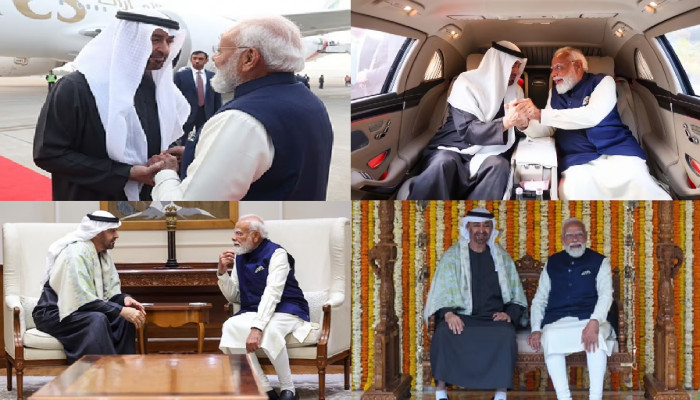
As geopolitical turbulence and a fluid world order continue to threaten the rules-based order, the deepening strategic partnership between India and the UAE has piqued analysts' interest. The extremely short, last-minute visit by UAE President Mohammed bin Zayed Al Nahyan, widely known as MBZ, has drawn attention to the brewing rivalry among the Arab states. Oftentimes, whirlwind visits without prior official buzz hint at an unstated strategic urgency.
Every minutia of this extremely short visit signalled a strategic clarity. Accompanied by a high-powered delegation comprising members of the Royal families of Abu Dhabi and Dubai, several ministers and officials, MBZ arrived in India. As a special gesture, PM Modi received the President at the airport, and both leaders travelled together to 7 Lok Kalyan Marg for extensive restricted talks on bilateral, regional and global issues. Seemingly unplanned, the expansive list of outcomes of the three-hour visit showcased the great deal of preparation by both countries in evolving a framework of cooperative partnership that has blended into synergism.
MBZ is seeking to strengthen the Comprehensive Strategic Partnership with India at a time when the fissures between the two Arab nations-UAE and Saudi Arabia, are widening. United in their pursuits to diversify their oil-dependent economies, the UAE and Saudi Arabia, both US allies, have strongly opposed the rise of the Muslim Brotherhood in Egypt in the aftermath of the Arab Spring. They even jointly spearheaded the collective boycott of Qatar for its ties with the Muslim Brotherhood. Indeed, MBZ handled the American scrutiny against Saudi over the reports of MBS's involvement in Jamal Khashoggi’s assassination.
Though committed to the Palestinian cause, motivated by strategic opportunities and regional interests, during Trump’s first regime, the UAE normalised diplomatic ties with Israel through the Abraham Accords in 2020. But around the same time, Saudi Arabia, donning the mantle of the Islamic leadership as the custodian of Mecca and Medina, hesitated to establish ties with Israel. This reluctance has turned into a formal rejection of ties with Israel until the creation of an independent Palestinian state, post 10/7 Hamas terror attack. In the recent past, hardening its stance, Riyadh has adopted an adversarial tone towards Israel.
Amid rising Israel-Iran rivalry, Washington’s retrenchment and Trump’s transactionalism have drastically altered the regional security architecture. The uncertainty over security guarantees to the traditional allies and the eroding trust have forced countries to diversify their security portfolio. Given American unreliability, days after Israel’s attack on the Hamas negotiating team in Qatar, Saudi Arabia and Pakistan signed a Strategic Mutual Defence Agreement (SMDA). Modelled along the lines of NATO’s Article 5, where any aggression against one country is treated as an attack on both, the countries solidified longstanding strategic ties into a defence framework. Though the agreement had no explicit mention of nuclear cooperation and Pakistan hasn’t formally offered nuclear deterrence, Saudi Arabia has clarified, “this is a comprehensive defensive agreement that encompasses all military means”, implying that a nuclear shield would be extended to Riyadh.
Amid serious concerns about America’s commitment to NATO under Trump, Turkey, a NATO member with the second-largest military, has entered into talks with Saudi Arabia and Pakistan for a defence alliance. Abetting the speculations of a plausible “Islamic NATO”, Pakistan signalled potential expansion of the defence partnership, citing ‘Zionist threat’ and volatility in South Asia. Operation Sindoor has exposed the deepening military cooperation between Pakistan and Turkey. A veritable Islamic axis is emerging between Pakistan, Saudi Arabia, and Turkey, at a time when two parallel currents, those of Saudi Arabia and the UAE, are steadily diverging.
Since the intervening years of forging diplomatic ties with Israel, the bilateral relations between the UAE and Saudi Arabia ruptured, with both countries finding themselves on opposite sides. In a bid to counter political Islam and secure the maritime routes, the UAE began extending support to the dissent factions in Yemen, Sudan and Somalia, all bordering Saudi Arabia and lying along the Bab-el-Mandeb Straits. Initially, coalition partners, the UAE and Saudi Arabia, militarily intervened to stall the takeover of Yemen by Houthi rebels in 2015 and helped restore the internationally recognised government of President Mansour Hadi. But both countries soon parted ways over the UAE's perception of the dominant party of the Yemeni government Islah Party’s close affiliation with the Muslim Brotherhood. The UAE designated the Muslim Brotherhood as a terrorist organisation in 2014.
Soon UAE began training Yemeni fighters in the southern territories, boosting their secessionist struggle. Post 2019, the UAE diverted its military support to the Southern Territorial Council (STC), a group that existed before its unification with the north. Pursuing the vision of expanding maritime footprint to position itself as a global commercial hub, the UAE has been securing ports, constructing airstrips and logistical infrastructure across the Red Sea and the Horn of Africa. UAE backed the STC to increase its maritime presence in Southern Yemen, especially in al-Mahra, which has direct access to the Indian Ocean. Saudi Arabia wanted to build an oil pipeline from its eastern province through al-Mahra to reduce dependence on the Straits of Hormuz chokepoint.
STC’s takeover of al-Mahra and Hadramawt has intensified the Saudi-Emirati rift as both contested for influence over maritime routes across the Red Sea. Dominating the Red Sea has been an integral part of Mohammed bin Salman’s ambitious Vision 2030. While the UAE is backing armed proxies, the Rapid Support Forces (RSF) in Sudan and the Sudanese Armed Forces (SAF) in Somalia, to securitise ports and its economic investments in this crucial region, Saudi Arabia is resorting to financial leverage and coalition-building.
Conflict between Arab states spilled into the open with Saudi airstrikes on Mukkalla seaport targeting the transfer of weapons from the UAE to STC. Saudi Arabia accused the UAE of arming the STC, reportedly carrying out military operations along its Southern border. Riyadh termed it a national security threat and a ‘red line’. With immediate effect, Saudi-allied Yemen’s Presidential Leadership Council (PLC) issued a decree suspending the joint defence agreement with the UAE and demanded the withdrawal of forces within 24 hours. Indeed, Riyadh's hard stance against the UAE and strikes were prompted by Israel’s recognition of Somaliland on December 26. While the Arab League strongly condemned this move, the UAE didn’t issue any condemnation.
UAE’s silence implied a tacit alignment with Israel. Arab states perceived the recognition of proxy forces or parallel entities as a threat to their sovereignty, and diplomatic recognition of such forces could embolden secessionists. The ongoing churn in the Middle East and the contest for maritime influence eventually shaped the rise of two axes- steered by Saudi Arabia and the UAE.
Speculations of Turkey joining the Saudi Arabia-Pakistan alliance might invariably turn it into an ideological Islamic axis. Aligning with Saudi Arabia against the UAE, Egypt, Sudan and Somalia are now coalescing with this ideological axis. On the otherhand, the UAE is building a coalition driven by strategic interests and common threats.
Abrahamic Accords of 2020 heralded a new shift in the UAE’s policy away from conflict towards diversification, economic and security integration. In 2021, the UAE established a multi-dimensional trilateral with Greece in Cyprus. Around the same period, the UAE joined I2U2, also known as Western Quad, a strategic partnership between India, Israel and the US. This engagement was further strengthened under the aegis of IMEC (India Middle East European Economic Cooperation), launched in 2023. UAE’s pragmatic restructuring of strategic partnerships has set it apart from its Arab-Islamic peer nations.
While news of SMDA has been buzzing, Israel, Cyprus and Greece have signed a trilateral military cooperation plan on Dec 28, 2025, to counter expanding Turkey’s footprint in the Mediterranean region. In response, Turkey moved to join SMDA. Reportedly, India has received a formal invitation to join the 3+1 format, triggering the rise of a ‘Mediterranean Quad’. MBZ’s India visit is an attempt to bolster its strategic autonomy in the face of global uncertainty and regional turbulences.
The 13th High-Level Task Force on Investments meeting in September 2025, the 16th India-UAE Joint Commission, and the 5th Strategic Dialogue engagement in December 2025 indeed laid the ground for the visit. ‘Trumpnomics’ tore apart the fragile global economic architecture. Developing nations, which are facing the rough end of the stick, are strategically recalibrating their trade and economic ties to mitigate the effect. As a full-term member of BRICS, the UAE is swiftly diversifying its foreign ties and aligning with dedollarisation by prioritising trade in national currencies. Being economically consequential, strategically autonomous and non-intrusive, India has emerged as an epitome of multipolarity. Direct talks between the leaders is attempt to infuse a new level of confidence with both countries seeking to consolidate multi-faceted cooperation.
Over the past decade, PM Modi has invested diplomatic capital to reshape and promote ties with the Gulf region, especially Emiratis. Along with strengthening the legendary bilateral and security pillars with the signing of a Letter of Intent (LoI) for Strategic Defence Partnership, countries are seeking to partner in defence innovation, defence industrial cooperation, and training between special forces in interoperability, cyberspace, counter terrorism. Countries registered $100 billion in bilateral trade through the Comprehensive Economic Partnership Agreement (CEPA) signed in 2022. Buoyed by the progress, leaders set a new trade target of $200 billion by 2032. The UAE is currently India’s third-largest trade partner and seventh-largest investment partner with a cumulative FDI of $22.84 billion. Strengthening the Bilateral Investment Treaty (BIT) signed in 2024, the UAE is seeking to partner in the development of the Special Investment Region in Dholera, which includes an international airport, a pilot training centre, a Maintenance, Repair, Overhaul (MRO) facility, a green field port, an urban township, rail connectivity and energy infrastructure.
As a testimony to growing trust and keenness to collaborate on AI and emerging technologies, countries are set to explore an interesting concept of Digital Embassy- protecting the most critical data of national and strategic importance in another territory to safeguard it from potential cyberattacks under mutually recognised sovereignty agreements. To secure India’s energy front, HPCL and Abu Dhabi National Oil Company Gas (ADNOC) signed a 10-year agreement for the supply of 0.5 million tonnes of LNG starting in 2028. Boosting financial and logistics cooperation, UAE companies- DP World and First Abu Dhabi Bank will now open offices in GIFT City. For settlement of trade in national currencies and reducing reliance on the US dollar, India and the UAE are operationalising the Local Currency Settlement System (LCSS), interlinking payment platforms and through UPI and Jaywan Card.
Countries signed an MoU on food security, space cooperation, and polar expeditions, and firmed up educational linkages by building offshore campuses and integrating Digital Locker and UAE platforms for seamless authentication of Indian degrees. Leaders expressed keen interest in exploring opportunities for nuclear cooperation under the Sustainable Harnessing and Advancement of Nuclear Energy for Transforming India (SHANTI) bill, including deployment of large nuclear reactors and Small Modular Reactors (SMR). The UAE has offered to provide historical artefacts for the National Maritime Heritage Complex at Lothal and establish India House in Abu Dhabi.
Geopolitical turbulence is not an understatement in contemporary times, but an inexorable reality. No region is insulated from this geopolitical churn. Instead of waiting for a crisis to unfold and then respond, in the face of shifting power dynamics, growing uncertainties, and the unreliability of external superpower security guarantees, MBZ made a quick visit to India for direct interaction to formalise a framework for long-term cooperation. Amid the geopolitical churn, India has emerged as an anchor of stability. Seeking stability, prioritising national interests, MBZ sought to personally invoke underlying mutual trust and respect to realign and reorient the partnership to tide through the geopolitical flux.
MBZ’s visit reinforces India’s steady rise as a reliable strategic partner of the Middle East, specifically the UAE. Pursuing an independent foreign policy shaped by multilateralism and strategic autonomy, the UAE has naturally drifted towards New Delhi, which is uncompromisingly safeguarding its strategic autonomy amid the headwinds of global uncertainties.
References
- List of Outcomes: Visit of His Highness Sheikh Mohamed bin Zayed Al Nahyan, President of UAE to India (January 19, 2026)
- UAE-India could sign multimillion dollar arms deal with deadly BrahMos missile at centre; Pakistan gets small donation
- Pakistan Floats Expansion Of Defence Pact With Saudi Arabia To Include Wider Islamic World | World News - News18
- Pakistan Floats Expansion Of Defence Pact With Saudi Arabia To Include Wider Islamic World | World News - News18
- Joint Statement: Visit of President of the UAE, His Highness Sheikh Mohamed bin Zayed Al Nahyan, to India (January 19, 2026)
Disclaimer: The opinions expressed within this article are the personal opinions of the author. MyIndMakers is not responsible for the accuracy, completeness, suitability, or validity of any information on this article. All information is provided on an as-is basis. The information, facts or opinions appearing in the article do not reflect the views of MyindMakers and it does not assume any responsibility or liability for the same.



 Loading...please wait
Comments