




The Gujarat Language Model: How a State Turned the Three-Language Formula into Practice
- In Current Affairs
- 01:56 PM, Aug 12, 2026
- Avinash Brahmbhatt
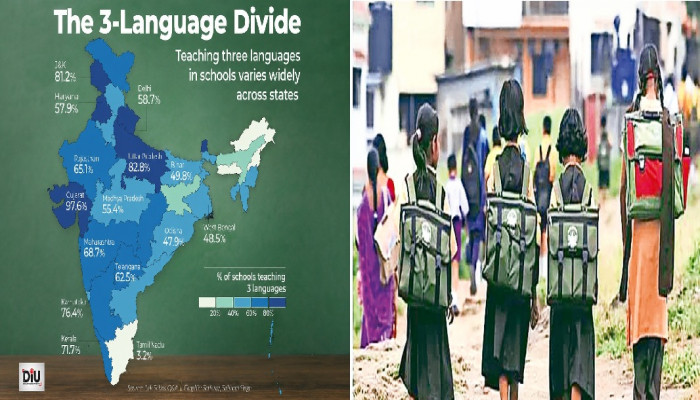
From Narendra Modi’s early education reforms to making Gujarati compulsory across school boards, Gujarat has built a model in which 97.6% of its schools offer students three languages, preserving their linguistic roots while opening doors to national and global opportunities.
India has debated the Three-Language Formula for decades. In some states it remains politically contentious. Yet the gap between accepting the idea and actually putting it into classrooms remains wide.
According to Unified District Information System for Education Plus (UDISE+) 2023–24 data placed before the Lok Sabha, 61.6% of Indian schools offer three languages. The same data shows that Gujarat stands at 97.6%, i.e. 52,357 schools, with 97.6% of the state's students enrolled in schools offering three languages. That is the highest school-level coverage reported among states and union territories.
An Old Idea, Unevenly Implemented
The Three-Language Formula is much older than the present political debate. It evolved through national consultations in the 1950s (Indian Kanoon) and 1960s (The Nehru Archives), was examined by the Kothari Commission, and received formal national backing in 1968.
In 1968, following the recommendations of the Kothari Commission, Parliament adopted a resolution on the National Policy on Education that gave formal national backing to the Three-Language Formula. It envisaged Hindi-speaking states teaching Hindi, English and another Indian language, preferably one from southern India, while non-Hindi-speaking states were to teach the regional language, Hindi and English (Raj Bhasha). By 1995, 27 states/UTs were officially classified as having adopted the Three-Language Formula. Though this does not mean that 100% of their schools actually taught three languages (The Hindu Archives).
Yet three decades later, only 61.6% of Indian schools actually offer three languages. Gujarat stands at 97.6%.
How did Gujarat get here?
Gujarat did not invent the formula. Its distinction is its implementation. A national aspiration that remained uneven across India was gradually turned into a deeply embedded educational practice in the state.
The Modi Years: Adding Opportunity Without Compromising Identity
When Narendra Modi became Chief Minister in 2001, Gujarat already had a multilingual school framework. His government’s contribution was not to replace Gujarati with English but to strengthen a model in which both could coexist.
This language strategy was supported by a much wider educational push. Shala Praveshotsav, initiated in 2003, sought to expand enrollment, with particular emphasis on bringing girls and out-of-school children into classrooms. A multilingual curriculum means little if children do not enter and remain in the school system in the first place.
During the tenure of Chief Minister Madhavsinh Solanki (1980–85), English was reintroduced in Class V, but as an optional subject, so most students didn’t study it. Modi changed that in 2004, making English exams mandatory in Class 5 across the state (Vibes of India).
The language philosophy became clearer with SCOPE, the Society for Creation of Opportunities through Proficiency in English - established by the Gujarat Government in 2007 under Modi's leadership. SCOPE's official website says it has enrolled more than six lakh candidates (SCOPE, Government of Gujarat).
The clearest school-level intervention came toward the end of Modi's tenure. In 2012, Gujarat decided to advance compulsory English from Class V to the second semester of Class III from the 2013-14 academic year. The important point here is what did not happen: Gujarati was not displaced. English was added earlier to an already multilingual curriculum (The Indian Express).
Taken together, these measures reveal a clear philosophy of multilingual education: adding new linguistic opportunities without displacing the mother tongue.
Gujarat did not treat English as an enemy of Gujarati. Multilingual ability was treated as accumulated human capital: Gujarati for identity and cultural roots, an additional Indian language for wider national communication, and English for higher education, employment and global opportunity.
From Continuity to Universalisation
Successive Gujarat governments under Prime Minister Narendra Modi’s leadership at the centre then expanded this architecture.
Yet one gap remained: while Gujarati was firmly embedded in Gujarat Board schools, it was not necessarily taught in schools affiliated with CBSE, ICSE, IB and other boards, particularly English-medium institutions. The Gujarat High Court later recorded the state's concern that some such schools taught English, Hindi and even foreign languages while Gujarati was absent, leaving children studying in Gujarat without systematic instruction in the state's own language (Indian Kanoon).
The Vijay Rupani government moved decisively on this gap through a Government Resolution dated 13 April 2018 (The Times of India). Gujarati was made mandatory in non-Gujarati-medium schools in a phased manner, beginning with Standards I and II and progressively extending to Standard VIII. The requirement was also connected to the NOCs issued to schools seeking affiliation with other boards (Indian Kanoon).
Therefore, Gujarati was no longer protected merely because it dominated Gujarat Board schooling. The principle now was that choosing an English-medium, CBSE, ICSE or international education should not require a child in Gujarat to lose formal exposure to Gujarati.
In 2023, Chief Minister Bhupendra Patel gave this principle statutory teeth through the Gujarat Compulsory Teaching and Learning of Gujarati Language Act, 2023. (The Hindu) The law requires Gujarati to be taught as an additional compulsory language in elementary schools across Gujarat, including private schools, minority institutions and schools affiliated with other boards (Gujarat Act No. 4 of 2023).
The Gujarat Model and the Philosophy of NEP 2020
Gujarat's experience also offers an interesting point of comparison with the multilingual philosophy of the National Education Policy (NEP) 2020. While both the 1968 Three-Language Formula and NEP 2020 recognise the value of multilingual education, the approach to implementation has changed significantly. What has transformed is merely the governance philosophy. Though, many have simply failed to acknowledge the Prime Minister’s contribution to this transformation.
The 1968 policy was more about imposition, particularly in non-Hindi-speaking states, Hindi + English + regional language. It was politically centralised and coercive.
NEP 2020, under Prime Minister Modi, retains the objective of multilingual education but does it differently. No language will be imposed, States decide implementation, students can choose languages, at least two languages should be Indian, with flexibility in interpretation.
That is an important distinction. The lesson from Gujarat is not that every state must teach the same three languages. Rather, it demonstrates that multilingual education can strengthen cultural identity without becoming linguistically coercive, and that protecting a regional language need not come at the cost of English proficiency or an acceptance of a global outlook.
Roots, Reach and Opportunity
Gujarat has created institutional conditions and an ecosystem in which almost every schoolchild encounters multiple languages while the expansion of English-medium and national-board education has not been allowed to push Gujarati entirely out of the classroom.
For too long, India's language debate has been framed as a choice between regional identity and global aspirations. Gujarat's experience suggests another possibility:
Gujarati for roots
An Indian language for reach
English for possibilities
Narendra Modi may not have invented Gujarat’s Three-Language Formula. But his contribution was to deepen the educational ecosystem around multilingual capability and successive Gujarat governments widened its reach ultimately providing Gujarati statutory protection.
Even as language politics and contentions around the three-language formula continue to dominate the political discourse even today, Gujarat has shown the way on how to make it work practically keeping regional identity, national integration and global interests together.
References
https://sansad.in/getFile/loksabhaquestions/annex/184/AU3785_CrYSEV.pdf?source=pqals
https://indiankanoon.org/doc/96281/?type=print
https://rajbhasha.gov.in/en/official-language-resolution-1968
https://www.librarydrdl.com/pdf/newspaper/Third%20Language%2C%20THE%20HINDU%2003.04.2025.pdf
https://scope.gujgov.edu.in/AboutUs/CEPTViews
https://indianexpress.com/article/cities/ahmedabad/english-to-be-made-compulsory-from-class-iii/
https://indiankanoon.org/doc/54244447/
https://prsindia.org/files/bills_acts/acts_states/gujarat/2023/Actno4of2023Gujarat.pdf


 Loading...please wait
Comments