




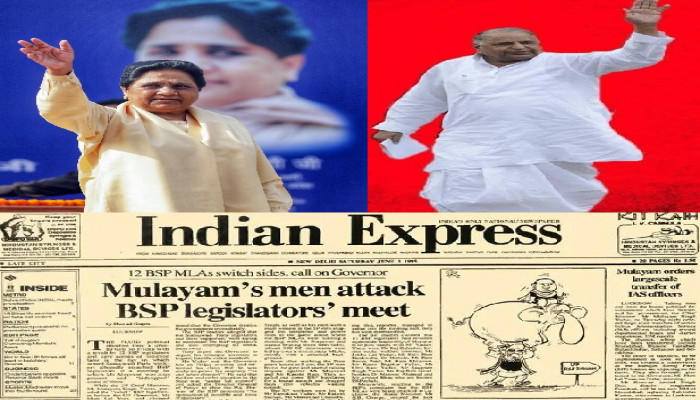
Moments in democratic politics crystallise, with brutal clarity, the true nature of the forces contending for power. The Lucknow Guest House incident of June 2, 1995, was such a moment for Uttar Pradesh. What happened at the State Guest House on that summer afternoon a sitting minister and BSP leader besieged in a government building by a violent mob of Samajwadi Party workers, rescued ultimately by BJP legislators who responded to her call for help was not a random episode of political violence. It was a revelation: a glimpse of the raw coercive logic beneath the SP's rhetoric of social justice and socialist solidarity, and a demonstration that, in the struggle for power in UP, the Bahujan Samaj Party and its leader would have to chart their own course or be destroyed.
The Political Context: Growing BSP Assertion and SP Anxiety
By early 1995, the SP-BSP arrangement that had brought Mulayam Singh Yadav back to power in November 1993 was under severe strain. The BSP under Kanshi Ram had entered the alliance on the explicit understanding that it would be a partnership of equals, that BSP workers would receive their share of government patronage, that BSP ministers would be treated with respect, and that the alliance would eventually produce a power-sharing formula that gave the BSP its proportionate share of governmental authority.
None of these expectations had been met. The Mulayam Singh government functioned as an SP government with BSP toleration rather than a genuine coalition. BSP ministers found their decisions second-guessed by SP bureaucrats; BSP workers complained that Yadav networks monopolised government contracts and administrative postings; and Mulayam Singh's government showed no inclination to honour any informal power-sharing arrangements discussed during the alliance's formation.
From Mulayam's perspective, the BSP's growing organisational independence was more threatening. Kanshi Ram and Mayawati were not content to remain permanently subordinate partners; they were building their own organisational presence in constituencies where the BSP had previously been weak, poaching voters from communities that the SP considered its own, and signalling through their public statements that the alliance was a tactical arrangement rather than a permanent merger. The SP responded by escalating pressure on the BSP through administrative harassment, police action against BSP workers, and ultimately the physical intimidation of BSP leadership.
June 2, 1995: The Attack
Mayawati had called a meeting of BSP legislators, workers, and supporters at the State Guest House in Lucknow on June 2 to discuss the alliance's future and the BSP's organisational situation. The meeting was a routine political gathering that any party in a coalition government might hold. What was not routine was the SP leadership's response, which apparently used the occasion to deliver a physical warning to Mayawati about the consequences of BSP independence.
A large mob of SP workers and associated elements, estimated by eyewitnesses at several hundred, surrounded the Guest House and began attempting to force their way in. The state police, whose neutrality had been comprehensively compromised by Mulayam Singh's politicisation of the force, did nothing to disperse the mob or protect the Guest House's occupants. Mayawati and her supporters were effectively trapped, with a violent mob outside and an unresponsive police force that appeared to be facilitating rather than preventing the attack.
At this point, Mayawati called BJP legislators, and that call became one of the defining moments of UP's political history. The BJP's response was immediate: a group of BJP MLAs, led by senior leaders, arrived at the Guest House and physically interposed themselves between the mob and Mayawati, escorting her to safety. Confronted by BJP legislators whose presence would have created a major political incident if violence occurred, the SP mob backed down.
The Immediate Political Consequences: Mayawati as Chief Minister
The Guest House incident destroyed the SP-BSP alliance comprehensively and permanently. The BSP withdrew its support from the Mulayam Singh government, which fell. In the political manoeuvring that followed, the BJP extended support to the BSP to form a government, and Mayawati became Chief Minister of Uttar Pradesh for the first time on June 3, 1995, literally the day after the Guest House attack.
The symbolism was extraordinary, and the political message was unmistakable. The party that the secular establishment described as the great enemy of Dalit welfare had just rescued the Dalit community's most prominent leader from physical attack by the nominally pro-Dalit socialist party, and was now supporting that leader's elevation to the Chief Ministership. Whatever the BJP's motivations — including the straightforward political calculation that a BSP government dependent on BJP support would be more tractable than an SP government hostile to BJP interests — the practical consequence was the installation of the first Dalit Chief Minister in UP's history.
Mayawati's first Chief Ministership lasted only 137 days, ending in October 1995 when the BJP withdrew support. But its significance lay not in its duration, but in what it demonstrated: a Scheduled Caste woman from Bundelkhand, the daughter of a government clerk, governing India's most populous state from the Chief Minister's chair. For millions of Dalit families across UP, this was not a political event but a civilisational moment, proof that the Constitution's promise of equality was not entirely aspirational.
The Pattern Repeats: 1997 and the Rotational Government
The SP-BSP-BJP triangle that had produced the 1995 arrangement played out again in 1996-97 with similar dynamics. The 1996 elections produced a hung assembly; after a period of political negotiation, the BJP and BSP agreed to a rotational government arrangement in which each party would serve as Chief Minister for a fixed period with the support of the other. Mayawati served as Chief Minister from March to September 1997; the BJP's Kalyan Singh then took over.
The rotational arrangement was, even by UP's baroque standards of coalition politics, an unusual experiment. It worked imperfectly: each party spent much of its tenure in government trying to strengthen its own organisational position rather than govern effectively, but it showed that BJP-BSP cooperation was not a one-time aberration but a recurring political logic rooted in their shared interest in containing SP dominance.
Mayawati's 1997 tenure, brief as it was, established several important precedents for her subsequent, more substantial Chief Ministerships. Her emphasis on the transfer of police officers who had been complicit in atrocities against Dalits, her symbolic gestures of Ambedkarite cultural assertion, the renaming of towns and districts after Dalit icons, the construction of Ambedkar parks and statues and her aggressive use of state power to signal the change in the political hierarchy all defined the BSP's governing identity. Whether these measures constituted genuine governance reform or primarily symbolic politics is a question that UP's voters would eventually answer at the ballot box.
Long-Term Consequences: The SP-BSP Enmity and UP's Political Fragmentation
The Guest House incident and its aftermath institutionalised a fierce SP-BSP enmity that would shape UP politics for the next two decades. The BSP's narrative of the incident — that the SP had attempted to destroy the BSP's leadership physically and was willing to use state violence against Dalit political assertion became a foundational element of the party's political identity. For BSP workers and supporters, the Guest House was not a historical event but a living wound: evidence that the SP's socialist rhetoric concealed a deep hostility to genuine Dalit political empowerment.
For UP voters as a whole, the Guest House incident and the political chaos of the mid-1990s reinforced growing disillusionment with regional parties' capacity to govern. The decade since the Congress's decline had produced the SP's muscular Yadav dominance, the BSP's symbolic Dalit assertion, and the BJP's cultural nationalist mobilisation, but very little actual governance improvement for the ordinary citizen struggling with collapsing law and order, corrupt administration, and stagnant economic development. The political conditions for a more decisive electoral verdict were slowly assembling.
The Rise of Dalit Consciousness: Kanshi Ram, the BSP, and the Shift to Identity Politics Part 15
Disclaimer: The opinions expressed within this article are the personal opinions of the author. MyIndMakers is not responsible for the accuracy, completeness, suitability, or validity of any information on this article. All information is provided on an as-is basis. The information, facts or opinions appearing in the article do not reflect the views of MyindMakers and it does not assume any responsibility or liability for the same.



 Loading...please wait
Comments