




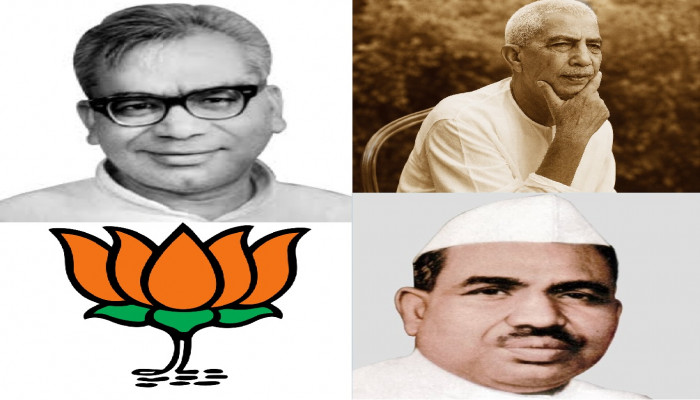
The political landscape of Uttar Pradesh in the three decades following independence was never simply a Congress-versus-everyone-else binary. Between the Congress's dominant centre and the Jana Sangh's nationalist opposition lay a complex and shifting universe of socialist parties, regional movements, peasant organisations, and caste-based formations that collectively constituted the anti-Congress centre-left. Their history of genuine ideological commitment, tactical improvisation, and ultimately fatal internal contradictions is essential to understanding how UP's politics evolved from the Congress-dominant system of the 1950s to the fragmented multiparty competition of the 1990s and beyond.
The Socialist Tradition: Lohia, Ram Manohar, and the UP Connection
The socialist movement in India had deep roots in UP. Ram Manohar Lohia, the most original and combative of India's socialist thinkers, was closely associated with the state, born in Faizabad (now Ayodhya), educated partly at Banaras Hindu University, and politically active across the Hindi belt. Lohia's particular contribution to Indian socialist thought was his insistence that caste was central to any serious project of social transformation. Unlike the mainstream left, which tended to treat caste as a superstructural phenomenon that would dissolve with economic development, Lohia argued that caste was the primary form of social oppression in India and that socialism without caste consciousness was an abstraction.
Lohia's formula that an alliance of the lower OBC castes, Scheduled Castes, women, and the poor could break the Congress's hold on power was theoretically compelling and practically far ahead of its time. In the 1967 elections, his Samyukta Socialist Party participated in the Samyukta Vidhayak Dal (SVD) governments in UP and several other states, demonstrating that anti-Congress coalitions could actually win and govern. But the SVD governments were notoriously unstable, victims of the very contradictions among castes, egos, and ideological traditions that Lohia's analysis had identified but not resolved.
Lohia's death in 1967, at age 57, removed the one figure who combined intellectual authority with personal charisma strong enough to hold the socialist movement together. In his absence, the movement fragmented into competing factions: the Samyukta Socialist Party, the Praja Socialist Party, the Socialist Party of India, and various splinter groups, each claiming his ideological legacy while pursuing its own organisational interests. This fragmentation was not merely a political misfortune; it was a structural feature of a movement that had never fully resolved the tension between its commitment to caste-based mobilisation and its aspiration to a class-based politics.
Charan Singh and the Peasant Politics of the Hindi Belt
The most successful practitioner of anti-Congress politics in UP in the 1960s and 1970s was Charan Singh, a figure whose significance in the political history of northern India is difficult to overstate. Born into a peasant Jat family in western UP, Charan Singh spent his entire career opposing what he saw as the Congress's urban, upper-caste, and industrialist bias. His advocacy for the peasantry for fair agricultural prices, for opposition to land ceilings that he believed would undermine peasant farming, and for the interests of the middle peasant castes that formed the backbone of UP's rural society gave him a mass base that the Jana Sangh, with its primarily urban constituency, could not match.
Charan Singh's political journey took him from the Congress, which he served as Chief Minister of UP in 1967-68 and briefly again in 1970, to the Bharatiya Kranti Dal (BKD), and eventually to the Janata Party and then the Lok Dal. His willingness to repeatedly break with his party organisation rather than compromise his positions on agricultural policy reflected both his personal integrity and the genuine ideological distinctiveness of the peasant politics he represented.
The tension between Charan Singh's peasant nationalism and the Jana Sangh's cultural nationalism defined UP politics in the late 1970s and 1980s. Both were anti-Congress and rooted in the values and concerns of UP's Hindi-speaking majority, but their social bases and policy priorities differed significantly. The Jat and OBC peasant communities that formed Charan Singh's core constituency had complex relationships with the upper-caste trading communities that were the Jana Sangh's primary social base. Finding a formula that could align these constituencies would be the central challenge of anti-Congress coalition politics for the next two decades.
The Janata Experiment: Triumph and Collapse
The Janata Party government of 1977-1979, which brought together the Jana Sangh, Charan Singh's Lok Dal, the Congress (O), the Socialist parties, and Jagjivan Ram's Congress for Democracy, represented the most ambitious attempt to unite the anti-Congress forces under a single organisational roof. In UP, the Janata government under Ram Naresh Yadav (1977-1978) and then Banarsi Das (1978-1979) demonstrated both the possibilities and the limitations of this coalition.
The Janata government in UP, like its central counterpart, was consumed by internal contradictions almost from the beginning. The principal fault line was between the Jana Sangh component, which retained its RSS connection and its cultural nationalist agenda, and the socialist and secular components, which saw the RSS as an authoritarian organisation incompatible with democratic pluralism. The 'dual membership' controversy the demand that Jana Sangh members choose between the Janata Party and the RSS ultimately tore the coalition apart nationally, though in UP the fractures had been visible long before that.
The collapse of the Janata government nationally in 1979, precipitated by Charan Singh's withdrawal of support and his subsequent installation as Prime Minister in a government that lasted only months without facing Parliament, was both a political tragedy and an instructive lesson. It demonstrated that anti-Congress unity, however electorally powerful, could not be sustained without ideological coherence and organisational discipline. The constituent elements of the Janata coalition had united against a common enemy but had not resolved their fundamental differences over what they stood for.
The BJP's Birth and the Socialist Reckoning
The Jana Sangh's decision to reconstitute itself as the Bharatiya Janata Party in 1980, following the collapse of the Janata experiment, represented a considered strategic choice. The party chose not to continue the coalition enterprise but to build its own independent organisational identity, one that acknowledged the lessons of the Janata period while returning to the ideological foundations that had distinguished the Jana Sangh from its coalition partners.
For the socialist and centre-left parties in UP, the 1980s were a period of continued fragmentation and diminishing political returns. The inability to agree on a common programme, the personal rivalries between leaders, and the capture of caste-based parties by particular jati networks all contributed to a progressive loss of electoral relevance. The Lohiaite dream of a unified lower-caste and peasant coalition remained unfulfilled because the various socialist parties competed for the same vote banks rather than cooperating to build a broader coalition.
This socialist fragmentation had a paradoxical consequence for UP politics: it created the political space in which caste-based regional parties, the SP and the BSP, would eventually emerge as dominant forces by mobilising specific caste communities more effectively than the class-based socialist parties had managed. In this sense, the failure of socialist politics in UP was not a failure of its social analysis but of its organisational capacity: Lohia had correctly identified the caste question as central; his successors could not translate that insight into organisational form.
The Legacy: Coalition Politics and Its Contradictions
The history of anti-Congress coalition politics in UP between 1967 and 1989 offers several enduring lessons. First, negative unity opposition to a common enemy is insufficient to sustain a governing coalition; positive agreements on policy priorities and power-sharing arrangements are essential. Second, the tension between caste-based and ideologically-based mobilisation is structural rather than contingent: it cannot be wished away by rhetorical appeals to unity. Still, it must be addressed through patient organisational work and genuine programmatic compromise. Third, and perhaps most importantly, the opposition's fragmentation was not merely a political failure but a governance failure; it allowed the Congress and its successors to govern UP without effective accountability for decades, with catastrophic consequences for the state's development.
The BJP's eventual success in UP owed much to these lessons. Under Amit Shah's organisational leadership and Narendra Modi's ideological coherence, the party transcended the traditional limits of Hindu nationalist politics by building a genuinely broad social coalition—including non-Yadav OBCs and non-Jatav Dalits that the Jana Sangh's predominantly upper-caste base had never achieved. This achievement was built on the failures and partial successes of a generation of anti-Congress coalition-building in the Hindi heartland.
The Crucible of Resistance: Emergency, Tyranny, and the Heroic Fightback from UP Part 6
Disclaimer: The opinions expressed within this article are the personal opinions of the author. MyIndMakers is not responsible for the accuracy, completeness, suitability, or validity of any information on this article. All information is provided on an as-is basis. The information, facts or opinions appearing in the article do not reflect the views of MyindMakers and it does not assume any responsibility or liability for the same.



 Loading...please wait
Comments