



The Evolution of K. Annamalai: From Disapproving Coalition to NDA Force Multiplier
- In Politics
- 12:34 PM, Apr 17, 2026
- Digital Nomad
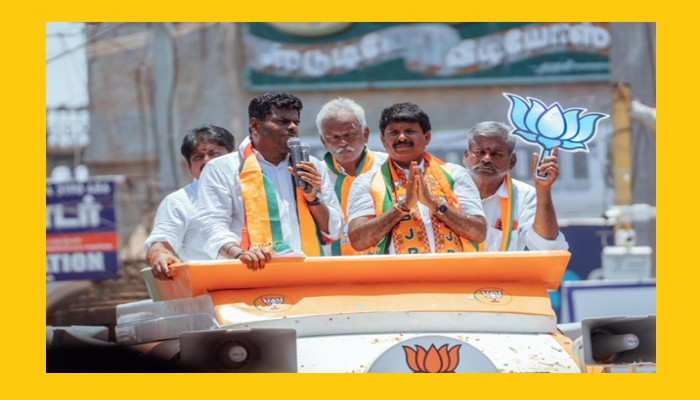
The entry of K. Annamalai into the Tamil Nadu political arena represented a departure from traditional recruitment patterns. An engineering graduate from PSG College of Technology and an MBA holder from IIM Lucknow, Annamalai’s transition from a decorated career in the Indian Police Service to the presidency of the Tamil Nadu BJP was swift. His tenure leading up to the 2024 Lok Sabha elections was defined by an aggressive, high-visibility style of opposition, exemplified by his En Mann En Makkal yatra. Although he failed to make a mark in the 2024 election from Coimbatore, his performance cemented his role as the primary ideological challenger to the Dravidian establishment.

Strategic Realignment and the Non-Contest Decision
A significant recalibration of BJP tactics has marked the lead-up to the 2026 Assembly elections, as the high command pursued a broader alliance strategy that at times conflicted with the assertive brand of politics Annamalai cultivated. His decision not to contest the 2026 elections was framed as a pivot to act as a statewide campaign overseer, yet underlying this move was evident dissatisfaction regarding constituency allocation. Reports indicated that Annamalai was unhappy that the BJP was consulted on preferred seats only after the AIADMK had finalised arrangements with other allies, leaving the national party with geographical segments that limited its election prospects. His supporters expressed profound anguish, perceiving his exclusion from the candidate list as a tactical sidelining despite his willingness to contest from Coimbatore North or Tiruppur North.

The Disciplined Karyakarta and the Campaign Trail
Annamalai has publicly subordinated these personal grievances to the dictates of party discipline, articulating his role as a loyal karyakarta committed to the singular objective of securing victory for all NDA candidates. This pivot has manifested in a relentless, high-velocity campaign schedule that functions as a force multiplier across the state. His itinerary reveals an intense focus on the western belt and southern strongholds, frequently covering five to seven constituencies in a single day. A clear pattern emerges where he maintains a saturation presence in regions like Coimbatore, Madurai, and Erode, often transitioning from morning sessions in rural segments to late-evening rallies in urban centres.
The scale of his meticulous coverage of a vast majority of the 234 assembly seats often outpaces the traditional campaign rhythm of other front-line leaders. While major figures like M.K. Stalin and Edappadi K. Palaniswami typically focus on broader regional rallies, Annamalai has adopted a granular approach, blanket-campaigning through specific neighbourhoods and villages to ensure the NDA's visibility. His preferred constituencies of Coimbatore North, Singanallur, and Kinathukadavu remain central to his logistics, with his programme ensuring multiple appearances in these segments during the critical final weeks of April 2026. His focused effort in the Kongu region suggests a tactical decision to weaponise his personal resonance in territories where the NDA requires a decisive breakthrough. By blanketing these specific geographies, he is not merely campaigning; he is physically anchoring the alliance’s presence in the most contested electoral theatres of the state.

Structural Eloquence and Local Resonance
The effectiveness of Annamalai’s 2026 campaign speeches lies in their unique structural composition and fearless delivery. Unlike the generic rhetoric often seen in state-level campaigning, his addresses are clinically prepared, blending sharp critiques of the DMK leadership with highly localised data points. He typically arrives prepared with the specific administrative lapses within a constituency, the antecedents of the rival INDI alliance candidate, and a detailed profile of the NDA candidate’s achievements. By weaving together the salient points of both the BJP and AIADMK manifestos while simultaneously highlighting the perceived failures of the incumbent administration, he creates a compelling narrative. This is often laced with a sharp, relatable humour and anecdotes to resonate with the public.

Crucially, he concludes every address by explicitly naming and thanking every local leader from all alliance parties within that specific constituency. This ritual serves a dual strategic purpose: it ensures the logistical cohesion of the various alliance machineries and systematically endears him to the second and third level leadership across the entire NDA front. By publicly validating these grassroots workers, Annamalai is effectively building a personal loyalist base that transcends party lines, ensuring that the alliance operates as a singular force rather than a collection of disparate interests. This granular recognition acts as a powerful motivator for the cadre, as it transforms abstract state-level alliances into a tangible, shared mission at the booth level. Such a strategy not only mitigates the risk of internal friction during the high-pressure final phase of polling but also positions Annamalai as the unifying bridge for a post-2026 political landscape where regional and national interests must increasingly align.
Reconciliation with the AIADMK Old Guard
The most striking feature of the current campaign is the reception Annamalai has received from senior AIADMK leaders who were previously his most vocal critics. During a rally in Madurai West, Sellur Raju, who once engaged in bitter public spats with Annamalai, was seen praising his campaign energy and oratorical skills profusely. In the western heartland, Pollachi Jayaraman has proactively acknowledged the necessity of the alliance, marking a sharp departure from his earlier scepticism.
In Coimbatore, the integration of Annamalai with the AIADMK machinery is particularly evident. Amman K. Arjunan has leveraged Annamalai’s presence to bolster the campaign in Coimbatore South. In Singanallur, K.R. Jayaram has coordinated closely with the former IPS officer, while P.R.G. Arunkumar in Goundampalayam and S.P. Velumani in Thondamuthur have similarly roped in Annamalai into their high-decibel campaign events. This pragmatic truce suggests that the 2026 contest has forced a reconciliation between the regional veterans and Annamalai, as both realise that their mutual survival depends on a unified offensive.
A Force to Reckon With
With only seven days remaining until the polling date, Annamalai has successfully transitioned from a controversial firebrand into a formidable political asset. Regardless of the final seat tally in this unpredictable election, his performance has established him as a force that cannot be ignored by either the central BJP leadership or the Dravidian majors. He has demonstrated an ability to command the public imagination and mobilise cadres across traditional party lines, cementing his place as a force to reckon with.
The clinical reality is that Annamalai has achieved what few outsiders have managed in the history of the state: he has successfully inserted himself into the very marrow of the Dravidian political discourse. By subordinating his individual ego to the mechanical demands of the alliance while simultaneously outworking every veteran on the trail, he has rendered himself indispensable to the immediate survival of his partners and for the long-term ambitions of his party. Whether the arithmetic of the ballot box reflects it or not, the post-2026 political landscape will be defined not just by those who hold office, but by the shadow of a leader who proved he could lead from the streets as effectively as from the headquarters. Annamalai has not merely cemented his place as a force to be reckoned with; he has fundamentally rewritten the rules of political engagement in Tamil Nadu.



 Loading...please wait
Comments