




The Eternal Line: The Āśrama Paradigm for an Age of AI
- In Religion
- 08:50 PM, Sep 28, 2026
- Dr. Bal Ram Singh
In my previous essay (Singh, 2026), I proposed that we call this fortnight Pūrvaja Pakṣa, the fortnight of all who came before us. I also suggested a reading of santāna: those who extend faithfully the values they have received. By that measure, a son and a daughter are both heirs. So is a student.
The tradition itself makes this connection. The Taittirīya Saṃhitā says that a person is born owing three debts. The debt to the ṛṣis is repaid through study, the debt to the gods through sacrifice in service of others, and the debt to the ancestors through progeny. In the same verse, children and learning sit side by side as ways a line continues. This fortnight honors the second kind of heir as much as the first.
That raises a hard question for our time: is our education producing santāna?
What machines now do
Machines can now retrieve any fact, summarise any book, and write working code in seconds. An education that measures what a student can store and reproduce is training young people for work that machines already do better. The result is often a mind full of information but unsure what it believes, and anxious because it knows it can be replaced.
What machines cannot do is equally clear. A machine cannot test a principle in its own life. It cannot carry understanding into terrain it has never seen and adapt it there. And it cannot take responsibility for a decision. In my reading, these are exactly the capacities that the four āśramas were designed to build.
A life in four colours
The tradition speaks of a life of a hundred years (śatāyur vai puruṣaḥ), divided into four āśramas. I read the twenty-five years assigned to each not as a fixed term but as a proportion: a quarter of a life. For a life of eighty years, each stage is about twenty.
I use the older compound varṇāśrama in a specific sense. Varṇa literally means colour, and in my reading it marks the four stages as distinct, the way we colour the four quadrants of a graph to tell them apart. This differs from the usual reading of varṇāśrama as two systems, social class and life stage, joined together. It is not a claim about varṇa-vyavasthā, which deserves its own careful treatment.
The four āśramas as quarters of a mature life · two lifespans compared
Modern biology points to turning points in roughly the region this proportion predicts. The brain's frontal cortex keeps maturing into the mid-twenties. Gene expression in the human brain behaves differently before and after early adulthood: variability between individuals rises consistently with age once development ends, as I discussed in my review (Singh, 2024) of work by Işıldak and colleagues (2020).
Molecular studies increasingly suggest that we age in waves rather than along a straight line. Blood-protein studies find bursts of change around ages 34, 60 and 78 (Lehallier et al., 2019), and broader molecular profiling finds sharp shifts around 44 and 60 (Shen et al., 2024) after a developmental transformation around age 20. In my reading of brain gene-expression data (Singh, 2024), the transitions may fall at roughly twenty-year intervals. If that pattern is confirmed, the āśramas may prove to be more than a cultural scheme. They may be an early map of the body's own seasons.
The four stages as a method of learning
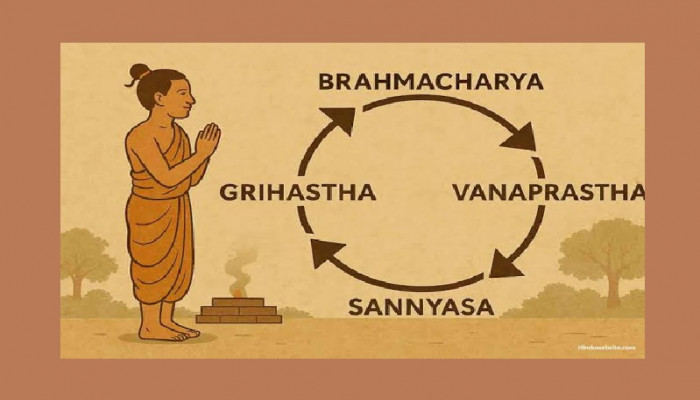
In my reading, the name of each stage carries its own instruction. Carya means to keep moving, stha to be established in, prastha to set out, and nyāsa a foundation. Together they describe how anything worth knowing is learned.
Brahmacarya: expanding the horizon. The first stage coincides with the brain's great windows of plasticity. In early childhood, sensory and language circuits wire themselves at remarkable speed. In adolescence, a second critical period opens in the frontal cortex, the region that supports reasoning and self-control (Perica et al., 2022). This period should be spent building foundations: language and its roots, mathematics, and the methods by which knowledge is tested. When answers are cheap, the ability to ask good questions becomes the scarce skill, and a broad inner canvas keeps the mind from becoming a narrow loop.
Gṛhastha: verification in the self. Conventionally this is the householder's stage. My own reading is that the first home, the first gṛha, is the body, as it is in yat pinde tat brahmande (what is in this body is what is in the entire universe), or the Bible’s this body is the kingdom of God. Before a principle is applied to the world, it should be tested in one's own habits, health and conduct. A machine can explain balance; only a person can practice it.
Vānaprastha: adaptation in unknown terrain. I read the forest not as retirement but as unfamiliar ground, where one's credentials and reputation count for nothing. As a biochemist, I learned techniques through controlled experiments. Their real test came when they met messy, unpredictable problems in the world. Education should deliberately place students in unfamiliar disciplines, communities and cultures, so they learn to transfer understanding rather than repeat it.
Saṃnyāsa: acting from a settled foundation. The standard derivation is sam + ni + as, "to lay down completely," which is renunciation. I read nyāsa also in its sense of placing or depositing, a foundation set down firmly. In my view, saṃnyāsa is not withdrawal but engagement without ego and attachment, the Gītā's niṣkāma karma. Grounded in principle, a person can enter a crisis for the sake of truth rather than for recognition or reward.

The four āśramas as a learning cycle · the instruction in each name
These stages describe a whole life, but they also describe a cycle that repeats. A single course, a career, or a new skill at seventy can pass through all four - acquire it broadly, verify it in yourself, test it in unfamiliar conditions, then act from it with steadiness.
Where machines help, and where only people can go
In my view, AI helps most in the first stage and least in the last. It can make brahmacarya broader and faster. It cannot live, adapt or decide on a student's behalf.
|
Stage |
A machine can supply |
Only a person can |
|---|---|---|
|
Brahmacarya |
Facts, explanations and practice on demand |
Be curious, and judge what is worth asking |
|
Gṛhastha |
Rules for healthy habits and right conduct |
Live them in sleep, diet, restraint and daily conduct |
|
Vānaprastha |
Information about unfamiliar fields and places |
Enter them, and adapt when the map fails |
|
Saṃnyāsa |
Options, forecasts and analyses |
Decide, and bear responsibility for the decision |
A school built on this paradigm would use machines to speed up the first stage, and spend the time saved on the other three, practice in the student's own life, work in unfamiliar settings, and real decisions with real consequences.
The teacher as example
Yāska's Nirukta explains ācārya as one who makes the student grasp ācāra, right conduct. The teacher's life is the curriculum. In an age when information is freely available, this is the one thing a school can offer that a machine cannot, i.e., a person whose conduct shows what the knowledge is for.
As we honour our ancestors this fortnight, we might remember the teachers among them too. We repay both debts the same way, by raising heirs, in our homes and in our classrooms, who carry forward what they received and extend it faithfully.
Notes and references
-
Taittīriya Saṃhitā 6.3.10.5, on the three debts.
-
Yāska, Nirukta 1.4, on ācārya.
-
Singh BR. Temporal changes in the gene expression heterogeneity during brain development and ageing (review of Işıldak et al., 2020). Ayurveda Journal of Health, 22: 25–32 (Fall 2024).
-
Singh, BR. Pitṛ Pakṣa or Pūrvaja Pakṣa? Remembering All Who Came Before, September 25, 2026. https://medium.com/@balramsingh_298/bal-ram-singh-1bae696d58b8
-
Işıldak U, Somel M, Thornton JM, Dönertaş HM. Temporal changes in the gene expression heterogeneity during brain development and ageing. Scientific Reports 10:4080 (2020).
-
Perica MI et al. Development of frontal GABA and glutamate supports excitation/inhibition balance from adolescence into adulthood. Progress in Neurobiology (2022).
-
Lehallier B et al. Undulating changes in human plasma proteome profiles across the lifespan. Nature Medicine 25:1843–1850 (2019).
-
Shen X et al. Nonlinear dynamics of multi-omics profiles during human ageing. Nature Ageing (2024).
- The readings of varṇa as colour-coding, of the 25-year stages as proportions, of gṛha as the body, and of carya, stha, prastha and nyāsa as instructions are the author's own.
Disclaimer: The opinions expressed within this article are the personal opinions of the author. MyIndMakers is not responsible for the accuracy, completeness, suitability, or validity of any information on this article. All information is provided on an as-is basis. The information, facts or opinions appearing in the article do not reflect the views of MyindMakers and it does not assume any responsibility or liability for the same.


 Loading...please wait
Comments