




How the DMK used its position in the UPA coalition to extract massive rents from the national government — and how it nearly brought down India's economy
The UPA Coalition and DMK's Strategic Position
The United Progressive Alliance governments of 2004-2014 represented the high-water mark of DMK's national political influence and simultaneously the most damaging period of the party's engagement with national governance. The DMK's parliamentary strength made it an indispensable coalition partner for the Congress-led UPA, giving it leverage over ministerial allocation and policy far beyond what its vote share would have warranted in a more purely majoritarian system.
Karunanidhi negotiated the coalition terms with characteristic ruthlessness. The DMK secured key ministries — including the Ministry of Communications, which would prove spectacularly consequential — and used its ministerial positions as instruments for the enrichment of the Karunanidhi family and the DMK's broader patronage network. The degree to which the UPA's national governance was distorted by DMK's coalition demands represents one of the most damaging episodes of regional party influence in national government in Indian democratic history.
The 2G Spectrum Scam: India's Biggest Corruption Scandal
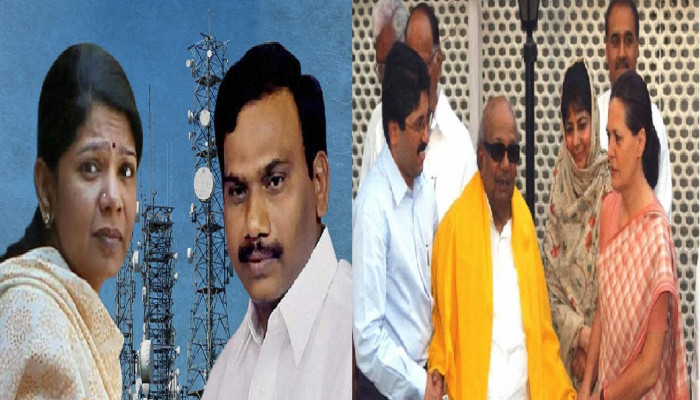
The 2G spectrum allocation scandal, centred on the tenure of DMK's A. Raja as Union Minister of Communications and Information Technology, is widely regarded as the largest corruption scandal in independent India's history. The Comptroller and Auditor General of India estimated the notional loss to the public exchequer at Rs. 1.76 lakh crore — a figure that, even accounting for the methodological debates around the CAG's calculation, represents a staggering act of corruption.
The mechanics of the scam were brazen. 2G spectrum licences — rights to use the electromagnetic spectrum for mobile telecommunications — were allocated at prices fixed at 2001 levels despite the dramatically increased value of spectrum in the 2007-08 period when the allocations were made. Hundreds of licences were awarded to companies that did not meet the eligibility criteria, on a first-come-first-served basis that favoured companies with political connections, at prices that bore no relationship to the spectrum's market value. Many of the beneficiary companies immediately sold their licences to international telecom corporations at enormous profits, demonstrating the artificial underpricing.
The 2G scam was not merely a ministerial corruption case — it was a systematic extraction of public wealth on an industrial scale. The licences given away at throwaway prices to politically connected entities represented a transfer of public resources to private hands that had no parallel in the post-independence governance record. India's international credibility in managing major economic assets was severely damaged.
A. Raja and DMK MP Kanimozhi — Karunanidhi's daughter and a Rajya Sabha member — were among those arrested and charged in the case. Kanimozhi's arrest was particularly significant: she was accused of receiving kickbacks from telecom companies that had benefited from the spectrum allocations, routed through the Kalaignar TV channel in which the Karunanidhi family had interests. The case implicated the Karunanidhi family directly in the corruption, demonstrating that the 2G scam was not merely a ministerial malfunction but a family enterprise.
Coal-Gate and Tamil Nadu's Role
The 2G scam was not an isolated event — it was symptomatic of a broader culture of coalition corruption that characterised the UPA-2 period. The coal block allocation scandal (Coalgate), while centred on the Prime Minister's Office's oversight failures, also implicated companies with connections to Tamil Nadu's political economy. The culture of licence allocation as political currency — which the 2G case exemplified — had penetrated multiple sectors of India's regulated economy during the UPA decade.
The DMK's role in the UPA's governance failures extended beyond specific scandals. Its blocking of economic reform measures, its demands for state-specific fiscal concessions, and its use of coalition leverage to protect party interests against national regulatory agencies all contributed to the governance paralysis that marked the UPA's second term and ultimately contributed to the historic electoral defeat of 2014.
The Tamil Eelam Dimension: Anti-National Foreign Policy Pressure
During the UPA years, the DMK consistently pressured the Central government on the issue of Sri Lankan Tamil rights, including during the final phase of the Sri Lankan civil war in 2009 when the Sri Lankan military's offensive against the LTTE resulted in significant civilian casualties. The DMK's pressure on the UPA government — including withdrawing ministerial support at one point — forced India's foreign policy toward Sri Lanka to be partly subordinated to Tamil Nadu's domestic political calculations.
This interference with national foreign policy was not primarily driven by humanitarian concern for Sri Lankan Tamils, though that concern was real and legitimate. It was driven by the electoral calculation that strong advocacy for Tamil Eelam causes would consolidate the DMK's vote bank in Tamil Nadu. The result was that India's strategic relationship with Sri Lanka — a critical neighbour with implications for maritime security, Chinese influence, and regional stability — was repeatedly damaged by DMK-driven foreign policy interference.
When a regional party's domestic electoral calculations override national security and foreign policy considerations, the result is a governance failure of the gravest kind. The DMK's Sri Lanka policy during the UPA years was precisely this — Tamil Nadu's electoral politics being run as a substitute for Indian foreign policy.
The UPA's Fall and DMK's Complicity
The UPA government's catastrophic defeat in the 2014 general elections — which brought Narendra Modi and the BJP to power with an absolute majority — owed much to the governance failures of the coalition period, of which the 2G scam was the most symbolically powerful. The Anna Hazare anti-corruption movement of 2011, which galvanised middle-class India against UPA corruption, drew its emotional energy substantially from the 2G and Coalgate scandals.
The DMK, recognising the political damage from its association with the scams, withdrew from the UPA in 2013 — a face-saving exit that fooled nobody. The party's electoral performance in Tamil Nadu in the 2014 general elections was dismal: it won zero Lok Sabha seats, a historic wipeout that reflected public anger at its governance record. Karunanidhi's family-run party, which had used the UPA years to enrich itself at national expense, paid an electoral price — but the damage to India's economy, to public trust in democratic institutions, and to the credibility of coalition governance was far longer lasting.
Part 7: The Dravidian Deception: Tamil Nadu Post- Jayalalitha, Post-Karunanidhi and a Decade of DMK Misrule Part 7 https://myind.net/Home/viewArticle/the-dravidian-deception-tamil-nadu-post-jayalalitha-post-karunanidhi-and-a-decade-of-dmk-misrule-part-7



 Loading...please wait
Comments