




The Currency of Breath
- In Health & Wellbeing
- 01:46 PM, Sep 01, 2026
- Swami Pranaka
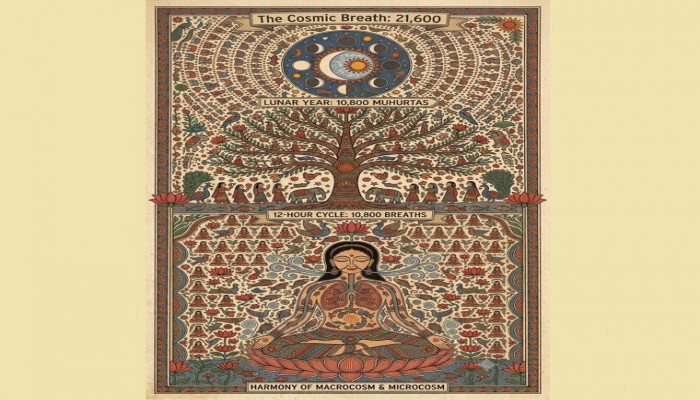
The Magic of 10800 - Mapping the Lunar Cycle onto Human Body
We often think of time as something outside of us - a ticking clock, a calendar on the wall, the wheel of the celestial bodies in the solar system. But the ancient Siddha tradition viewed the human body not just as a vessel, but as a biological mirror of the cosmos. The macrocosm is folded perfectly into the microcosm.
I was recently revisiting a Sutra by Agasthya Muni from the Vaithiya Sadhaka Nadi - Verse 12, and a new layer of meaning revealed itself - one that maps the phases of the moon directly onto the rhythm of our respiration and the flow of our vital energy.
Here is the verse:
போச்சுதே கடிகை ஒன்றில் சுவாசம் தானும் புகழாக முந்நூற்று அறுபதாக
pōccutē kaṭikai oṉṟil cuvācam tāṉum pukaḻāka munnūṟṟu aṟupatāka
வாச்சுதே நாளொன்றுக்கு இருபத்தோராயித்தறு நூறு மூன்றிலொரு கூறு பாழாம்
vāccutē nāḷoṉṟukku irupattōrāyittaṟu nūṟu mūṉṟiloru kūṟu pāḻām
The Daily Allowance of Prāna
The first line establishes our baseline metric. A katikai is an ancient unit of time equal to 24 minutes. The text states that in one katikai, a human takes 360 breaths.
Multiply that by the 60 katikais that make up a full 24-hour day, and you arrive at 21,600 breaths.
In the Siddha framework, respiration is not just the movement of air; it is the vehicle for prāna, the vital life force. These 21,600 breaths are our daily currency of life. It is the span of prana granted to us each day to spend as our will.
But there is a second, hidden layer here that moves beyond the daily cycle and scales up to the solar-lunar year.
The 10,800 Correlation: The Lunar Clock in Our Body
Let’s look at the traditional harmonised lunar year, which is calculated using tithis (lunar days).
The Lunar Year: 12 lunar months × 30 tithis per month = 360 tithis.
The Muhūrta: Each standard day or tithi is divided into exactly 30 muhūrtas (periods of 48 minutes).
The Cosmic Calculation: 360 tithis × 30 muhūrtas = 10,800 muhūrtas in a lunar year.
Now, let's bring it back to the human breath. We established that a healthy human takes 21,600 breaths of prāna in a 24-hour period. If we divide the day strictly into its light (solar) and dark (lunar) halves, we get exactly 10,800 breaths during the day and 10,800 breaths during the night.
Look at the direct mathematical correlation: there are exactly 10,800 muhurtas in the lunar year, and exactly 10,800 breaths in a 12-hour human cycle.
Do you see the architectural elegance here?
The rhythm of our respiration is directly linked to the passage of solar and lunar time. Every single breath of prāna we draw during the day corresponds precisely to one muhurta of the lunar year. We are breathing the lunar calendar. Every breath is a microscopic tick of the cosmic clock.
The Modern Science Translation
What happens when we subject this poetic, ancient math to the cold light of modern science? It holds up with shocking precision.
1. The Respiratory Rate
To hit 21,600 breaths in a 24-hour period, we have to breathe at a highly specific rate:
21,600 breaths ÷ 24 hours ÷ 60 minutes = 15 breaths per minute.
Modern physiology textbooks state that the normal resting respiratory rate for a healthy adult is between 12 and 18 breaths per minute. The absolute median, the baseline of human respiration? 15 breaths per minute. The author of the Vaithiya Sadhaka Nadi - Agasthya Muni, wasn't estimating; he had pinned down the precise median of human biology.
2. The Wasted Third (Anatomic Dead Space)
The most fascinating part of the verse, however, is the second line: "One third is wasted normally" (மூன்றிலொரு கூறு பாழாம்).
This is often interpreted as the prana lost to worldly distractions, stress, or shallow breathing. But if we look at modern pulmonology, this "wasted third" is a literal, anatomical fact.
It is called Anatomic Dead Space.
When we take a normal resting breath (our tidal volume), we inhale about 500 milliliters of air. However, not all of this air reaches the alveoli in our lungs where gas exchange (absorbing oxygen, removing carbon dioxide) actually happens.
About 150 milliliters of that air stays trapped in the upper respiratory tract (the trachea and bronchi) - areas where no gas exchange can occur. When we exhale, that air is simply pushed back out, completely unused.
150 ml is exactly 30% of our 500 ml breath.
Nearly exactly one third of every breath we take is biologically "wasted."
Whether through profound internal observation, generational empirical study, or sheer meditative insight, the Siddha tradition mapped not just the cosmic cycles, but the very volume and efficacy of the human lung.
The next time you take a breath, remember what it is you're doing: you are keeping time with the moon, channelling prāna in sync with the cosmos - not just exchanging the gases from the atmosphere of the earth.


 Loading...please wait
Comments