




The “Cockroach Janta Party” Movement and the “Blue Revolution” Narrative: An Analysis of Funding, Political Mobilisation & Coalition Building
- In Current Affairs
- 01:29 PM, Jul 21, 2026
- Rudra Dubey
Introduction
The emergence of the so-called “Cockroach Janta Party” (CJP) during 2026 illustrates how modern protest movements can rapidly evolve from a localised controversy into a broader political phenomenon. The name originated from public reactions to remarks attributed to the Chief Justice of India. It later intersected with protests surrounding examination irregularities, student demonstrations, Sonam Wangchuk’s campaign, and the “Chalo Sansad” march.
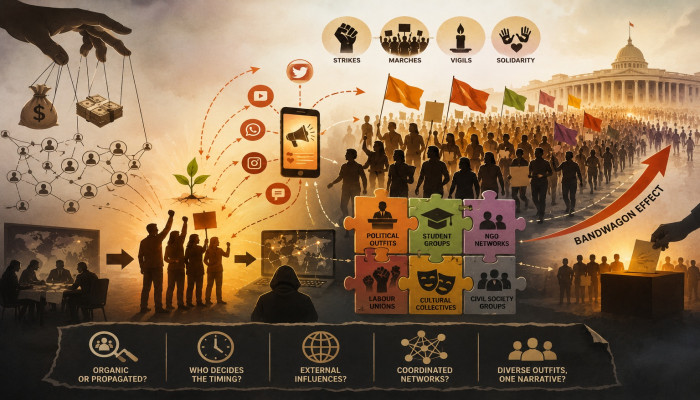
A book called Blue Revolution (sometimes Neeli Kranti in context) argues that certain unrests start small but are amplified through coordinated networks, non-violent symbolism (strikes, marches), digital tools, and alliances with broader activist ecosystems. Critics claim this creates rapid “bandwagon” effects, with diverse outfits (political, student, NGO-linked) latching on, raising questions about organic vs. propagated growth, timing, and external influences.
As the movement expands, it attracts attention from politicians, celebrities, activists, comedians, writers, and social media influencers, transforming what began as a narrow issue into a wider public conversation about governance, institutions, accountability, and dissent.
Some commentators interpret this evolution through the lens of the Blue Revolution framework, while others view the same developments as a normal feature of democratic politics in which public figures rally around issues consistent with their long-held beliefs.
This article examines both perspectives while distinguishing documented developments from interpretive conclusions.
The Blue Revolution Framework
According to proponents of the Blue Revolution framework, contemporary movements often follow a recognisable sequence:
- A triggering event captures public attention.
- Social media rapidly amplifies the issue.
- Influential personalities endorse or discuss the cause.
- Additional grievances become associated with the original issue.
- The movement evolves into a broader political or institutional narrative.
Supporters of this framework argue that digital communication accelerates coalition-building and extends the lifespan of protests far beyond their original trigger. Critics respond that similar dynamics have characterised democratic movements worldwide for decades and do not, by themselves, indicate centralised planning or coordination.
Expansion Beyond the Original Issue
Apparently, these unrests start small but now, as expected, are amplified through coordinated networks, using safe non-violent symbolism (strikes, marches), digital tools (very powerful, well-funded and organised toolkits), and alliances with broader activist ecosystems. A rapid “bandwagon” effect has drawn diverse outfits (political, student, NGO-linked) to latch on, raising questions about organic vs. propagated growth, timing, and external influences. A dangerous situation that can trigger bug unrest, riots and significant civil unrest, potentially disrupting government functioning.
Observers note that the movement eventually attracted individuals from diverse political, ideological, and professional backgrounds.
Public expressions of support, commentary, or participation came from politicians, actors, filmmakers, writers, comedians, and activists, including:
|
Public Figure |
Public Background |
Connection to Original Trigger |
|
Shabana Azmi |
Actor and social activist |
Public commentary; no direct involvement in the originating judicial issue |
|
Prakash Raj |
Actor and filmmaker |
Public statements on governance and democracy |
|
Brinda Karat |
CPI(M) leader |
Political support and commentary |
|
Manish Sisodia |
AAP leader |
Public engagement on education and governance |
|
Mahua Moitra |
Member of Parliament |
Commentary on institutional issues |
|
Akhilesh Yadav |
Samajwadi Party president |
Political criticism of the government |
|
Kunal Kamra |
Comedian |
Satirical commentary |
|
Swara Bhasker |
Actor and activist |
Public support through social media |
|
Anurag Kashyap |
Filmmaker |
Commentary on contemporary political issues |
|
Arundhati Roy |
Author |
Public statements consistent with long-standing activism |
|
Rakesh Tikait |
Farmer leader |
Participation in wider protest discussions |
|
Other film personalities |
Including various actors and public figures |
Expressions of solidarity through statements or social media |
Many of these individuals have no direct connection to the original judicial remarks or to the specific examination-related grievances that initially received public attention. Their participation is documented through public appearances, interviews, social media posts, or statements. However, participation alone does not establish centralised coordination, common strategy, or shared organisational leadership.
Sonam Wangchuk as a Bridge or a facade
Among the public figures associated with the broader protest ecosystem, Sonam Wangchuk occupies a distinctive position.
Unlike many celebrities and political leaders who expressed support from outside the movement’s original context, Wangchuk had an ongoing campaign focused on constitutional protections and governance issues relating to Ladakh. His demonstrations subsequently intersected with broader protest activity in Delhi, creating a point of convergence between different causes.
Some commentators view this convergence as evidence of issue-based coalition building, while others interpret it as a natural outcome of multiple groups mobilising around broader themes of governance and accountability.
Competing Interpretations
Interpretation 1: Strategic Political Amplification or anti-government movement
Supporters of the Blue Revolution framework argue that:
- multiple unrelated issues became associated with a common protest narrative;
- celebrities and politicians substantially increased media visibility;
- digital platforms accelerated message dissemination;
- diverse activist networks reinforced one another through shared messaging.
From this perspective, the movement demonstrates how modern digital ecosystems can rapidly expand the reach of a protest beyond its original scope.
Interpretation 2: Organic Democratic Coalition Building
Political scientists and many civil society observers offer a different explanation.
They argue that:
- public figures frequently support causes aligned with their established political positions;
- opposition politicians often join high-profile demonstrations;
- celebrities regularly comment on issues of public concern;
- social media naturally accelerates coalition formation without requiring centralised direction.
Under this interpretation, broad participation is characteristic of democratic politics rather than evidence of coordinated orchestration.
Historical Comparisons
1. The Arab Spring
Beginning in Tunisia in 2010, protests triggered by the self-immolation of Mohamed Bouazizi rapidly spread across North Africa and the Middle East.
Digital media enabled rapid dissemination of videos, images, and eyewitness accounts.
Some governments argued that foreign actors amplified unrest, while many researchers emphasised the central role of domestic grievances, youth unemployment, corruption, and political repression.
Most scholars conclude that both internal and external factors influenced events to varying degrees depending on the country.
2. Occupy Wall Street
The Occupy movement began in New York in 2011 with criticism of economic inequality.
Its slogan—“We are the 99%”—became globally recognisable.
Although the movement lacked centralised leadership, it attracted: labour organisations, academics, celebrities, artists, and political figures.
Researchers describe Occupy as an example of decentralised, digitally coordinated collective action.
3. Anna Hazare and the Anti-Corruption Movement
India’s anti-corruption movement demonstrated how a focused issue—corruption and the proposed Lokpal legislation—expanded into a nationwide campaign.
Television coverage, SMS campaigns, Facebook, and emerging social media significantly increased participation.
Political parties initially observed from a distance before becoming more actively involved as public attention grew.
4. Hong Kong Protests
Hong Kong’s demonstrations illustrated highly sophisticated digital organisation.
Participants used encrypted messaging, online polling, decentralised leadership, crowdsourced logistics, and rapid information sharing.
Observers noted both remarkable organisational efficiency and intense debate over foreign influence, funding, and external support. These issues remain contested and are interpreted differently by governments, researchers, and participants.
5. Black Lives Matter
BLM evolved from a hashtag into a global movement.
Millions participated across countries with varying political systems.
The movement combined grassroots activism with support from civil society organisations, foundations, corporations, public figures, athletes, and entertainers.
Its growth demonstrates how digital visibility can transform local incidents into international conversations.
6. Farmers’ Protests in India
The farmers’ protests became one of India’s largest sustained protest movements.
Support came from: farmer organisations, labour unions, opposition parties, diaspora communities, and public figures.
Questions about funding, logistics, and international attention became part of public debate. While various claims circulated, determining the sources of support required evidence beyond social media speculation.
The Role of Celebrities
Celebrities often increase visibility rather than determine outcomes.
Their participation may: attract media attention; expand audience reach; legitimise a movement for supporters; and provoke criticism from opponents.
Whether celebrity involvement reflects genuine personal conviction, strategic communication, or public expectation varies by individual and cannot be assumed without evidence.
Resource Mobilisation Theory
One influential theory in sociology is Resource Mobilisation Theory.
It argues that successful movements require access to resources such as: volunteers; leadership; communication networks; organisational skills; funding; legal support; transportation; and media relationships.
Importantly, the theory does not imply that large resources necessarily indicate improper conduct. Many lawful social movements rely on donations, membership fees, philanthropy, unions, advocacy groups, or volunteer labour.
Digital Campaigns: What Do They Cost?
A recurring public question concerns the potential cost of sustaining large-scale digital and on-the-ground campaigns.
Some analysts have produced hypothetical estimates of what it might cost to operate a professional, agency-managed movement with paid communications teams, advertising, logistics, legal support, and event management.
Hypothetical Cost Estimates and Questions About Funding
One aspect that has generated considerable online discussion concerns the potential cost of sustaining a movement of this scale.
Some social media commentators have attempted to estimate what it would cost to operate a movement of similar size if it were managed as a fully professional campaign using paid agencies, advertising firms, logistics providers, media consultants, and event management companies rather than relying primarily on volunteers.
One widely circulated estimate—described as being based on publicly available information—suggests the following illustrative costs:
|
Activity |
Estimated Cost (Hypothetical) |
|
Initial digital launch (first 1–2 months) |
US$30,000–120,000 |
|
Ongoing digital operations (monthly) |
US$15,000–50,000 |
|
Food, logistics, transport, stage, legal support, media management, and other on-ground operations (monthly) |
US$85,000–250,000+ |
|
Estimated initial 4–6 Week launch |
US$150,000–500,000+ |
|
Estimated sustained monthly operations |
US$110,000–330,000 |
These estimates typically assume:
- professional agencies rather than volunteers;
- paid content creation and digital promotion;
- organised logistics and event management;
- continuous operations over an extended period.
It is important to emphasise that these figures are hypothetical estimates, not evidence that such expenditures actually occurred or that any specific organisation financed the activities.
Questions Worth Examining
Whether one believes the movement was primarily volunteer-driven or professionally organised, several legitimate questions may arise in relation to large-scale public mobilisations:
- What were the primary sources of financial support?
- To what extent was the movement volunteer-driven versus professionally managed?
- Were donations, sponsorships, or organisational support publicly disclosed where required?
- Were applicable financial reporting, taxation, or foreign-funding laws complied with, where relevant?
- Have any official investigations, audits, or publicly available records substantiated or contradicted claims regarding the movement’s financing?
These questions cannot be answered solely through hypothetical costing models. Reliable conclusions require evidence such as audited accounts, regulatory filings, investigative journalism, official inquiries, or judicial findings.
The Importance of Distinguishing Observation from Interpretation
The observable facts include: the movement expanded beyond its original trigger; a wide range of public figures expressed support or commentary; social media substantially amplified the movement; and different protest themes occasionally intersected.
The interpretation of these developments, however, remains contested.
Some commentators view them as evidence of strategic amplification consistent with the Blue Revolution framework. Others regard them as ordinary democratic coalition-building in which individuals with similar political or ideological perspectives independently support common causes.
Distinguishing between documented events and interpretive narratives is essential for objective analysis.
Conclusion
The “Cockroach Janta Party” movement and its association with the Blue Revolution narrative demonstrate how contemporary protest politics can expand rapidly through symbolic language, digital amplification, public-figure endorsement, and the convergence of multiple grievances. The movement’s growth can be read in more than one way: as an example of strategic political amplification, or as a natural form of democratic coalition-building around shared concerns about governance, institutions, and accountability.
Ultimately, the key analytical challenge is not simply to ask whether diverse actors participated, but to determine what their participation proves. Celebrity involvement, political support, social media coordination, and estimated campaign costs may raise legitimate questions, but they do not by themselves establish hidden funding, centralised orchestration, or improper influence. Any firm conclusion must rest on verifiable evidence, transparent records, official findings, or credible investigative reporting. Until such evidence is available, the most responsible assessment is that the movement reflects both the power of modern digital mobilisation and the continuing complexity of democratic protest politics.
Disclaimer: The opinions expressed within this article are the personal opinions of the author. MyIndMakers is not responsible for the accuracy, completeness, suitability, or validity of any information on this article. All information is provided on an as-is basis. The information, facts or opinions appearing in the article do not reflect the views of MyindMakers and it does not assume any responsibility or liability for the same.



 Loading...please wait
Comments