




Thailand and Cambodia sign agreement to end border fighting
- In Reports
- 04:14 PM, Dec 27, 2025
- Myind Staff
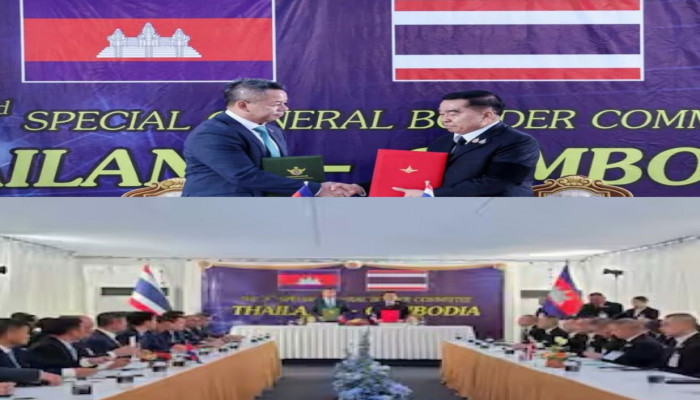
Thailand and Cambodia have agreed to an immediate ceasefire to end weeks of intense and deadly fighting along their shared border. The agreement was reached after talks aimed at stopping the clashes, which have killed more than 100 people and forced over half a million civilians to flee their homes in both countries.
In a joint statement issued on Saturday, the defence ministers of Thailand and Cambodia confirmed that the ceasefire would take effect immediately after the signing of the agreement. “Both sides agree to an immediate ceasefire after the time of signature of this Joint Statement,” the Thai and Cambodian defence ministers said. They further added, “Both sides agree to maintain current troop deployments without further movement.”
According to the agreement, the ceasefire came into force at noon local time on Saturday, which was 05:00 GMT. It applies to “all types of weapons” and strictly prohibits “attacks on civilians, civilian objects and infrastructures, and military objectives of either side, in all cases and all areas.”
Reporting from the Cambodian border city of Poipet, Al Jazeera’s Assed Baig said that the situation appeared calm after the ceasefire began. He stated that the “guns seem to have fallen silent” as both countries appeared to be following the truce. However, Baig also warned that the ceasefire remains fragile.
“But I must tell you, right up until the point of that ceasefire being implemented, there was some intense firing going on… really, really intense – right up until that moment. And it kind of gives you the idea of how fragile this actually is,” Baig said.
He added that the continued uncertainty has affected the confidence of civilians who were forced to flee due to the fighting. “That doesn’t instil a great deal of confidence in people here who want to return home and will be watching if this ceasefire will hold,” he said.
The agreement was signed by Thai Defence Minister Natthaphon Narkphanit and Cambodian Defence Minister Tea Seiha. It brings an end to 20 days of fighting, which has been described as the worst conflict between the two Southeast Asian neighbours in several years.
As part of the ceasefire deal, Thailand has agreed to return 18 Cambodian soldiers who were captured during earlier clashes. This will take place 72 hours after the ceasefire “has been fully maintained.” Both sides also committed to avoiding actions that could increase tensions along the border.
In the joint agreement, Thailand and Cambodia agreed to refrain from taking “provocative actions that may escalate tensions” and to avoid “disseminating false information” as part of efforts to reduce hostility and maintain calm.
The deal also includes regional oversight. A team of observers from the Association of Southeast Asian Nations (ASEAN) will monitor how the ceasefire is implemented. The agreement states that both countries have agreed to keep communication channels open “to resolve” any issues that may arise on the ground during the truce.
Diplomatic efforts are also continuing beyond the ceasefire. On Sunday, Cambodian Foreign Minister Prak Sokhonn is scheduled to travel to Yunnan, China. There, he will attend a trilateral meeting with his Thai counterpart and Chinese Foreign Minister Wang Yi.
This meeting has been described as a “mutual confidence” building initiative. According to a statement released on Saturday, the talks aim to restore “peace, security, and stability” along the Thailand-Cambodia border.
Assed Baig reported that the coming days will be critical in determining whether the ceasefire succeeds. He said that “the next 72 hours is crucial” and noted that many displaced civilians are unlikely to return home immediately.
He explained that hundreds of thousands of people who were forced to flee due to the fighting will wait to see if the ceasefire holds and whether their safety can be guaranteed before making any move back to their homes.
The long-running conflict between Thailand and Cambodia is rooted in territorial disputes along their 800-kilometre (500-mile) shared border. Several ancient temples located in border areas are claimed by both countries. These disputes have been further complicated by colonial-era border demarcations, which have been a source of resentment on both sides for more than a century.
The most recent violence is part of a pattern of recurring clashes. In July, five days of fighting killed dozens of people before a ceasefire was brokered with the help of the United States, China and Malaysia. However, that truce collapsed earlier this month, leading to renewed fighting.
Following the breakdown of the earlier ceasefire, both Thailand and Cambodia accused each other of starting the latest round of clashes. Each side also claimed that the other deliberately targeted civilians during the fighting.
With the new ceasefire now in place, attention is focused on whether both countries will fully honour their commitments. Regional monitoring by ASEAN observers and ongoing diplomatic talks are expected to play a key role in ensuring that the truce holds and that stability returns to the border region.
For now, while the fighting has stopped, the situation remains tense. Displaced civilians, regional observers and international partners are closely watching developments in the coming days to see if the ceasefire will bring lasting peace after weeks of deadly conflict.



 Loading...please wait
Comments