



‘Terrorism has no nationality and no theology’: Rajnath Singh at SCO meet in Kyrgyzstan
- In Reports
- 12:36 PM, Apr 29, 2026
- Myind Staff
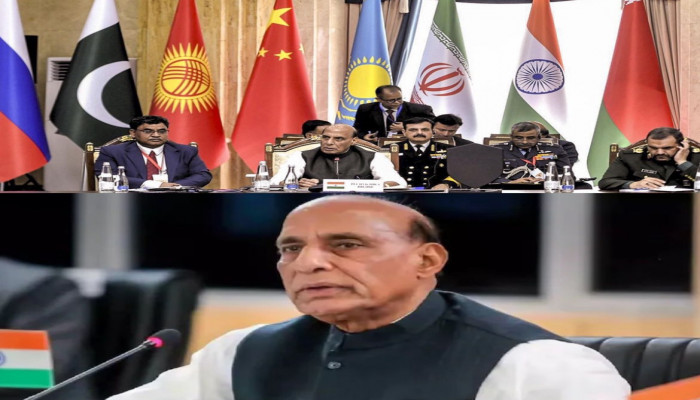
India’s Defence Minister Rajnath Singh stressed that terrorism cannot be linked to any religion or nationality and called for a strong and united global response against it. Speaking in Bishkek, Kyrgyzstan, during the Defence Ministers’ Meeting of the Shanghai Cooperation Organisation on Tuesday, he urged member nations to take a clear and firm stand against terrorism in all its forms.
He said that the SCO must act firmly against those “who abet, shelter and provide safe havens to terrorists,” and made it clear that there should be no room for double standards in dealing with terror. Emphasising consistency in action, he stated, “The real test of collective credibility remains in consistency. We must not forget that terrorism has no nationality and no theology. Nations must take a firm and collective stance against terrorism.”
Highlighting the importance of counter-terrorism, Singh described it as a core principle of the SCO. He pointed out that the 10-member grouping has repeatedly condemned acts of terror and extremist ideologies as part of a shared fight against the threat. Referring to last year’s Tianjin Declaration, he said it reflected India’s firm and united stand against terrorism. He described it as a strong example of the country’s zero-tolerance policy towards terrorism and those involved in it. He added, “By tackling terrorism, separatism, and extremism without exception, we transform regional security from a challenge into a cornerstone for peace and prosperity.”
Singh also called on member countries to come together to address terrorism, separatism, and extremism without making political exceptions. He stressed the need to eliminate safe havens for terrorists and highlighted concerns over state-sponsored cross-border terrorism, which he said directly threatens a nation’s sovereignty.
Referring to India’s recent military response, he spoke about Operation Sindoor. He said the operation demonstrated that “terrorism epicentres are no longer immune to justifiable punishment.” The operation was launched following the April 22 terror attack in Pahalgam, which claimed 26 lives. In response, India carried out strikes in the early hours of May 7, targeting terror and military sites in Pakistan and Pakistan-occupied Kashmir. Pakistan is also a member of the SCO, adding further significance to the remarks made at the meeting.
He also underlined the role of the SCO’s Regional Anti-Terrorist Structure in addressing security challenges. Singh mentioned that the joint statement by the Heads of State on “Countering Radicalisation leading to Terrorism, Separatism and Extremism,” issued during India’s Chairmanship in 2023, reflected a shared commitment among member countries to tackle these issues together.
The meeting took place at a time of rising global tensions, particularly in West Asia, due to the ongoing conflict involving the United States, Israel, and Iran. Against this backdrop, Singh said the SCO has an important role to play in maintaining stability. He noted that the current global environment appears divided, with many countries focusing more on their own interests.
Raising broader concerns about the global order, he questioned whether the world needs a new system or a more stable and disciplined one. He said, “Do we need a new world order or a world which is more orderly? We need an order where every citizen of this world is treated with dignity and respect. We need an order where differences do not become disputes and disputes don’t precede disasters. The real crisis today is not of a non-existent order but a tendency to question the established rule-based world order. We must focus on a global consensus where co-existence, co-habitation and compassion take precedence over chaos, competition and conflict.”
He further stressed that nations should prioritise dialogue and diplomacy over the use of force. He warned against allowing the current period to turn into an era marked by violence and conflict. Emphasising the responsibility of leaders in defence and security roles, he said, “We should not allow it to become an era of violence and war, but an era of peace and prosperity…As people responsible for defence and security, we have the responsibility to uphold this spirit of brotherhood and harmony. The real test of power is not in using it against the poor and the weak, but to use it in the interest of those who are unable to defend themselves.”
Through his address, Singh highlighted the need for unity, consistency, and a balanced approach in tackling terrorism while also promoting peace and cooperation in a rapidly changing global landscape.



 Loading...please wait
Comments