




Technology Needs Roots: Why India’s Youth Must Reconnect with Culture and Heritage
- In Current Affairs
- 10:02 PM, Aug 05, 2026
- Prasad Peketi
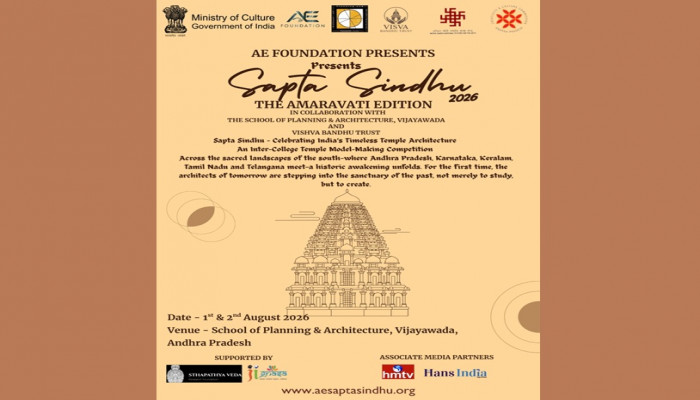
As India races towards an AI-driven future, the question is no longer whether our youth should learn technology. They must. But if we want them to build wisely, not just efficiently, they also need art, architecture, humanities and civilisational memory. Sapta Sindhu 2026 – Amaravati Edition showed what happens when young minds are given a meaningful platform to engage with India’s heritage.
Artificial Intelligence is reshaping the world with extraordinary speed. Today, almost every serious conversation about the future turns quickly to automation, coding, data science, innovation and digital skills. Schools are introducing AI courses, universities are strengthening STEM programmes, and parents increasingly see technology as the safest route to opportunity and success.
That focus is necessary. India must continue to lead in science, engineering and technology. But it also raises a question we can no longer postpone.
However, there is an equally important question that deserves our attention.
Can a country become a true global leader if it invests only in technology while allowing its humanities, arts and cultural heritage to fade into the background?
The Gap Is Not Interest — It Is Opportunity
For some years now, a familiar complaint has surrounded India’s young generation. We are told that Gen Z spends too much time on social media, is distracted by reels, lacks patience, and is slowly moving away from Indian traditions and values. There may be some truth in these concerns. Yet they also point to a deeper failure—not of young people, but of the ecosystem around them. Some of these concerns may have merit. Yet, they also reveal a deeper failure—not of young people, but of society itself.
Perhaps the real question is not whether young people are losing interest in culture, the real question is whether we have created enough meaningful opportunities for them to discover it, experience it and make it their own.
For decades, India’s education system has understandably placed engineering, medicine, management and technology at the centre of aspiration. These fields have powered economic growth and transformed millions of lives. These sectors have fuelled economic growth and transformed millions of lives. But in this pursuit of excellence, the humanities, fine arts, architecture and traditional knowledge systems have too often been pushed to the margins.
The result is predictable. When creativity does not find serious and inspiring platforms, entertainment naturally fills the vacuum. It is therefore unfair to blame technology alone when society has not invested equally in nurturing cultural imagination.
The challenge before India is not to choose between technology and tradition. It is to ensure that both grow together.
Sapta Sindhu 2026: A Platform That Trusted Young Minds
This is precisely where Sapta Sindhu 2026 – Amaravati Edition offered an inspiring example.
Organised by AE Foundation in collaboration with the School of Planning and Architecture, Vijayawada, the Ministry of Culture, the Indira Gandhi National Centre for the Arts and Visva Bandhu Trust, the initiative demonstrated what becomes possible when young people are trusted with India’s civilisational inheritance.
Instead of asking, "What is wrong with today's youth?", the organisers asked a different question:
“What can today’s youth achieve when they are given the right platform?”
The answer unfolded over two remarkable days.
Over two remarkable days on 1st and 2nd August 2026, 459 students from architecture schools, universities and institutions across Andhra Pradesh, Telangana, Karnataka, Kerala and Tamil Nadu transformed classrooms into vibrant spaces of creativity and learning.
Temple architecture models displayed exceptional design thinking. Intricately crafted pallakis reflected patience, skill and imagination. Traditional mural paintings celebrated India’s artistic diversity, while rangoli and architectural presentations revealed a thoughtful understanding of temple aesthetics, symbolism and sacred space.


Some participants recreated historic temple complexes with impressive precision. Others reimagined sacred spaces through contemporary and sustainable design ideas, showing that India’s ancient wisdom can continue to inspire modern architecture.


The event also brought accomplished temple architects, conservation experts, academicians, government officials, historians and spiritual leaders onto one platform. It created a rare space where traditional knowledge met youthful imagination.
Young People Respond When Culture Is Made Meaningful
What stood out was not merely the quality of the exhibits. It was the enthusiasm with which young participants embraced India’s heritage when it was presented as living knowledge rather than as a distant memory.
This offers an important lesson.
Young people are rarely indifferent to culture. More often, they are simply not introduced to it in ways that are engaging, dignified and relevant to their lives. When institutions create coding hackathons, young people enthusiastically participate. When institutions organise robotics competitions, they innovate.
When institutions create platforms rooted in heritage, architecture, sculpture, painting and traditional knowledge, young people respond with the same energy, commitment and creativity that they bring to coding hackathons or robotics competitions.
The issue has never been capability. The issue has been opportunity.
Heritage Is Not Nostalgia; It Is Knowledge
India’s temple architecture is one of humanity’s great intellectual and artistic achievements. It is far more than stone and sculpture. It brings together mathematics, astronomy, engineering, ecology, philosophy, aesthetics and spirituality into a single living tradition.
Preserving this legacy requires more than restoring monuments. It requires nurturing future architects, artists, historians, conservationists and cultural ambassadors who understand why this heritage matters.
That journey begins with education. It begins by recognising that humanities and culture are not decorative extras to be remembered only during festivals. They are essential to building thoughtful citizens who understand the civilisation they inherit.
They are essential to building thoughtful citizens who understand the civilisation they inherit. As India prepares to become a global AI powerhouse, our educational vision must become broader, not narrower.
Technology will build smarter machines. Humanities will build wiser societies.
Artificial Intelligence may shape the future of work. Culture shapes the future of civilisation.
The Future Must Be Built With Both Confidence and Continuity
The success of Sapta Sindhu 2026 shows that India’s youth possess immense creative potential. What they seek is not a cynical view, but meaningful opportunities, inspiring mentors and platforms that allow them to explore their identity with confidence.
When society chooses to invest in such platforms, young people do not merely participate. They surprise us. Perhaps the future of India's civilisation will not be secured only through digital innovation or economic growth.
It will also be safeguarded by young architects who design timeless spaces, artists who preserve ancient traditions, scholars who interpret our knowledge systems, and citizens who understand that progress is strongest when it is rooted in heritage.
India's future does not lie in choosing between technology and tradition. It lies in giving the next generation the confidence to build both.
That is the true message of Sapta Sindhu 2026 — and one that deserves to become a national movement.


Disclaimer: The opinions expressed within this article are the personal opinions of the author. MyIndMakers is not responsible for the accuracy, completeness, suitability, or validity of any information on this article. All information is provided on an as-is basis. The information, facts or opinions appearing in the article do not reflect the views of MyindMakers and it does not assume any responsibility or liability for the same.



 Loading...please wait
Comments