



Taliban signals willingness for dialogue after Pakistani airstrikes on Kabul, Kandahar
- In Reports
- 03:44 PM, Feb 28, 2026
- Myind Staff
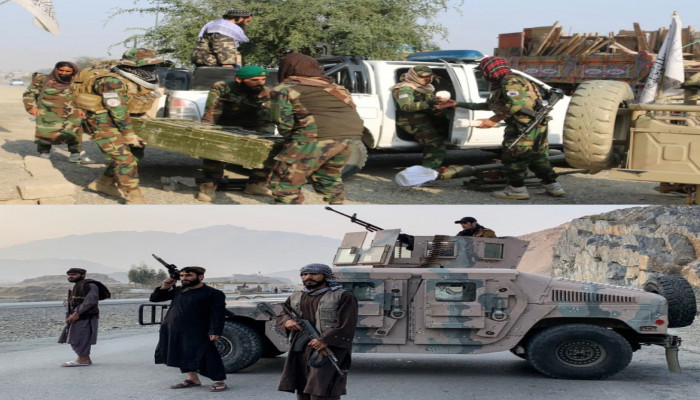
Afghanistan’s Taliban leadership has said it is ready to hold talks with Pakistan after heavy fighting broke out between the two neighbours. The statement came after Pakistan carried out airstrikes on several major Afghan cities, including the capital Kabul and Kandahar, where top Taliban leaders are based. Pakistan’s Defence Minister Khawaja Asif declared that the situation had turned into an “all-out confrontation,” writing on X, “Now it is open war between us and you.” The clashes follow months of rising tension and repeated exchanges of fire between the two sides.
Pakistan launched strikes on Kabul, Kandahar and other towns on Friday, while fighting also continued along the shared border. Both countries claimed they inflicted heavy losses on each other. Afghan government spokesman Zabihullah Mujahid said Taliban leaders are willing to negotiate to end the violence. He said, “The Islamic Emirate of Afghanistan has always tried to resolve issues through dialogue, and now also we want to resolve this matter through dialogue.” His statement came as both sides accused each other of starting the latest escalation.
The current round of violence began after Pakistan carried out airstrikes on Afghan territory last weekend. In response, Afghan forces launched retaliatory attacks along the border on Thursday. Tensions between the two countries have been building for a long time, mainly because Pakistan claims that Afghanistan is sheltering fighters from the Tehreek-e-Taliban Pakistan (TTP), also known as the Pakistan Taliban. Afghanistan has denied this accusation. Mujahid said Pakistani strikes targeted parts of Kabul, Kandahar and Paktia on Thursday night. On Friday, more strikes hit Paktia, Paktika, Khost and Laghman provinces.
Following those attacks, Afghan forces carried out drone strikes late on Thursday against Pakistani military positions and installations in northwest Pakistan near the border. Pakistan’s army spokesperson, Lieutenant General Ahmed Sharif Chaudhry, said that Pakistani air and ground operations killed at least 274 members of Afghan forces and allied fighters and wounded more than 400 others. He added that 12 Pakistani soldiers were killed and 27 were wounded, while one soldier was missing in action.
Mujahid rejected Pakistan’s claims about Afghan casualties, calling them “false.” He said that 55 Pakistani soldiers were killed and that the bodies of 23 of them were taken to Afghanistan. He also claimed that “many” Pakistani soldiers were captured. According to him, 13 Afghan soldiers were killed and 22 were wounded. He also said that 13 civilians were injured during the fighting. Later on Friday, the Afghan government stated that 19 civilians were killed and 26 others were injured when Pakistan carried out strikes in the southeastern provinces of Khost and Paktika.
The casualty figures given by both sides have not been independently verified by Al Jazeera. The current operation marks Pakistan’s most widespread bombardment of Kabul and its first airstrikes on Kandahar, the Taliban’s southern stronghold, since the Taliban returned to power in 2021.
Abdul Sayed, a Sweden-based analyst who studies conflict in Afghanistan and Pakistan, said that domestic factors in Pakistan limit its ability to start a full-scale war against Afghanistan. He explained, “This limitation stems from the deep ties between the populations of both countries, particularly the tribes residing on either side of the Durand Line,” referring to the 2,575-kilometre frontier that is internationally recognised as Pakistan’s border but not accepted as legitimate by Afghanistan. He added, “Consequently, despite its substantial military capabilities, Pakistan cannot sustain the large-scale bloodshed that an armed conflict with Afghanistan would entail.”
Relations between the two neighbours have sharply worsened in recent months. Most land border crossings have remained largely shut since deadly clashes in October that killed more than 70 people on both sides. After those clashes, Qatar and Turkiye helped broker an initial ceasefire, and several rounds of talks took place between Islamabad and Kabul. However, these efforts did not lead to a lasting agreement. After repeated violations of the truce, Saudi Arabia stepped in earlier this month and helped secure the release of three Pakistani soldiers who had been captured by Afghanistan in October.
International leaders have expressed concern about the situation. United Nations Secretary-General Antonio Guterres said he was “deeply concerned by the escalation of violence” between Afghanistan and Pakistan and the impact it is having on civilians. His spokesperson, Stephane Dujarric, shared this statement at a news briefing. Russia, Iran and Iraq are among the countries that have called for an immediate end to the fighting and urged both sides to reduce tensions.



 Loading...please wait
Comments