




Taiwan passes $25 billion defence spending bill after months of political deadlock
- In Reports
- 06:18 PM, May 08, 2026
- Myind Staff
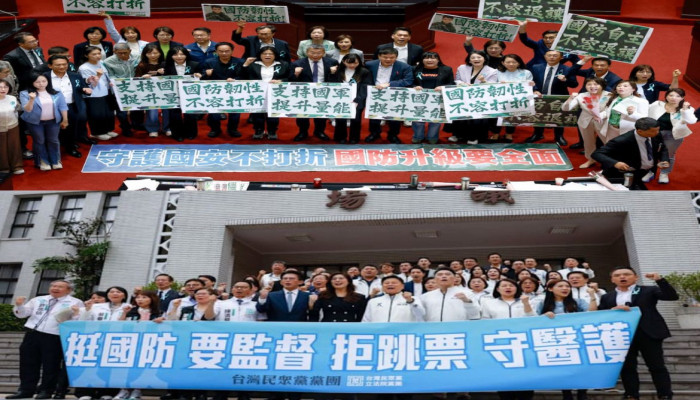
Taiwan’s parliament on Friday approved a defence spending bill worth nearly $25 billion after months of political disagreements over military spending and weapons purchases. The bill was passed following a final vote in parliament, with opposition lawmakers saying the approved funds would mainly be used for buying weapons from the United States.
The approved amount is significantly lower than the proposal put forward by President Lai Ching-te’s government, which had sought a defence budget of nearly $40 billion. The issue had led to prolonged political clashes between ruling and opposition parties over how much Taiwan should spend on strengthening its defence against a possible attack from China.
China claims Taiwan as part of its territory and has repeatedly threatened to take control of the island by force if necessary. Because of rising military pressure from Beijing, defence spending has become one of the most debated political issues in Taiwan.
The opposition Kuomintang, also known as the KMT, and the Taiwan People's Party announced before the vote that they were ready to increase their earlier proposal and approve a maximum of NT$780 billion, which is nearly $25 billion, but only for purchasing American weapons.
The KMT and TPP together control Taiwan’s 113-seat parliament. During Friday’s session, 107 lawmakers were present. The bill was passed with 59 votes in favour. The result was formally announced by the parliamentary speaker after voting concluded.
President Lai’s government has promised to increase Taiwan’s overall defence spending to more than three per cent of the country’s GDP this year. The administration had proposed a much larger defence package worth NT$1.25 trillion. The plan included spending not only on American weapons but also on Taiwan-made drones and other defence equipment.
The proposed special defence funds were meant to be spread over eight years. These funds would have been separate from Taiwan’s regular annual defence budget.
Lawmaker Chen Kuan-ting from Lai’s Democratic Progressive Party criticised the KMT leadership for excluding domestic defence procurement from the approved spending plan. He accused opposition leaders of weakening Taiwan’s military preparedness.
“If we restrict ourselves only to US arms purchases, then if one day Taiwan is encircled, Taiwan is blockaded, how are we going to maintain our ammunition supply and how are we going to sustain our combat capacity?” Chen said.
KMT lawmaker Hsu Chiao-hsin defended the opposition’s stand on defence spending. She said the party supported stronger military capabilities but objected to combining different categories of purchases into a single package.
The party supported “reasonable defence buildup and arms procurement”, but could not “accept lumping together arms sales, commercial purchases, and commissioned production”, Hsu said.
The debate over the bill also exposed divisions within the KMT itself. Months of internal disagreements left the party split over how much support should be given to the government’s defence plans. KMT chairperson Cheng Li-wun, who has faced criticism from both within and outside the party for being too close to China, had earlier pushed for an allocation of NT$380 billion for American weapons with room for future purchases.
However, pressure from the United States, Taiwan’s most important security ally, increased in recent weeks. Senior KMT lawmakers later demanded a much larger defence budget than what the party had originally proposed.
Taiwan’s parliament had already approved government agreements related to four major American weapons deals. These include M109A7 self-propelled howitzers, Javelin anti-armour missiles, TOW 2B missiles, and High Mobility Artillery Rocket Systems, commonly known as HIMARS.
The weapons form nearly $9 billion of the $11.1 billion arms package announced by Washington in December.
Before the vote, KMT caucus leader Fu Kun-chi said the party was ready to support a second phase of arms purchases worth more than $15 billion. According to Taiwan’s defence ministry, the package would include “Patriot missiles, Hellfire (missiles), and related counter-drone defence systems”.
Political analysts believe the final outcome was both a victory and a setback for President Lai’s government. Lev Nachman, a political science professor at National Taiwan University, said the result was a “huge blow to Lai”.
“This is much less than (his) proposed budget, but it is still greater than zero,” he said.
Taiwan analyst Wen-Ti Sung said the KMT’s decision showed enough support for US-Taiwan security ties to reduce criticism from Washington, while also avoiding angering Beijing.
The development comes just days before US President Donald Trump is expected to travel to Beijing for a summit with Chinese President Xi Jinping. Xi has repeatedly warned the United States against increasing arms supplies to Taiwan.
Cheng recently visited China and met Xi during her trip. She has also expressed hopes of visiting the United States in June.



 Loading...please wait
Comments