




Taiwan partners with U.S. firm Kratos to develop low-cost attack drones against rising China threat
- In Reports
- 02:44 PM, Feb 06, 2026
- Myind Staff
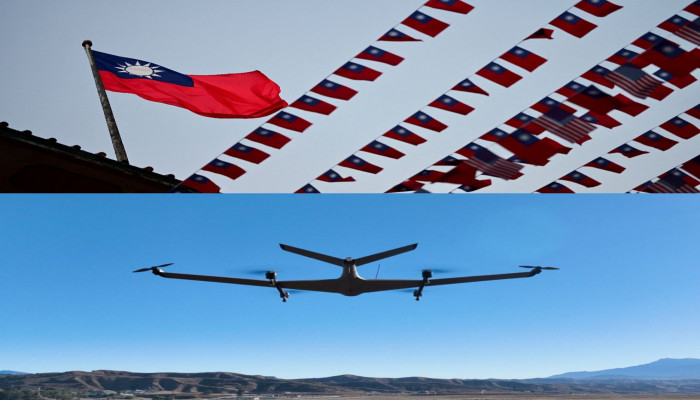
Taiwan’s military and U.S.-based defence company Kratos Defense have successfully tested a new jet-powered attack drone, in a move aimed at quickly increasing Taiwan’s ability to deploy “large numbers” of low-cost drones as the threat from China continues to rise.
According to a statement released by Kratos on Thursday, the test campaign was conducted at the company’s facility in Oklahoma City. During the testing, engineers from both Kratos and Taiwan worked together to validate the integration of a Taiwanese mission payload onto the Mighty Hornet IV attack drone.
Kratos described the successful test as a “milestone” that could open the door for deeper cooperation between the company and Taiwan’s leading military research organisation, the National Chung-Shan Institute of Science and Technology (NCSIST).
Taiwan has been actively working to strengthen its security ties with the United States. This includes efforts to jointly develop and manufacture weapons systems. The cooperation comes as China continues to increase military pressure on Taiwan, in an attempt to force the democratically governed island to accept Beijing’s sovereignty claims.
In its own statement, NCSIST called the project a “new milestone in U.S.-Taiwan defence technology collaboration.” The organisation said such cooperation can shorten development timelines and meet Taiwan’s needs for “rapid countermeasures and long-range preemptive strikes.”
The Mighty Hornet IV drone is being developed as a low-cost weapon similar to a cruise missile. Kratos stated that both sides are aiming to base a “large quantity” of these systems in Taiwan. The drones are expected to serve both as a deterrent and as an important wartime asset if conflict occurs.
China views Taiwan as its own territory despite Taiwan’s objections. In recent years, Beijing has been frequently sending warplanes and warships near Taiwan’s airspace and surrounding waters. Taiwan’s government has described these actions as “grey zone” tactics.
China also carried out its latest large-scale war games near Taiwan in late December, further increasing tensions in the region.
Taiwan’s defence minister said this week that the number of detected Chinese military aircraft operating near Taiwan, including fighters and drones, rose by 23% in 2025 compared to the previous year.
Taipei has been focusing on obtaining cheaper and more widely available unmanned systems, as these are seen as important tools for making any potential Chinese attack more difficult.



 Loading...please wait
Comments