



Supreme Court to consider urgent hearing on plea challenging UGC equity regulations 2026
- In Reports
- 05:06 PM, Jan 28, 2026
- Myind Staff
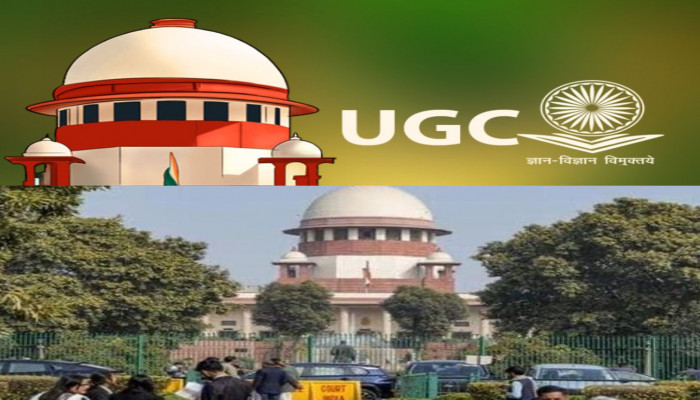
The Supreme Court on Wednesday agreed to consider an urgent listing of a petition challenging the constitutional validity of the University Grants Commission (Promotion of Equity in Higher Education Institutions) Regulations, 2026. The move comes amid growing debate and controversy surrounding the new rules that aim to address caste-based discrimination in higher education institutions.
The matter was mentioned before Chief Justice of India (CJI) Surya Kant by advocate Parth Yadav, who appeared on behalf of social activist and entrepreneur Rahul Dewan. During the hearing, Yadav requested the court to take up the case urgently, arguing that the implementation of the regulations could lead to discrimination and that the issue needed immediate judicial examination.
Responding to the request, CJI Surya Kant said that the court would consider assigning an early date for hearing the matter. He also directed the counsel to remove all defects in the petition so that it could be listed before the court. This development marks an important step in the legal challenge against the newly notified equity regulations.
Rahul Dewan’s petition is one of at least three petitions that have reached the Supreme Court against the 2026 regulations. These rules were notified by the University Grants Commission (UGC) on January 13, replacing the earlier framework of 2012. One of the earlier petitions was filed by Mrityunjay Tiwari, a post-doctoral researcher at Banaras Hindu University in Uttar Pradesh. Another petition was filed by advocate Vineet Jindal on Tuesday morning.
The court proceedings have taken place in the context of a wider national debate over the UGC’s newly notified equity regulations. The rules require universities, colleges, and deemed institutions to establish Equal Opportunity Centres and equity committees. These bodies are meant to address complaints of discrimination and promote inclusion on educational campuses. The regulations are also linked to an August 2019 Supreme Court petition that sought stronger safeguards against discrimination in higher education.
While marginalised student groups have welcomed the new framework, several upper-caste organisations and students have opposed it. They have claimed that the regulations are vague and could be misused. On Tuesday, some upper-caste students staged protests outside the UGC headquarters in Delhi, demanding that the regulations be rolled back.
In response to these concerns, Union Education Minister Dharmendra Pradhan sought to reassure protesters. He said, “I want to humbly assure everyone that no one is going to face any harassment. There will be no discrimination and no one will have the right to misuse the regulation in the name of discrimination.” He further added that the new framework would function strictly within the boundaries of the Constitution.
The petitions before the Supreme Court primarily challenge Regulation 3(c) of the 2026 rules. This provision defines “caste-based discrimination” as discrimination “only on the basis of caste or tribe” against members of the Scheduled Castes (SC), Scheduled Tribes (ST), and Other Backward Classes (OBC). The petitioners argue that this definition is problematic because it assumes that caste-based discrimination happens only in one direction.
According to the petitions, the definition excludes students from the general category from the scope of protection and creates a presumption of guilt without sufficient safeguards. Advocate Vineet Jindal’s petition argues that the provision is arbitrary, discriminatory, and violates fundamental rights. It also claims that the regulation is ultra vires the University Grants Commission Act, 1956. The petition seeks a declaration that Regulation 3(c) is unconstitutional. Alternatively, it asks the court to read down the provision and adopt a caste-neutral and inclusive definition of discrimination. Jindal has also sought an interim restraint on the enforcement of the provision.
In his petition, Mrityunjay Tiwari has also questioned the underlying assumption of the regulation. He has argued that the definition is based on an “untenable presumption” that caste-based discrimination is unidirectional. He stated that, “by design and operation,” the regulations give “legal recognition of victimhood” only to certain reserved categories, while excluding general or upper-caste students from protection and grievance redressal mechanisms.
Government officials, however, have ruled out any rollback of the regulations. They have maintained that the equity framework is intended to protect all stakeholders on educational campuses. Officials have emphasised that the Constitution places a greater responsibility on the State to protect marginalised communities, which is why the regulations explicitly refer to SC, ST, and OBC students. At the same time, they have clarified that the grievance redressal mechanisms under the regulations are open to all categories of students, faculty, and staff.
The equity regulations also lay down specific institutional mechanisms to ensure implementation. Each institution is required to set up a 10-member equity committee chaired by the head of the institution. The committee must include representation from reserved categories, women, and persons with disabilities. The regulations also require the committee to act on complaints within strict timelines. In addition, the framework provides for equity squads, a 24-hour helpline, and equity ambassadors to promote awareness and inclusion across campuses.
As the Supreme Court prepares to consider the urgent listing of the petitions, the debate over the UGC’s equity regulations continues to intensify. The outcome of the legal challenge is expected to have significant implications for how discrimination and inclusion are addressed in India’s higher education system.



 Loading...please wait
Comments