




Supreme Court sets up five-member committee to probe use of excessive police force against protesters
- In Reports
- 10:20 PM, Aug 20, 2026
- Myind Staff
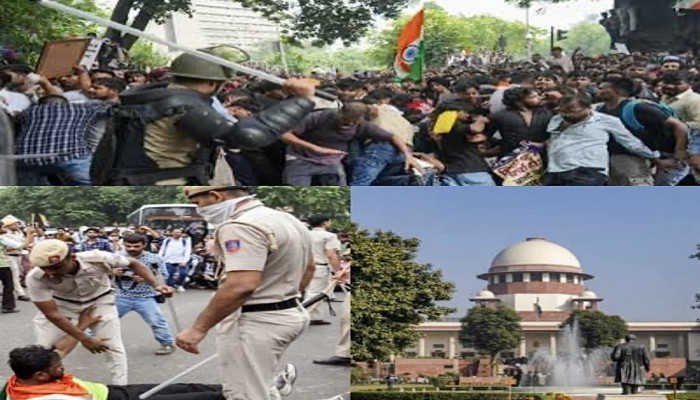
The Supreme Court has formed a five-member High-Powered Enquiry Committee (HPEC) to investigate allegations of excessive force used by police, paramilitary forces and other security personnel against protesters. Former Supreme Court judge Justice R. Subhash Reddy will head the panel. The committee will examine claims of disproportionate crowd-control measures and alleged violations of protesters’ rights.
The other members of the panel are former Punjab and Haryana High Court Chief Justice Ravi Shankar Jha, former Delhi High Court judge Justice Shalinder Kaur, former CBI Director Rishi Kumar Shukla and retired Meghalaya Director General of Police Dr L.R. Bishnoi. The committee will examine the allegations against security personnel as well as the concerns raised by authorities over violence against police personnel and damage to public property.
The HPEC will look into allegations of excessive use of force during protests. These include the use of pellet guns, electric batons, lathi charges and tear gas without adequate warning or in a manner that was not proportionate to the situation. The inquiry will examine claims that such actions caused severe injuries, including some that were allegedly grievous and lasting.
The committee will also consider how police and security forces should respond to protests, public gatherings and peaceful assemblies. It will examine whether the response was measured and proportionate while maintaining public order. The inquiry will also assess how authorities can balance the need for public safety with the constitutional right to peaceful dissent.
Another key issue before the panel is the demand to prohibit metallic kinetic projectiles or pellets fired from pump-action rifles or projectile-action guns. The committee will examine whether such weapons should be banned in crowd-control operations, keeping in view the serious and sometimes irreversible injuries that their use can cause to protesters.
The panel will also examine concerns about the identification of police and security personnel during arrests and crowd-control operations. It will consider whether officers should be required to wear proper uniforms and visible nameplates while using force or making arrests. Such measures could help establish accountability and make it easier to identify individual officers involved in an incident.
The alleged monitoring and surveillance of protesters will also come under the committee’s review. It will examine whether police personnel carried out such surveillance and whether those actions were consistent with protesters’ constitutional rights to privacy and freedom of peaceful assembly.
The HPEC will separately examine allegations of targeted violence, harassment, molestation and secondary victimisation of women protesters. The Supreme Court has identified these allegations as matters requiring focused and speedy examination due to their seriousness and sensitivity.
The committee will also assess the medical and other support provided to people who allegedly suffered abuse at the hands of police. This includes examining the adequacy of medical assistance and compensation provided to victims so far. The panel will consider whether affected individuals received the support required after sustaining injuries during protests.
Another issue concerns the use of blanket prohibitory orders under Section 163 of the Bharatiya Nagarik Suraksha Sanhita, 2023. The committee will examine whether such orders were imposed routinely or as a preventive measure that restricted peaceful assembly. It will consider whether authorities used these powers only when there was a genuine and proportionate threat to public order.
The panel will also examine the use of Section 152 of the Bharatiya Nyaya Sanhita, 2023. The inquiry will consider whether the provision has been used in a way that could restrict political dissent or peaceful protests. It will assess the need for strict constitutional safeguards so that the provision remains limited to its intended purpose and does not discourage people from exercising their rights to speech and peaceful assembly.
The Supreme Court said the parties were given freedom to place their suggestions before it on the issues that must be considered by the HPEC. After examining the material submitted by all sides, the court broadly identified the concerns raised by the petitioners. These issues now form the core areas of the committee’s inquiry.
The panel’s investigation will therefore cover the use of force, crowd-control methods, police accountability, surveillance, alleged violence against women protesters, medical assistance and compensation. It will also examine the use of prohibitory orders and laws that may affect the rights to peaceful protest and political expression. At the same time, the committee will consider the authorities’ allegations of violence against security personnel and damage to public property.



 Loading...please wait
Comments