




Supreme Court rejects mandatory ethanol content disclosure plea, directs to High Court
- In Reports
- 05:21 PM, Aug 31, 2026
- Myind Staff
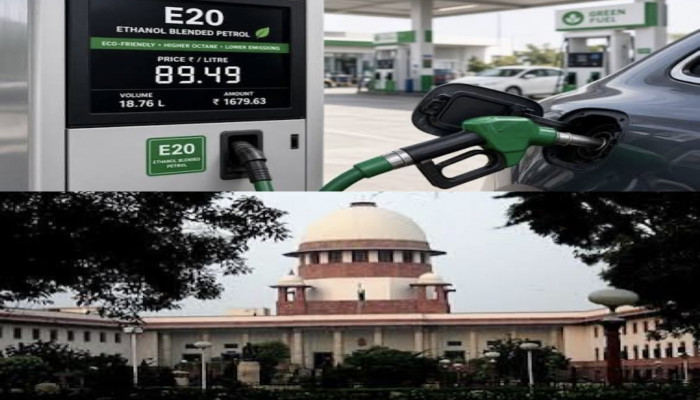
The Supreme Court on Monday declined to entertain a petition seeking mandatory disclosure of the ethanol content in petrol at fuel stations and on fuel bills and receipts. A bench of Justices MM Sundresh and Prasanna B Varale refused to hear the plea under Article 32. The court, however, gave petitioner Narendra Kumar Goswami the liberty to approach the concerned High Court with his grievances.
Goswami had sought directions to authorities to ensure that fuel stations prominently and uniformly display the exact percentage of ethanol blended into petrol on every dispensing nozzle. He also sought a mandatory requirement for fuel invoices, bills and receipts to clearly state the percentage of ethanol in the petrol purchased by consumers.
The petitioner argued that consumers have a right to know the composition of the fuel being sold to them. During the hearing, Goswami told the court, “See the receipt; there is no mention of ethanol. I have the right to know," Goswami submitted. He maintained that buyers should receive clear information about the fuel they are purchasing at petrol pumps.
The plea also sought the creation of an official and publicly accessible database showing vehicle-wise compatibility with different ethanol blends. Goswami proposed that the database should allow consumers to search information based on the vehicle manufacturer, model, engine type and year of manufacture. It should clearly indicate which ethanol blends are suitable for different vehicles.
The petitioner further sought a transparent framework for the transition of older vehicles and vehicles that may not be compatible with higher ethanol blends. He also asked authorities to consider making lower-ethanol petrol available wherever it is technically, economically and logistically feasible.
Another major request involved the formation of an independent expert committee. Goswami proposed that the committee include representatives from the Petroleum Ministry, Ministry of Road Transport and Highways, Bureau of Indian Standards, ARAI or ICAT, consumer organisations, automobile engineers, fuel technologists, environmental and public-health experts and water-resource specialists.
The proposed committee would examine several issues linked to the country's ethanol-blending programme. These would include the real-world compatibility of E20 petrol with India's existing vehicle fleet. It would also study the impact of E20 fuel on fuel efficiency, engine life and maintenance costs. Warranty and insurance concerns would also form part of the review.
The committee was also proposed to examine the wider environmental impact of ethanol blending. This would include tailpipe emissions and the amount of water required for ethanol production. The petitioner also raised concerns over food security and the diversion of crops and other resources towards ethanol production.
Goswami's petition further asked the government to place before the Supreme Court the policy files and technical material that formed the basis of the compulsory rollout of E20 petrol. This included technical studies, vehicle compatibility reports, safety standards, consumer advisories and records of public consultations.
The plea also called for a national Consumer Disclosure Protocol for ethanol-blended petrol. Goswami proposed that the protocol be prepared in consultation with the Central Consumer Protection Authority and the Bureau of Indian Standards. The aim was to establish clear and uniform disclosure requirements for consumers across fuel stations.
During the hearing, Goswami also referred to an earlier proceeding in which he claimed that the Attorney General had described the ethanol-blending programme as an “experiment". According to the petitioner, the Centre later issued a clarification stating that the Attorney General had not made such a statement. Goswami subsequently sought an assurance from the Centre on the issue.
The Attorney General for India opposed the manner in which Goswami was pursuing the petition. “He wants the government of India to be answerable to him!" the Attorney General said.
Goswami rejected the suggestion that the petition sought any personal benefit. He argued that the issue concerned the rights of citizens. “Not to me, to the citizens of India. We have the right to know what we are purchasing," he argued.
The Attorney General also described the plea as a “proxy petition". He pointed out that the Supreme Court had dismissed a similar petition last year.
The Supreme Court ultimately declined to entertain Goswami's plea under Article 32. The bench did not examine the merits of the various demands raised in the petition. It instead allowed Goswami to approach the appropriate High Court and seek relief over the disclosure of ethanol content, vehicle compatibility and other concerns linked to ethanol-blended petrol.



 Loading...please wait
Comments