




Supreme Court rejects blanket internet ban for children , calls access a fundamental right
- In Reports
- 04:46 PM, Oct 18, 2026
- Myind Staff
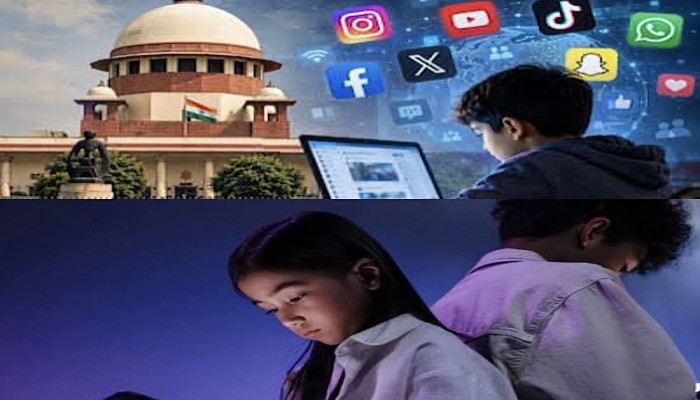
The Supreme Court has recognised internet access as a fundamental right for every individual, including children, and rejected a blanket age-related ban on its use. The court called for stronger safeguards to protect children from online sexual abuse while preserving their freedom.
"We have no hesitation in saying that the right to access and use the internet is a fundamental right of every individual under Article 21 read with Article 19(1)(a) of the Constitution," the court observed on Friday.
It added: "Our children, irrespective of their age, enjoy the same rights, and to deny the same altogether would be as absurd as saying children below a certain age do not have a conscience worth protecting or a freedom of speech worth expressing."
Justices J B Pardiwala and K V Chandran made the observations on October 15 while hearing applications filed by child rights NGO Just Rights for Children Alliance and another applicant. They alleged that social media platforms were failing to meet their legal obligations to report child sexual exploitation and abuse material (CSEAM) to Indian authorities.
"The safety of our children and their freedom are not at odds with each other. Our children are entitled to both," the bench stated.
The court refused to impose a blanket age-based restriction. Instead, it called for stricter parental controls, the removal of sexual abuse material and child mode features on social media platforms. It observed that children continue to use the internet even when laws prohibit them from doing so.
The bench also criticised authorities and social media intermediaries for their "lack of earnest initiative to protect the victims". It flagged the repeated circulation of child abuse material despite existing guidelines.
"We are deeply saddened to note that the news reports placed before us by the applicants flagging alleged incidents of paid promotions of CSEAM on social media platforms through redirect links and websites is only one rare instance of such harmful activities being discovered and brought to light," the court noted.
"There comes a time when we must ask ourselves, how many more victims of such harmful content must continue to suffer, before our conscience is stirred into making collective effort in the right direction," it added.
The applicants sought uniform reporting procedures, a centralised portal and action against non-compliant platforms. Addressing these concerns, the court directed the Centre to establish a national database of digital identifiers and URLs linked to confirmed abusive material to support its detection and removal.
The bench also directed the Centre to frame guidelines and standard operating procedures for perceptual hash-matching, URL listing and other technological measures to identify and remove such content.
"We cannot emphasise this enough, that there can be no space for non-consensual sexually exploitative and abusive material on the internet, particularly on platforms that are readily accessible to the most impressionable and vulnerable of our society."



 Loading...please wait
Comments