




Supreme Court pulls up Mamata Banerjee for disrupting ED raids on I-PAC office
- In Reports
- 07:41 PM, Apr 22, 2026
- Myind Staff
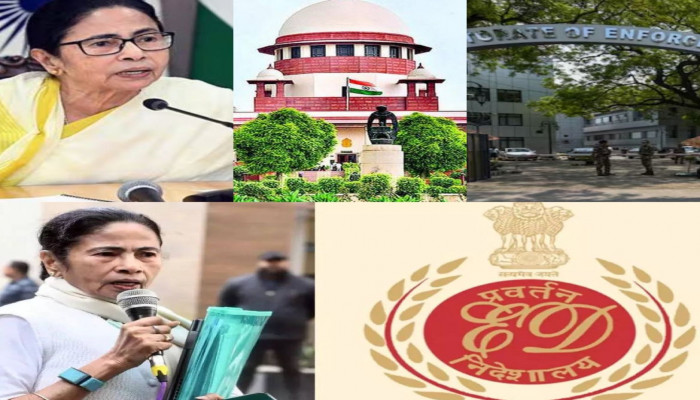
The Supreme Court on Wednesday strongly criticised West Bengal Chief Minister Mamata Banerjee for interfering in an ongoing Enforcement Directorate (ED) investigation involving the political consultancy firm I-PAC. The court made it clear that a sitting Chief Minister has no authority to step into or disrupt a probe being conducted by a central agency. It also rejected the argument that the issue should be treated as a dispute between the Centre and the state.
The observations came from a two-judge bench comprising Justice Prashant Kumar Mishra and Justice N V Anjaria while hearing a writ petition filed by the ED. The agency has sought the registration of a CBI FIR against Mamata Banerjee and certain West Bengal police officials. The ED has alleged that they obstructed its raid on I-PAC, which works as a political consulting firm for the Trinamool Congress. Alongside this, ED officers have also filed a separate writ petition challenging the FIR registered against them by the West Bengal Police.
During the hearing, the bench questioned the state’s argument that the matter was a Centre versus state dispute. Rejecting this claim, Justice Kumar said, "What right of the State does this involve? This is not a dispute between the State and the Central government. You cannot walk in. Any Chief Minister of any State walks in the midst of an inquiry or investigation, and you say that it is essentially a dispute between the State and the Central government?" The court further raised concerns about the implications such actions could have on democratic institutions.
Continuing with his remarks, Justice Kumar stated, "Any Minister just walks in the midst of an enquiry, and you see make the democracy in peril and argues that it's a dispute essentially between the state and centre?" The bench appeared unconvinced by the justification offered by the State and stressed that such conduct cannot be defended under the framework of federal conflict.
Solicitor General Tushar Mehta, representing the ED, informed the court that incriminating material had allegedly been taken away by the Chief Minister during the incident. This added weight to the ED’s claim that the investigation had been obstructed in a serious manner.
Justice Kumar further clarified the court’s position by stating, "This is not per se a dispute between the State and the Union. This is, per se, an act committed by an individual who happens to be the Chief Minister of a State, keeping the whole system and the whole democracy in... You are saying that, if at all, this can be maintainable, it cannot be maintained under Article 32 but only under Article 132... You have taken us through Kesavananda Bharati and Seervai. But none of them would have ever conceived of this situation—that in this country a day will come when a sitting Chief Minister will walk into the office of some other agency." The remarks highlighted the court’s concern about the unprecedented nature of the situation.
The case is linked to raids conducted by the ED on January 8 as part of a money laundering investigation related to an alleged multi-crore coal smuggling scam. According to the ED, Mamata Banerjee arrived at the I-PAC office and the residence of its founder, Pratik Jain, during the searches. She was reportedly accompanied by over 100 police personnel and senior officials.
The agency has alleged that during this visit, key evidence was removed without proper authority. This included laptops, mobile phones, and documents that contained important electoral data. These actions, the ED claims, directly interfered with the investigation process.
In earlier proceedings, the Supreme Court had already described the situation as “very unusual” and called it an “unhappy situation.” The court had also expressed concern over the lack of clear legal remedies in cases where a senior state functionary is accused of obstructing a central agency’s work.
The ED has urged the court to order a probe by the Central Bureau of Investigation into the alleged interference. It has also requested appropriate legal action against both the Chief Minister and the state’s Director General of Police. The agency argued that central investigative bodies should not be left without remedies if their operations are physically blocked.
On the other hand, the West Bengal government has opposed the ED’s plea. Senior advocates Kapil Sibal and Abhishek Manu Singhvi, appearing for the state, argued that the petition is not maintainable. They stated that the ED, being a government department, cannot claim fundamental rights or directly approach the Supreme Court under Article 32.
The state has also maintained that the ED’s actions are politically motivated. It alleged that the raids are aimed at weakening the Trinamool Congress ahead of the 2026 West Bengal Assembly elections.
In a related development, I-PAC co-founder Vinesh Kumar Chandel was arrested on April 13 in connection with the same case. Following his arrest, the organisation is reported to have scaled down or paused its operations in West Bengal. A court at Patiala House remanded Chandel to 10 days of ED custody. He is expected to remain in custody until April 23 as the investigation continues.
The case has now raised larger questions about the limits of authority, the independence of investigative agencies, and the balance between state and central powers.



 Loading...please wait
Comments