




Supreme Court orders release of protestors without criminal antecedents, mulls independent probe
- In Reports
- 02:22 PM, Jul 28, 2026
- Myind Staff
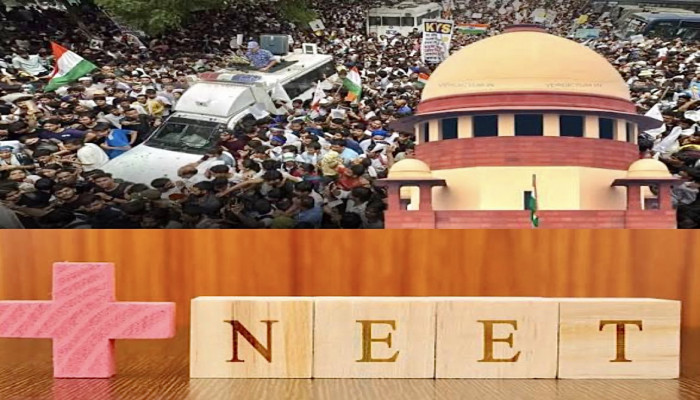
The Supreme Court on Tuesday directed authorities to release students who were arrested or detained during the recent nationwide protests if they do not have any criminal antecedents. The court also ordered that no coercive action should be taken against such students. At the same time, it indicated that an independent investigation may be required to examine allegations of violence involving both protesters and police personnel during the demonstrations.
The directions came while the Supreme Court heard a batch of petitions that alleged police excesses during protests over examination-related issues, including the alleged NEET paper leak. A bench comprising Chief Justice of India Surya Kant and Justices Joymalya Bagchi and V Mohana passed several interim directions to safeguard the rights of students and ensure that evidence linked to the incidents remains protected.
The bench made it clear that students who participated in the protests should not face arrest or detention if they have no criminal record. It ordered the release of all such students who remain in custody. The court also directed authorities not to initiate any coercive action against them while the matter remains under consideration.
To ensure that all relevant evidence remains available for further proceedings, the Supreme Court directed authorities to preserve CCTV footage, drone recordings, body-worn camera footage, wireless communication records and Police Control Room (PCR) logs connected to the incidents. The bench said these records could play an important role in determining what happened during the protests.
The court also ordered authorities to protect the personal information and digital data of student protesters. It directed that such information should not be placed in the public domain for the time being. The bench stressed the need to protect the privacy of the students while the case is being examined.
During the hearing, the Supreme Court observed that the material placed before it made out a prima facie case for a fair and independent investigation. The bench sought responses from the Union government and the governments of Assam, Bihar, West Bengal, Uttar Pradesh, Madhya Pradesh, Maharashtra and Kerala. It also indicated that it may constitute a Special Investigation Team (SIT), headed by a retired Supreme Court judge, to ensure a transparent inquiry into the incidents.
The Chief Justice referred to several allegations mentioned in the petitions. These included claims of the use of shock batons, pellet gun injuries, assaults on lawyers, violence by police personnel who were allegedly dressed in civil clothes and injuries suffered by a 19-year-old girl. The bench noted that these allegations required careful examination through an independent process.
At the same time, the court also considered petitions filed on behalf of injured police personnel. It observed that an independent investigation would help determine responsibility wherever excesses had taken place. The bench made it clear that the proposed inquiry would examine allegations against all sides involved in the incidents.
Solicitor General Tushar Mehta appeared before the court on behalf of the Centre. He told the bench that if students had indeed been attacked, it was a serious matter that the government could not ignore.
He also informed the court that around 250 police personnel were injured during the protests. The Solicitor General suggested that anti-social elements may have infiltrated the demonstrations. He agreed with the court's proposal to conduct an independent investigation under the supervision of a retired judge appointed at the court's discretion.
The petitions before the Supreme Court relate to protests that began on July 20 over alleged irregularities in examinations, including the alleged NEET paper leak. The petitioners claimed that police used excessive force against protesters, carried out large-scale detentions and violated established crowd-control protocols. They requested an independent inquiry into the police action taken during the demonstrations.
During earlier hearings, the Supreme Court had reiterated that the Constitution protects the right to peaceful and lawful protest. The bench observed that participation in a protest cannot, by itself, justify excessive use of force or a lathi charge. The court once again underlined the importance of protecting constitutional rights while maintaining law and order.
The latest directions provide interim relief to students who took part in the protests and ensure that evidence connected with the incidents remains protected. The Supreme Court will now consider the responses of the Union government and the concerned states before deciding on the next course of action, including the possible formation of an SIT to carry out an independent and transparent investigation into the allegations raised by both students and police personnel.



 Loading...please wait
Comments