




Supreme Court grills Indian Young Lawyers Association for Sabarimala PIL
- In Reports
- 09:48 PM, May 05, 2026
- Myind Staff
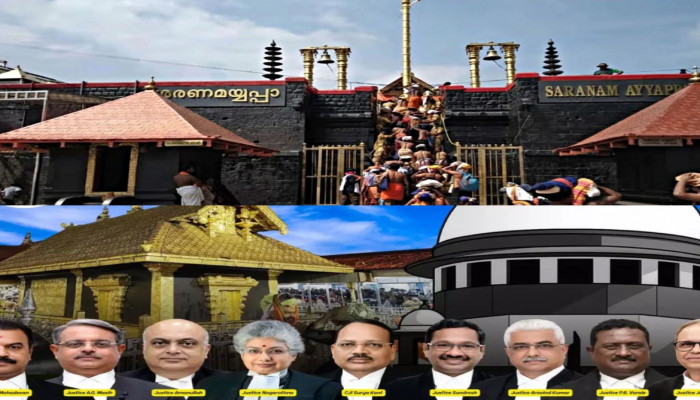
A nine-judge Bench of the Supreme Court of India raised sharp questions during a hearing on issues linked to the Sabarimala temple case. The Bench expressed concern over why a lawyers’ body had filed a public interest litigation (PIL) on a matter related to religious practices. The remarks came while hearing broader constitutional questions connected to the entry of women into the Sabarimala Temple.
The case stems from a PIL filed by the Indian Young Lawyers' Association. This petition led to the landmark 2018 judgment of the Supreme Court, which allowed women of all age groups to enter the temple. That ruling had overturned a long-standing custom that restricted entry of women of menstruating age. The verdict had triggered widespread protests across Kerala at the time.
During the current hearing, the Bench, led by Chief Justice of India Surya Kant, questioned the intent behind filing such a PIL. The Bench also included Justices BV Nagarathna, MM Sundresh, Ahsanuddin Amanullah, Aravind Kumar, Augustine George Masih, Prasanna B Varale, R Mahadevan and Joymalya Bagchi. The judges repeatedly asked why a legal association chose to intervene in a matter of faith.
“Who are you? Why are you concerned with all this, you please tell us,” said Justice BV Nagarathna.
“I am a believer,” the lawyer responded.
“Are you the Chief Priest of the country?” CJI Kant questioned.
“How are you concerned? Mind your business!” Justice BV Nagarathna added.
The Bench is currently examining seven key legal questions related to religious rights and freedoms in India. These questions arise from the review proceedings of the Sabarimala judgment. The Court began hearing this reference on April 7 and is focusing only on legal principles, not factual disputes.
The outcome of this case is expected to have a wide impact. It could influence several pending matters, including issues related to the entry of Muslim women in religious spaces, the excommunication of Parsi women who marry outside their community, and practices such as female genital mutilation in certain groups. The Court is also examining questions around the Essential Religious Practices test and the balance between fundamental rights under Articles 25, 26, and 14 of the Constitution.
The present proceedings are linked to the Supreme Court’s September 2018 judgment. In that decision, a five-judge Constitution Bench ruled by a 4:1 majority that women of all ages could enter the Sabarimala temple. This verdict set aside the traditional restriction on women of menstruating age. Following the ruling, several review petitions were filed challenging its correctness.
In November 2019, the Court delivered its decision on those review petitions. It noted that larger constitutional questions needed deeper examination. These included the interpretation of essential religious practices and the conflict between earlier rulings such as the Shirur Mutt case and the Durgah Committee case. As a result, the matter was referred to a larger nine-judge Bench, which is now hearing the case.
During the hearing, the counsel for the Indian Young Lawyers' Association challenged a report by a temple tanthri. The report had stated that Bhagwan Ayyappa does not prefer young women entering the temple. The lawyer argued against this claim.
“Is it in regard of Bhagwan Ayyappa or is it an insult of Bhagwan Ayyappa, (to say) that the ‘deity does not like young ladies’? This is not the belief. This could never be the belief,” he said.
However, this argument led to further questioning from the Bench. The judges again raised doubts about the role of the lawyers’ association in such matters. They questioned whether a legal body could claim religious beliefs.
“I (women members of the association) am first a woman, then I am a Hindu, then I am any other thing! My womanhood has been attacked. And you are putting words into Bhagwan Ayyappa? That Bhagwan Ayyappa does not like young ladies?” the lawyer replied.
“The Young Lawyers Association has no other business? They can’t work for the welfare of the Bar or assist the Bench or the legal system of this country?” Justice Nagarathna retorted.
“There are so many PILs,“ the lawyer contended.
“Work for the Bar, work for the younger members, work for their welfare, those who are struggling in the country from rural areas, they have difficulty coming to the city to argue cases, they are brilliant minds.. Work for them, rather doing this kind (of work) in the Supreme Court!” Justice Nagarathna replied.
Justice Aravind Kumar then asked whether the association had formally approved the filing of the PIL. He questioned if any resolution had been passed and whether the President of the association had signed it. Justice Nagarathna also asked if the association was officially registered.
Earlier, Justice Kumar had asked for the name of the association’s President. This point had drawn attention earlier as well, as the President’s identity had become a matter of public debate in 2018.
Responding to the Court, the association’s counsel said that the body was registered. However, he added that he was not aware of any formal resolution being passed to file the PIL.
Justice MM Sundresh then advised the lawyer to focus only on the legal issues identified for the nine-judge Bench. He made it clear that the Court was not examining factual aspects at this stage. He also criticised the association for taking up this issue.
"Don’t embarrass and expose yourself and embarrass the Court by taking up causes like this. We can’t say anything beyond this. It is a clear case of abuse of process of law. We are very sorry to say this. Alright, now, what do you want to say on seven issues framed? At least now, we don’t want to embarrass you. Please go into the legal issues and make your submissions. We are reasonable enough to hear you. Please tell us on the issues framed.. We have said at the beginning, we will not address issues of fact. That will be decided at later point of time. We are purely on the question of law. That’s what we are asking, if you have nothing else to offer, say it and we will go to the next point of law," Justice Sundresh said.
The lawyer responded by stating that the Court itself had not allowed the withdrawal of the PIL earlier. He said one of the petitioners had wanted to withdraw the case, but the Court had refused.
He further added that a Bench led by former Chief Justice of India Dipak Misra had held that the PIL could not be withdrawn due to threats or because of the identity of the association’s President.
At this point, the Court cautioned the lawyer against referring to individual judges in this manner during arguments.
Justice Nagarathna continued to question the purpose behind the petition.
"We want to know why you filed this PIL at all? What was it that you wanted to achieve? What good has come out of it?" she asked.
The lawyer replied that these issues had already been considered when the PIL was first admitted.
The Bench, however, continued to press for clarity on the petitioner’s belief and intent.
“What is your belief? That is what we want to know," the judges said.
The lawyer responded by explaining his personal approach to faith.
“I would not enter any temple unless I have belief. There is a temple of Bhagwan Hanuman where you have to offer bottle of drinks, just 4 km from here. I do not enter, because I don’t believe in it. I don’t want to offer a bottle of drinks to Bhagwan Hanuman, so I will not enter. If I am entering a temple, masjid or church, we have to follow the norms. So far as faith is concerned - the belief extracted from Kerala High Court Division Bench judgment, after research they (tanthri) have said Bhagwan Ayyappa does not like young ladies. This would not be the belief to the exclusion of others," he said.
The hearing is still in progress. The Court is expected to continue examining the legal questions that could shape the interpretation of religious rights and equality in India.



 Loading...please wait
Comments