



Supreme Court allows Hindu Puja and Namaz at Bhojshala site on Basant Panchami
- In Reports
- 06:47 PM, Jan 22, 2026
- Myind Staff
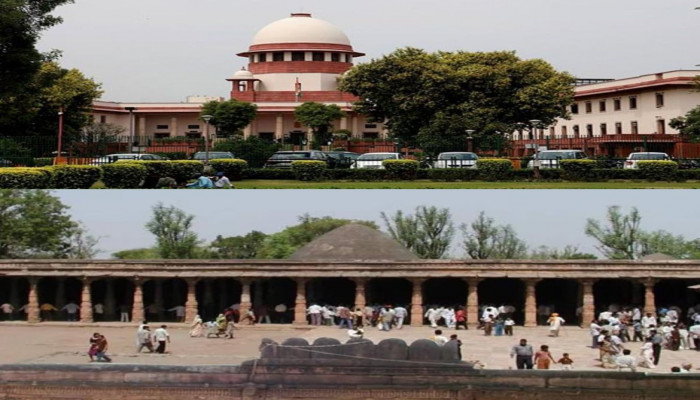
The Supreme Court on Thursday allowed both Hindu puja and Muslim namaz at the disputed Bhojshala Temple–Kamal Maula Mosque complex in Dhar district of Madhya Pradesh on Basant Panchami, which will be observed on Friday. The court issued detailed directions after the Madhya Pradesh government agreed to make arrangements for separate entry and exit for members of both communities and to ensure law and order at the site.
A bench headed by Chief Justice of India Surya Kant, along with Justices Joymalya Bagchi and Vipul M Pancholi, also directed the Madhya Pradesh High Court to share copies of a scientific survey report of the disputed site conducted by the Archaeological Survey of India (ASI) with the opposing parties.
The matter came up after an organisation, the Hindu Front for Justice, filed a plea seeking permission for day-long rituals at the Bhojshala site on Basant Panchami. The issue arose because this year Basant Panchami coincides with Friday, when Muslims traditionally offer namaz at the site.
During the hearing, Advocate Vishnu Shankar Jain, appearing for the applicant, pointed out that while the ASI allows puja and namaz on separate days, the coincidence of Basant Panchami with Friday created a special situation. The court initially suggested whether Hindus could perform rituals until around noon and then continue after 3 pm, once the namaz was completed.
Senior Advocate Salman Khurshid, representing the Muslim side, stated that only two hours would be required for namaz. Jain, however, argued that Basant Panchami rituals continue throughout the day and questioned whether the namaz could be shifted to after 5 pm. Khurshid expressed his inability to agree to that suggestion.
Additional Solicitor General K M Nataraj, appearing for the state government, said the administration was prepared to create separate entry and exit routes and distinct spaces within the same compound if the expected number of worshippers from both communities was provided. He assured the court that such arrangements could allow both communities to worship simultaneously without disturbing each other.
Both sides eventually agreed to the suggestion, following which the court issued formal directions. In its order, the bench said, “A fair suggestion was given that in the afternoon, for namaz within 1 and 3 pm, an exclusive and separate area within the same compound, including separate ingress and egress within the same compound, shall be made available so that namaz can be performed. Similarly, a separate space shall be made available to the Hindu community to hold traditional ceremonies on the occasion of Basant Panchami.”
The court also recorded a statement by Salman Khurshid. It said, “Salman Khurshid, senior counsel for the petitioner, states that the approximate number of persons belonging to the Muslim community coming for namaz tomorrow between 1 and 3 pm will be furnished to the district magistrate, preferably today itself.”
Further, the bench directed the district administration to take necessary steps to maintain peace and order. It stated that the administration “may, with a view to ensuring the maintenance of law and order, issue passes for the visitors or may adopt any other fair means to ensure that no untoward incident takes place.” The court also appealed to both communities “to observe mutual respect, and cooperate with the state and district administration in maintenance of law and order.” Nataraj also assured the court that the administration would maintain law and order, as it has done in the past.
The case is also linked to the scientific survey of the Bhojshala site. The Muslim side had challenged the March 11, 2024, order of the Madhya Pradesh High Court directing the ASI to conduct a scientific survey of the disputed structure. When the matter came before the Supreme Court on April 1, 2024, the court refused to stay the High Court’s order but directed that no physical excavation altering the character of the premises should be carried out. It also ordered that no further action should be taken on the outcome of the excavation without its permission.
On Thursday, Nataraj informed the court that the scientific survey had been completed and that the report was lying in a sealed cover before the High Court. Khurshid requested that a copy of the report be shared with the parties so they could file their responses. Agreeing to this request, the Chief Justice of India directed that the matter pending before the Madhya Pradesh High Court be taken up by a division bench, preferably headed by the Chief Justice of the High Court or the senior-most judge, within three weeks.
The Supreme Court further requested the division bench “to unseal the report in open court and supply copies thereof to both sides.” It also clarified that if any part of the report could not be copied, the parties should be allowed to inspect such portions in the presence of their experts and advocates. After this, the parties would be given two weeks to submit their objections or recommendations, following which the High Court could proceed with the final hearing.
The bench also directed that until the writ petition is finally decided, “the parties shall maintain status quo re alteration in the character of the Bhojshala temple cum Maulana mosque.” The court made it clear that it had not expressed any opinion on the merits of the case and that all contentions remain open for consideration by the High Court.



 Loading...please wait
Comments