




Students hold 'Heading to Bankrupt Indonesia' protests raising concerns over Prabowo's policies
- In Reports
- 08:05 PM, Jun 12, 2026
- Myind Staff
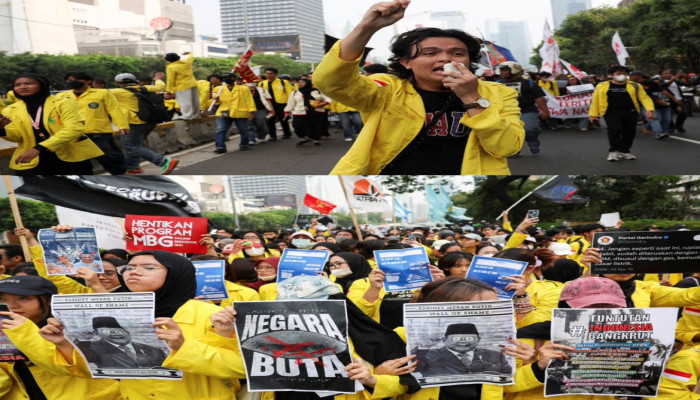
Hundreds of university students gathered in Jakarta on Friday to protest against the spending priorities of President Prabowo Subianto's government. The demonstrations were sparked by the government's recent decision to increase gasoline prices. Protesters argued that the move has added to the financial burden faced by ordinary Indonesians.
The protest was organised under the slogan "Heading to Bankrupt Indonesia." Students marched towards Jakarta's well-known Bundaran HI landmark in the city centre. However, organisers said that several groups of protesters were stopped before reaching the designated protest area. According to them, police officers and military personnel blocked access to the site.
Indonesia, Southeast Asia's largest economy, had previously kept gasoline prices unchanged despite a sharp increase in global oil prices caused by the ongoing Iran war. However, pressure on the country's budget has continued to grow. Government finances have come under strain due to President Prabowo's large spending programmes. As a result, authorities announced a significant increase in fuel prices earlier this week.
During the protest, students carried posters and banners displaying messages such as "Cancel the fuel price hike" and "Wall of Shame." Some posters specifically criticised members of Prabowo's cabinet and questioned the government's economic decisions.
Student leaders outlined several demands during the demonstration. Yatalathof Ma'shum Imawan, a student leader from the University of Indonesia, said protesters were calling for major policy changes. Their demands included ending Prabowo's flagship free-meals programme and the village cooperatives initiative. They also urged the government to lower fuel prices and reduce the cost of essential food items. In addition, they called for an end to what they described as unnecessary government spending.
Speaking during the protest, student participant Rafael Arreva criticised the government's spending priorities. He said, "Wasteful spending on free meals has led to a fiscal situation where subsidies initially provided had been withdrawn."
Many protesters argued that funds used for large-scale programmes should instead be directed towards maintaining subsidies and easing the financial burden on citizens. They claimed that rising living costs are becoming increasingly difficult for many families across the country.
The demonstrations also highlighted concerns beyond economic issues. Students and civil society activists criticised the growing role of the military in civilian affairs under President Prabowo. Critics fear that the expansion of military influence could weaken democratic institutions and push Indonesia closer to the authoritarian practices seen during the rule of former President Suharto.
Addressing the crowd's concerns, Yatalathof said, "We want to show that things are not okay. We don't want Indonesia to truly go bankrupt, but these behaviours prove that Indonesia will go bankrupt economically, democratically, and morally."
As protesters moved towards the city centre, tensions increased. A Reuters witness reported seeing hundreds of students confronted by hundreds of police officers and military personnel near the protest site. Authorities had also installed metal barricades to prevent demonstrators from advancing further.
The situation became more heated when some protesters attempted to cross the police lines and removed the barriers. This led to brief scuffles between demonstrators and security forces. Despite the clashes, students continued to voice their concerns and demand changes to government policies.
Jakarta police did not immediately respond to Reuters' request for comment regarding the alleged blocking of protesters and the security measures used during the demonstration.
One of the main targets of criticism was the government's free meals programme. The initiative aims to provide meals to around 83 million children and pregnant women across Indonesia. While the programme has been promoted as a major welfare effort, critics argue that it is costly and inefficient. They believe it is vulnerable to financial mismanagement and could be used to strengthen political support in remote regions.
The programme has also faced scrutiny due to safety concerns. Reports indicate that thousands of children have suffered food poisoning after consuming meals distributed under the scheme. These incidents have raised serious questions about oversight, implementation, and the government's ability to manage such a large-scale programme effectively.
Friday's protests reflected growing dissatisfaction among sections of Indonesia's youth over the government's economic and political direction. Demonstrators argued that rising fuel prices, concerns about public spending, and fears regarding democratic institutions require immediate attention. Through their protest, students sought to send a message that government policies must focus more on public welfare, transparency, and long-term economic stability.



 Loading...please wait
Comments