



Sri Lanka rejects US request to station warplanes: President Dissanayake
- In Reports
- 07:20 PM, Mar 20, 2026
- Myind Staff
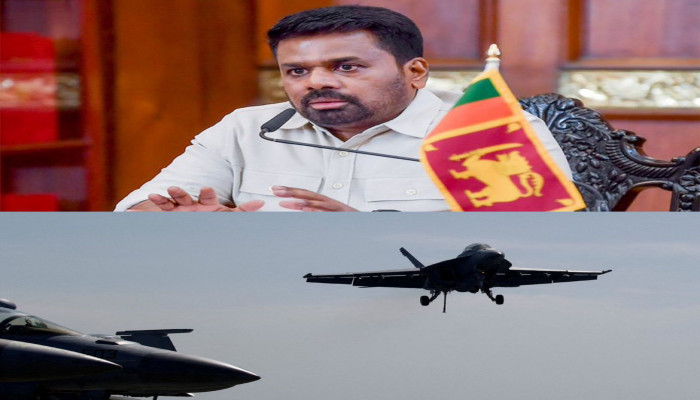
Sri Lanka declined a request from the United States to station two of its warplanes at a civilian airport earlier this month, President Anura Kumara Dissanayake informed Parliament on March 20. The request was made on February 26 and involved relocating two missile-equipped aircraft from a US base in Djibouti to the island’s Mattala International Airport in the south. The president said the government refused permission to maintain its neutral stance and to ensure that Sri Lankan territory was not used in any military activity that could support or oppose any side.
Addressing lawmakers, Dissanayake revealed that the US intended to deploy two warplanes armed with eight anti-ship missiles at the airport between March 4 and 8. He stated, “They wanted to bring two warplanes armed with eight anti-ship missiles to Mattala International Airport from March 4 to 8, and we said ‘no’.” He did not confirm whether the aircraft were meant to carry out operations against Iran, but emphasised that Sri Lanka would not allow its land or airspace to be used for military aggression.
The situation unfolded at a time when the Indian Ocean region is already witnessing heightened tensions. Sri Lanka was directly affected when a US submarine attacked an Iranian naval vessel, IRIS Dena, just off its coast in early March. The strike resulted in the deaths of at least 84 sailors. The mortal remains were later recovered and sent back to Iran. The incident brought the effects of the broader conflict closer to Sri Lanka’s shores.
Sri Lankan defence sources told AFP that the country’s policy does not permit its airspace or territory to be used to launch attacks against other nations. This position aligns with its long-standing foreign policy approach. The government has been careful in handling requests from both sides to avoid appearing biased or taking part in any conflict.
On the same day that the United States made its request, Iran also approached Sri Lanka seeking permission for three of its naval ships to dock in Colombo. These vessels were returning from India after participating in a naval exercise. President Dissanayake explained the government’s dilemma by saying, “We were still considering the Iranian request to bring the three ships to Colombo from March 9 to 13. Had we said ‘yes’ to Iran, we would have had to say ‘yes’ to the US too.” He added, “But we didn’t. We are steadfastly maintaining our position of neutrality,” which was met with applause in the 225-member Parliament. He further stated, “We will not succumb to pressure from anyone.”
Despite rejecting both military-related requests, Sri Lanka took humanitarian steps in response to the crisis at sea. The country’s navy and air force carried out rescue operations following the attack on the Iranian frigate. They managed to save 32 sailors from the wreckage and recovered the bodies of those who had died.
Another Iranian vessel, IRIS Bushehr, was granted entry into Sri Lankan waters shortly after the incident. This decision was taken due to concerns about the safety of its 219 crew members. The sailors were allowed to take shelter in Colombo. Explaining this move, Dissanayake said, “It was a humanitarian gesture to shelter the sailors.” He added, “We were saving lives.”
A third Iranian ship, IRIS Lavan, managed to reach the southern Indian port of Kochi. According to Indian officials, some of its crew members have since returned to Iran safely. These developments highlight the wider regional impact of the conflict and the challenges faced by countries located near strategic maritime routes.
The president also spoke about Sri Lanka’s stance at the international level. He noted that the country abstained from voting on a recent United Nations Security Council resolution that condemned Iran’s actions. Explaining the decision, Dissanayake said, “We did not support that resolution because it was a half-truth. It did not reflect the full story.” He further added, “We stand for justice and fairness.”
Sri Lanka continues to maintain strong relations with both the United States and Iran despite the ongoing tensions. The US remains the island’s largest export market, while Iran is a key buyer of Sri Lankan tea. This balance makes neutrality an important aspect of Sri Lanka’s foreign policy. The government’s recent decisions reflect its effort to avoid involvement in conflicts while still responding responsibly to humanitarian needs.



 Loading...please wait
Comments