




Spain deploys military after deadly Ceuta border rush leaves nine migrants dead
- In Reports
- 03:19 PM, Jul 31, 2026
- Myind Staff
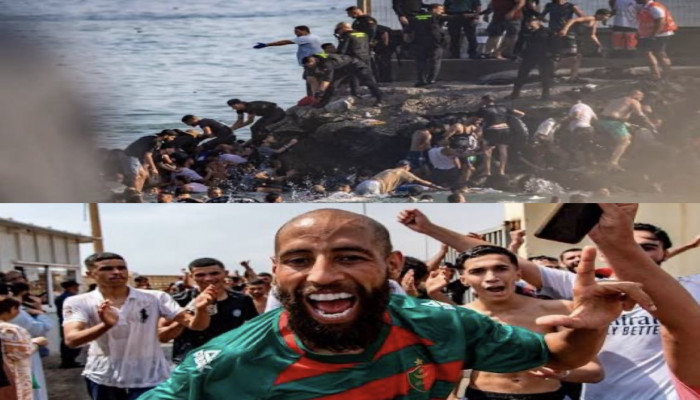
Spain has decided to deploy its military to restore order in Ceuta after thousands of migrants crossed into the Spanish territory from Morocco. The large-scale crossing created a major border crisis and left at least nine people dead. The Spanish government announced the move after local authorities in Ceuta sought urgent support from Madrid to control the rapidly worsening situation.
The crisis escalated on Thursday when large crowds breached the border fence separating Morocco from Ceuta. In response, Spain said it would send the Armed Forces to assist the Civil Guard in maintaining security across the territory. The government also confirmed that Prime Minister Pedro Sanchez and Interior Minister Fernando Grande-Marlaska would travel to Ceuta on Friday to assess the situation on the ground.
Rachid Sbihi, who heads the association representing Spain's Civil Guard officers stationed at the Ceuta border, described the situation as unprecedented. Speaking to the Associated Press, he said, "The situation is absolute chaos." He added, "It's not possible to give precise numbers, but there are thousands of migrants crossing," and said the border had "totally collapsed."
Achraf Maimouni, a member of the Moroccan Association for Human Rights in northern Morocco, also described the events as highly unusual. He said, "The Tarajal border was opened under unusual circumstances this morning and people crossed." His statement reflected the unexpected nature of the mass movement across the frontier.
Videos from the area showed large groups of people entering Ceuta through the breakwaters near Tarajal beach. Most of those crossing appeared to be young men. Families with women and young children also made the journey. Some migrants shouted "Viva Espana!" as they entered Spanish territory. A freelance photographer working for the Associated Press witnessed the scenes. Authorities have not confirmed what triggered such a large number of people to cross into Ceuta within a short period.
Spain's government delegation in Ceuta confirmed that at least nine people died during Thursday's events. Officials did not explain how the deaths occurred. However, bodies were seen floating in the water near the crossing point. Local authorities also noted that dozens of migrants have died this year while attempting to reach Ceuta.
The latest crisis followed another increase in migrant crossings on Wednesday. Many people attempted to reach Ceuta by swimming from the Moroccan coast. Moroccan authorities have not issued any public statement on the incident. Morocco's Interior Ministry also did not respond to requests for comment.
Spain's Interior Ministry said Moroccan authorities were working closely with Spain to manage the situation. According to the ministry, Moroccan police stopped many people who were trying to cross into Ceuta. Both governments also agreed to work together "for the return, as soon as possible, of all the people who entered Ceuta illegally."
The ministry stated that it would continue protecting the country's borders and ensure public safety. It also clarified that Spain could not declare a national emergency over migration, despite the request made by Ceuta's regional authorities. Officials said existing legislation does not classify migration flows as a national security emergency.
Responding to the crisis, the Italian Prime Minister Giorgia Meloni warned that Italy could suspend its participation in the Schengen open-border agreement with Spain. She said the move would help "to defend our borders and ensure the safety of our citizens." Italy does not share a direct land border with Spain, yet the developments in Ceuta raised concerns about migration across Europe.
Authorities in Ceuta had earlier linked the recent surge in arrivals to a ruling by Spain's Supreme Court earlier this month. The court ruled that authorities cannot immediately return migrants who arrive by sea without following legal procedures. The decision applies only to sea arrivals and not to migrants who enter Spain by land, including those who climb over the border fence.
Some Moroccan activists questioned that explanation. They argued that many migrants would likely have been unaware of the court ruling and suggested it was unlikely to have influenced such a large movement.
Spain remains one of the main entry points into Europe for migrants seeking better economic opportunities or trying to escape violence in their home countries. Ceuta, located on the northern coast of Africa, is one of two Spanish territories bordering Morocco. Migrants often swim around five kilometres from the Moroccan town of Fnideq to reach Ceuta. Others attempt the shorter route from the nearby town of Belyounech.
The latest scenes reminded many people of the border crisis in May 2021when more than 8,000 migrants entered Ceuta within two days. At the time, Morocco faced accusations of relaxing border controls after Spain allowed Polisario Front leader Brahim Ghali to receive medical treatment at a Spanish hospital. The decision triggered a diplomatic dispute between Rabat and Madrid. The Polisario Front has long claimed to represent the Sahrawi people of Western Sahara, while Morocco considers Western Sahara part of its territory.
Juan Jesus Vivas, the head of Ceuta's regional government, urged Spain's national government to declare an emergency on national security grounds. He requested additional police officers and asked for military deployment along the border "to guarantee the inviolability of the frontier and citizen safety."
Vivas had already warned on Wednesday that migrant reception centres had reached their limit. He said hundreds of migrants were sleeping on the streets after more than 1,500 people entered Ceuta during the previous week. Thousands more crossed overnight and throughout Thursday, placing further pressure on local authorities and emergency services.
Spain's Interior Ministry did not confirm the exact number of migrants who entered Ceuta over the past few days. The ministry said it would publish updated migration figures on August 3. Official data available until July 15 showed that nearly 3,000 migrants had entered Ceuta by land or sea this year.
The ministry also stated that government agencies were coordinating closely to respond quickly and effectively to the situation. Officials maintained that existing laws do not classify migration as a national emergency, despite growing pressure from local authorities.
Ceuta has remained under Spanish control since 1580. The territory has a diverse population that includes Christians, Muslims, Spanish residents and Moroccan workers. Most communities continue to live peacefully despite frequent migration challenges. Its border fence has long served as one of Europe's most sensitive frontiers, with many migrants risking dangerous journeys in hopes of reaching a safer future.



 Loading...please wait
Comments