




SpaceX's Starship faces mid-flight explosion over Bahamas on its eighth test Flight
- In Reports
- 04:07 PM, Mar 07, 2025
- Myind Staff
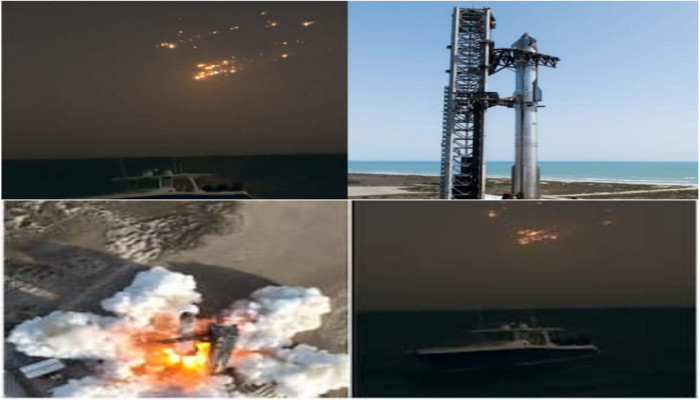
SpaceX carried out the eighth test flight of its massive Starship rocket system, aiming to push the spacecraft to its limits and accomplish objectives that weren’t met during January’s fiery test. However, like the previous 8th flight test, this 7th one is losing the Starship vehicle.
On a positive note, the company successfully recovered the rocket’s booster as it returned to the launch tower. However, the Starship spacecraft itself did not survive, according to CNN.
The uncrewed mission blasted off at 5:30 p.m. CT (6:30 p.m. ET) from SpaceX’s Starbase facility in South Texas. The launch had been initially scheduled for Tuesday but was delayed due to what SpaceX CEO Elon Musk described as "too many question marks."
The test involved the Starship spacecraft, also known as the upper stage, which was mounted on the 232-foot-tall (71-meter) Super Heavy booster. Around two and a half minutes into the flight, the booster successfully detached from the upper stage. After separating, the booster safely landed within the “chopstick” arms of “Mechazilla,” SpaceX’s launch tower near Brownsville, Texas. This is the third time a Super Heavy booster has successfully landed using the chopsticks.
As the Starship spacecraft fired its engines, it aimed to follow a suborbital path for roughly an hour. However, just 20 seconds before finishing its ascent burn, SpaceX lost communication with the vehicle. During the livestream, several engines were visibly shutting down. “Once you lose enough of those centre engines, you’re going to lose altitude control," described SpaceX’s Dan Huot. “And so we did see the ship start to spin, and at this point, we have lost contact with the ship."
About 17 and a half minutes after liftoff, Starship was supposed to release a set of test Starlink satellites for the first time. However, these satellites were not intended to enter orbit like the spacecraft.
This was the eighth test flight of Starship, with goals similar to the January mission, including an attempt to restart a single engine while in space. The previous flight ended in an explosion.
During today’s test, SpaceX lost communication with Starship at nearly the same point as the last test flight, which had exploded over the Turks and Caicos Islands, scattering debris and damaging a car. While it hasn’t been confirmed exactly where the vehicle exploded this time, reports from residents and CNN suggest that the blast happened over the Caribbean and was visible from parts of Florida.
The Federal Aviation Administration (FAA) temporarily stopped flights from entering airports in Miami, Fort Lauderdale, Palm Beach, and Orlando due to concerns over "falling space debris." This restriction remained in effect until 8 p.m. ET. Additionally, the FAA paused departures from Fort Lauderdale/Hollywood International and Miami International Airports, causing outbound flights from these locations to be delayed by about 30 to 45 minutes.
“We’ve got a lot of measures in place, like debris response areas, where we coordinate very closely with air traffic control," stated Huot. “We have many precautions before launching a rocket to ensure public safety. These worked last time, and they are actively in place now."
Following the explosion, SpaceX shared an update on X (previously known as Twitter), “During Starship’s ascent burn, the vehicle experienced a rapid unscheduled disassembly, and contact was lost. Our team immediately began coordination with safety officials to implement pre-planned contingency responses. We will review the data from today’s flight test to better understand the root cause. As always, success comes from what we learn, and today’s flight will offer additional lessons to improve Starship’s reliability."
The FAA has instructed SpaceX to investigate the loss of its Starship vehicle. As stated by the FAA, “A mishap investigation is designed to enhance public safety, determine the root cause of the event, and identify corrective actions to prevent a recurrence." SpaceX will lead the investigation, but the FAA will oversee the entire process, requiring its approval for the final report and any corrective measures. SpaceX can only resume flights once the FAA confirms that the incident does not threaten public safety.



 Loading...please wait
Comments