




South Korean President calls for defence self-reliance after Trump orders to scale down joint drills
- In Reports
- 05:57 PM, Aug 18, 2026
- Myind Staff
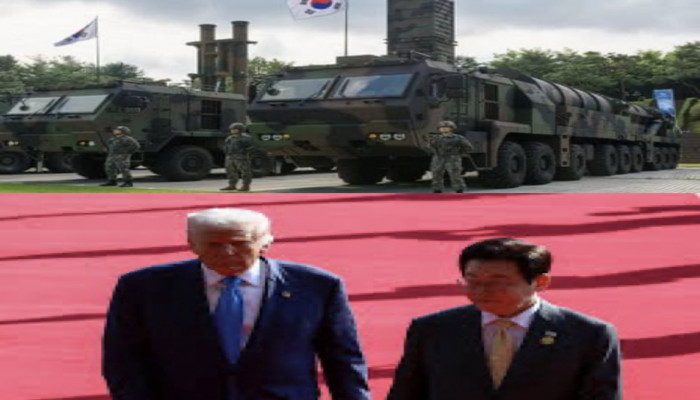
South Korean President Lee Jae Myung has called for stronger independent defence capabilities after US President Donald Trump ordered the Pentagon to substantially reduce joint military exercises between Washington and Seoul. Lee defended the drills as defensive measures and said they do not indicate any intention to attack North Korea or raise tensions on the Korean Peninsula.
Addressing a cabinet meeting on Tuesday, Lee said South Korea must strengthen its own military capabilities while maintaining its alliance with the United States. He also urged officials to speed up efforts to acquire nuclear-powered submarines. The move comes after Trump directed the Pentagon to scale back the annual military exercises, describing them as costly and hostile towards Pyongyang, according to South Korean media outlet Yonhap.
Lee also stressed the need to move ahead with the planned transfer of wartime operational control, or Opcon, of South Korean forces. He said the process should continue without disruption and be completed during his term, which runs until 2030. Under the current arrangement, wartime command over South Korean forces remains with a US four-star general who leads the Combined Forces Command. The system has been in place since the 1953 armistice that ended active fighting in the Korean War.
"A strong alliance makes the foundation of security stronger, and strengthening our own capabilities increases our value and necessity as an ally," Lee stated, describing self-reliant defence and the Washington-Seoul alliance as mutually reinforcing.
Lee said stronger national defence and the US-South Korea alliance should work together rather than compete. He also directed officials to accelerate the nuclear-powered submarine programme and called for faster implementation of the project as Seoul seeks to expand its independent military capabilities.
The South Korean President's comments came after Trump ordered a major reduction in the ongoing 10-day Ulchi Freedom Shield exercises. On Sunday, Trump announced that the exercises were expensive and described them as a hostile signal to North Korea. Trump said it was too late to cancel the drills completely but instructed Secretary of War Pete Hegseth to scale them down.
"Based on my very good relationship with Kim Jong Un, of North Korea, I am not happy with the fact that the United States has, long ago, agreed to participate in Joint Military Exercises with South Korea," Trump said.
The US President said the exercises were costly and argued that they sent a signal that was "totally inappropriate and hostile" to North Korea. He also claimed that Pyongyang had remained "unthreatening and respectful" during his presidency. Trump said his decision was also influenced by his relationship with North Korean leader Kim Jong Un.
Trump has said Kim personally responded to his request for talks in an exchange he described as "very positive". He has repeatedly highlighted his relationship with the North Korean leader and said the two have developed an understanding through their previous meetings.
Speaking to reporters earlier, Trump said Kim Jong Un had always treated him with "great respect". He said he had met Kim several times and that the two leaders understood each other. Trump also compared his relationship with Kim to the North Korean leader's reported views of previous US presidents.
Trump also criticised South Korea for refusing to contribute to US military actions against Iran. His contentious remarks came at a time when Washington and Seoul were to discuss their defence commitments and the future of the alliance.
The latest developments have placed greater focus on South Korea's plans for military self-reliance. Seoul now faces the task of strengthening its own defence capabilities while maintaining its security partnership with Washington. Lee's push for the Opcon transfer and the nuclear-powered submarine programme reflects that approach.
Trump's decision to reduce the military exercises could also affect the long-standing defence arrangements between the two allies. Seoul maintained that exercises are necessary for military readiness of forces against possible threats from North Korea. Lee's latest comments suggest that South Korea intends to strengthen its own capabilities even as it continues to rely on the US alliance.
The South Korean government is therefore moving on two tracks: preserving its close military partnership with Washington and building greater independent defence capacity. Lee has made clear that both goals can advance together as Seoul prepares for the planned transfer of wartime operational control before the end of his term in 2030.



 Loading...please wait
Comments