




Sonar Bangla Regains Bharat’s Civilisational Identity and Leadership of Hindu Renaissance
- In Politics
- 10:40 AM, May 09, 2026
- Rudra Dubey
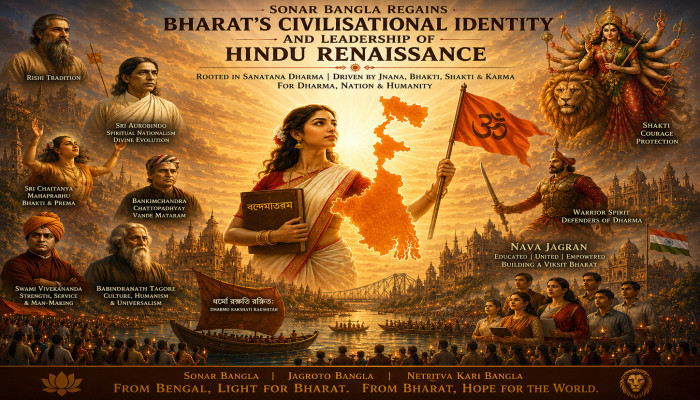
The idea of Sonar Bangla, or Golden Bengal, has never been a mere poetic memory or political slogan. It denotes a civilizational reality in which Bengal once stood at the forefront of India’s intellectual, spiritual, cultural, and economic life. Bengal’s historic greatness lay not only in material prosperity but in its role as a generative civilizational force that produced ideas, reform movements, artistic revolutions, and spiritual awakenings, shaping modern India. Any serious inquiry into Bengal’s present condition or its prospects for renewal must begin by understanding why it was once regarded as golden.
Historically renowned within India and beyond, Bengal’s prosperity alone did not define Sonar Bangla. Its enduring distinction arose from its function as one of India’s most fertile civilizational laboratories. The region’s most consequential contribution was the emergence of a modern Hindu renaissance that rearticulated Sanatana Dharma at a time of civilizational pressure, external domination, and internal stagnation. This renaissance was reformist yet rooted in tradition. It was philosophical rather than reactionary and oriented toward universal principles derived from classical reinterpretation. Long before organised political nationalism emerged, Bengal became the epicentre of an intellectual and spiritual awakening that restored Hindu civilisational self‑confidence.
That awakening did not emerge from a cultural vacuum. For centuries prior, Bengal’s Hindu society had developed traditions of civilizational resistance and continuity under political subjugation. During prolonged periods of Islamic rule, Hindu institutions in Bengal faced temple destruction, land alienation, demographic pressure, and the marginalisation of Sanskritic learning. Yet Hindu civilisation in the region did not collapse. Instead, it adapted and persisted through decentralised forms of social organisation, devotional movements, monastic networks, and the preservation of cultural memory.
Local zamindari patronage, temple‑centred economies, and kinship networks sustained Hindu social life despite the absence of sovereignty. In this context, Shakta and Vaishnava traditions, which were less dependent on court patronage than classical Brahmanism, became primary vessels of resilience. The devotional revolution associated with Sri Chaitanya Mahaprabhu was not only spiritual but civilisational. By emphasising ecstatic devotion, emotional intimacy with the divine, and broad participation across social boundaries, bhakti preserved Hindu metaphysics and communal identity during a period of vulnerability. Hindu activism in this era seldom took the form of centralised rebellion. It expressed itself instead through survival via ritual, culture, and continuity.
The nature of Hindu resistance transformed under British colonial occupation. While earlier regimes subordinated Hindu political power, colonialism sought to redefine Hinduism itself through Orientalist distortion, missionary critique, and epistemic dominance. The response that emerged in Bengal was not merely political but intellectual and civilizational. Reform movements arose as acts of self‑assertion that defended Hindu philosophy against claims of inferiority while selectively engaging modern frameworks of reason, ethics, and social reform.
The earliest structured expression of this response appeared in Raja Ram Mohan Roy’s founding of the Brahmo Samaj in 1828. Roy sought to recover the Upanishadic core of Hindu philosophy by emphasising reason, ethical monotheism, and moral reform without abandoning civilisational continuity. His opposition to practices such as sati and child marriage coincided with a robust defence of Hindu metaphysics against missionary criticism. Rather than rejecting Hinduism, Roy reinterpreted it, establishing a precedent for reform emerging organically from within tradition.
This reformist trajectory was deepened by Ishwar Chandra Vidyasagar, whose work transformed Hindu social ethics while remaining anchored in Sanskritic learning. His advocacy of widow remarriage, women’s education, and educational modernisation demonstrated that dharmic values possessed internal resources for ethical renewal. Tradition, when properly understood, was shown to be a source of progress rather than an obstacle to it.
Bengal’s renaissance acquired emotional and symbolic force through Bankim Chandra Chattopadhyay, who reshaped Hindu spiritual imagination into the language of national consciousness. Through works such as Anandamath and Vande Mataram, he fused devotion, aesthetics, and patriotism, transforming nationalism into a civilisational sentiment rooted in Shakta symbolism. The nation was imagined not merely as political territory but as Bharat Mata, a sacred presence subjected to foreign domination.
The most globally visible articulation of Bengal’s Hindu renaissance came through Swami Vivekananda. His address at the Parliament of the World’s Religions in Chicago in 1893 marked Hinduism’s reentry into global intellectual discourse on its own terms. Presenting Vedanta as a universal philosophy of consciousness, strength, tolerance, and spiritual democracy, Vivekananda restored Hinduism’s intellectual legitimacy while shaping generations of reformers, nationalists, and spiritual leaders.
Alongside him stood Sri Ramakrishna Paramahamsa, whose life embodied experiential spirituality. Rooted in devotion to Kali, Ramakrishna demonstrated that multiple spiritual paths could converge upon the same divine reality. From this spiritual core emerged the Ramakrishna Mission, which translated contemplative insight into education and social service and redefined the role of religious institutions in modern India.
Bengal’s spiritual landscape was further shaped by the enduring influence of Gaudiya Vaishnavism, which in the twentieth century assumed global dimensions through A. C. Bhaktivedanta Swami Prabhupada and the ISKCON movement. Equally significant was Bengal’s Shakta renaissance, which placed divine femininity at the centre of religious imagination through Kali worship, Durga Puja, and Tantric theology. This spiritual current profoundly shaped Bengal’s literature, music, and social symbolism.
Even Bengal’s revolutionary nationalism drew sustenance from spiritual inquiry. Sri Aurobindo exemplified this synthesis by uniting Vedantic philosophy, nationalist activism, and evolutionary spirituality. His journey reflected a Bengal in which national awakening and spiritual exploration were inseparable and where resistance to colonial rule was grounded in civilizational renewal rather than mere political protest.
Taken together, Bengal’s renaissance was not a singular movement but a continuous civilisational chain extending from medieval resilience under conquest through intellectual resistance to colonial domination and into modern spiritual and national awakening. Reformist monotheism, Vedantic revival, devotional democratisation, Shakta resurgence, and nationalist spirituality reinforced one another. This synthesis explains why Bengal became the primary civilizational engine of modern India, restoring Hindu self‑confidence and giving nationalism philosophical and spiritual depth.
The fracturing of this inheritance began with the Partition of 1947, which shattered Bengal’s civilizational geography and economic equilibrium. Subsequent political developments further weakened institutional vitality. What Bengal lost over time was not merely industrial capacity but civilisational confidence itself. This loss became visible in weakened universities, politicised institutions, hollowed spiritual traditions, and sustained talent migration.
This context lends weight to the present moment. History suggests that Bengal’s renewal cannot emerge from political change alone. Sonar Bangla was never created by governments but by thinkers, saints, reformers, poets, and spiritual revolutionaries who sustained a culture of synthesis and seriousness.
To reclaim that heritage, Bengal must restore educational meritocracy, rebuild industrial confidence, depoliticise institutions, revive cultural depth, and recover spiritual confidence without collapsing into sectarianism. Its historic genius lay in synthesis, in uniting spirituality with reason, reform with tradition, and cultural identity with universal aspiration. If Bengal rediscovers this civilisational grammar, it can once again claim its place as one of India’s defining civilisational centres.
And if Bengal rediscovers that genius, it can once again become not only India’s crown jewel, but one of the defining civilisational centres of the modern world.
References
1. Dasgupta, Subrata. The Bengal Renaissance: Identity and Creativity from Rammohun Roy to Rabindranath Tagore. Orient BlackSwan.
2. Kopf, David. The Brahmo Samaj and the Shaping of the Modern Indian Mind. Princeton University Press.
3. Sen, Amiya P. Swami Vivekananda. Oxford University Press.
4. Burke, Marie Louise. Swami Vivekananda in the West: New Discoveries. Advaita Ashrama.
5. Chatterjee, Bankim Chandra. Anandamath.
6. Nikhilananda, Swami. The Gospel of Sri Ramakrishna. Ramakrishna-Vivekananda Center.
7. Dimock, Edward C. The Place of the Hidden Moon: Erotic Mysticism in the Vaisnava-Sahajiya Cult of Bengal. University of Chicago Press.
8. Heehs, Peter. The Lives of Sri Aurobindo. Columbia University Press.
9. Roy, Tirthankar. India in the World Economy: From Antiquity to the Present. Cambridge University Press.
10. Maddison, Angus. The World Economy: Historical Statistics. OECD.
11. Sarkar, Sumit. The Bengal Renaissance and Other Essays. Permanent Black.



 Loading...please wait
Comments