




Solomon Islands recognises Australia as ‘primary security party’ and signs new security treaty
- In Reports
- 07:38 PM, Nov 25, 2026
- Myind Staff
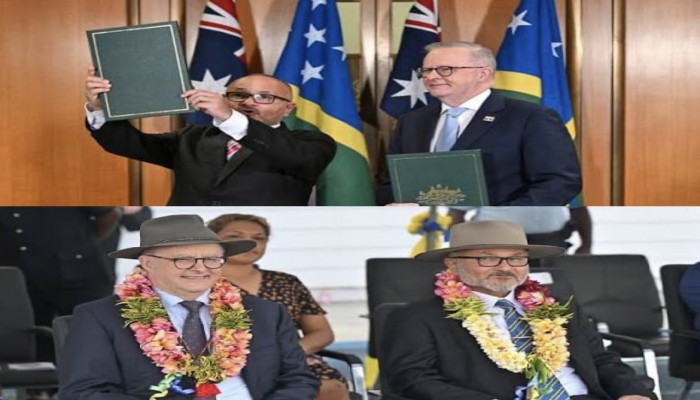
The Solomon Islands has signed a new security treaty with Australia, declaring that it will never allow a foreign military or security base on its soil. The country has also rejected its secretive defence agreement with China, which raised concerns about a possible Chinese naval presence in the South Pacific.
Solomon Islands Prime Minister Matthew Wale and Australian Prime Minister Anthony Albanese signed the bilateral security pact on Wednesday. The agreement comes amid reports that the Solomon Islands plans to end its five-year defence deal with China when it expires in early 2027.
The new treaty recognises Australia as the Solomon Islands’ “primary security partner”. It also clearly states that “there will be no foreign military or security base” in the island nation, located around 2,000 kilometres northeast of Australia.
The Solomon Islands hold significant strategic importance due to their location along the sea route between the United States and Australia. During World War II, the islands witnessed major battles between Allied and Japanese forces. Today, the country, with a population of fewer than 900,000, remains an important part of the US-led effort to counter China's growing influence in the region.
The agreement is the latest security arrangement Australia has signed with Pacific nations following China's 2022 treaty with the previous Solomon Islands government. Since coming to power in late 2022, Albanese's government has worked to strengthen Australia's regional partnerships through similar agreements with Fiji, Tuvalu and Vanuatu.
In 2024, Australia also signed a security-linked agreement with Papua New Guinea, promising 600 million Australian dollars ($396 million) over 10 years. The deal included plans to bring a Papua New Guinea rugby league team into Australia's national competition.
Wale declined to confirm or deny reports that his government had informed Beijing about its decision not to renew the Chinese security agreement. The deal, which brought Chinese police trainers to the capital, Honiara, includes a non-disclosure clause.
“Unfortunately, there is a non-disclosure clause in the treaty with China,” Wale told reporters at Australian Parliament House. “So, I am unable to talk about that. We have ongoing discussions with China.”
“As you know, Solomon Islands has been, for a number of years, a source of uncertainty and doubt in the region. Those days are done. Gone. We don’t want to be there again,” he added.
In Beijing, Chinese Foreign Ministry spokesperson Guo Jiakun avoided directly answering whether the Solomon Islands had decided to end the agreement.
“China always follows the principle of mutual respect and equality in developing relations with the Solomon Islands,” Guo said Tuesday. “There is no element of geopolitical rivalry or bloc confrontation in cooperation between China and Pacific island countries, including the Solomon Islands."
Albanese described the new treaty as a major step in bilateral relations, saying it had elevated ties to a “level which has never been seen before and has never been stronger.”
Beyond security cooperation, Australia has also committed to supporting the Solomon Islands through investments in infrastructure, education, renewable energy and sports.
Oliver Nobetau, Pacific Islands program director at the Lowy Institute, described the agreement as significant and aligned with the Solomon Islands' priorities.
“It demonstrates that Australia is listening to what the Pacific partners want,” Nobetau told Australian Broadcasting Corp.



 Loading...please wait
Comments