




Smart surveillance push: Centre plans high-tech border shield along Pakistan, Bangladesh borders
- In Reports
- 12:25 PM, May 23, 2026
- Myind Staff
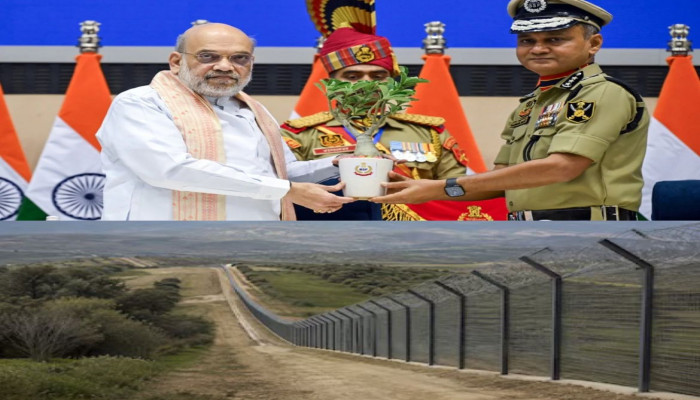
Union Home Minister Amit Shah on Friday announced that the Centre will soon launch a technology-based “Smart Border Project” to strengthen security along India’s borders with Pakistan and Bangladesh. The project will use drones, radars, smart cameras and several advanced surveillance systems to make the nearly 6,000-km stretch more secure and prevent infiltration.
Shah announced, while addressing the Border Security Force Investiture Ceremony and Rustamji Memorial Lecture in the national capital. He said the government is working towards building a strong and integrated border security network within the next year by combining different technologies under the Smart Border initiative.
“The government and home ministry will provide technological support to transform the country’s border into a smart border. Work is progressing towards creating an impregnable border security grid within the next year by integrating all kinds of technologies under the Smart Border concept,” Shah said.
He further added, “The home ministry will soon introduce a Smart Border Project equipped with drones, radars, modern cameras, and other advanced technologies. Once this initiative begins, the work of the BSF will become significantly easier and stronger.”
The event also remembered K F Rustamji, the founding father and first director general of the Border Security Force. The BSF, raised in 1965, is the world’s largest border guarding force with around 2.70 lakh personnel. It is responsible for guarding India’s borders with Pakistan in the west and Bangladesh in the east.
Shah described both borders as highly vulnerable and said they remain a major security concern for the country. According to him, the Pakistan border stretches around 1,289 km while the Bangladesh border is nearly 4,096 km long. He said traditional methods are no longer enough to guard such sensitive frontiers.
The home minister pointed out that these borders face several threats, including illegal infiltration, smuggling of narcotics, weapons and arms through drones, cattle smuggling, fake Indian currency notes and organised crime activities. He stressed that modern technology is now necessary to deal with such challenges effectively.
“It is most important to identify future dangers, and it is our responsibility to stop the artificial demographic change being attempted from the other side (of the border) through infiltration, and, for this, we have to remain alert and vigilant. Under the leadership of Prime Minister Narendra Modi, the government has resolved not only to stop infiltration, but also to identify and expel every single infiltrator from the country,” he said while addressing BSF officers and jawans.
Shah also said that securing borders is no longer the responsibility of only one force. He highlighted the need for better coordination among state police forces, Central Armed Police Forces, the armed forces, the Narcotics Control Bureau, intelligence agencies and state administrations.
The Union minister said the governments of Tripura, Assam and West Bengal were committed to preventing infiltration. He added that the home ministry would soon hold a meeting with the chief ministers of these states to improve coordination and strengthen border management.
“The governments in Tripura, Assam, and West Bengal are committed to preventing infiltration, and the BSF should work in coordination with them. Very soon, the home ministry will hold a meeting with the chief ministers and make plans to ensure that there is no infiltration,” he said.
At the same event, Shah announced that the Centre would soon begin a major anti-narcotics campaign across the country. He said the BSF would play an important role in this drive because border regions are often used for drug smuggling networks.
He also mentioned that fencing work along some parts of the West Bengal border had restarted after the state government handed over the required land to the BSF. According to officials aware of the matter, fencing work has resumed in the Phansidewa area of Darjeeling district in North Bengal after being stalled for more than a decade. Preventing infiltration was one of the BJP’s key campaign issues during the recent West Bengal Assembly elections.
Shah said border security in India would undergo major changes in the coming years due to the increasing use of technology. However, he also noted that this shift would bring greater responsibility for border forces.
“The next three to four years will bring transformative changes in border security. While technology will strengthen capabilities, it will also increase responsibilities,” he said.
He finally urged BSF personnel to maintain strong coordination with local communities and civil administrations. According to him, public cooperation and advanced technology together would help India move closer to becoming an “infiltration-free” nation.



 Loading...please wait
Comments