




Six Months of the US -Iran War and Lessons for India
- In Military & Strategic Affairs
- 10:41 PM, Aug 30, 2026
- Lt Gen L N Singh (Retd)
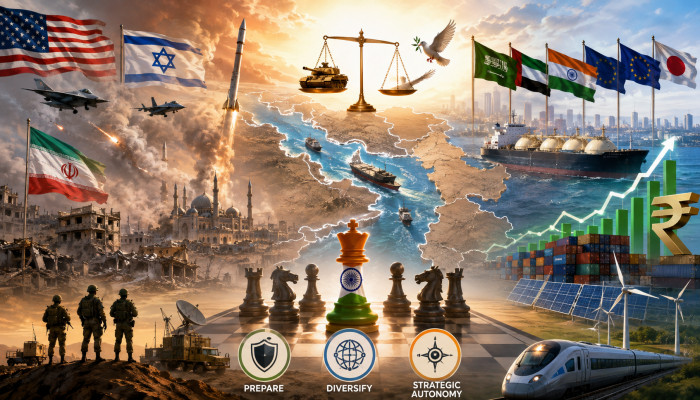
This war began with the US-Israeli military strikes against Iran on 28 February 2026. Now, six months later, the war is yet to produce the quick victory that Washington initially anticipated. Instead, it has developed into a protracted strategic stalemate, with enormous consequences for the Middle East and the global economy.
How Did We Get Here?
To understand the war over the last six months, we need to examine the three principal objectives attributed to the US campaign.
Objective 1 — Destroy Iran's military and missile capability. The US and Israel wanted to significantly reduce Iran's ability to launch missiles and drones.
Objective 2 — Eliminate or neutralise the nuclear threat. The United States argued that Iran must not acquire a nuclear weapon.
Objective 3 — Political change in Tehran. President Trump encouraged Iranians to overthrow the existing regime.
The US expectations appear to have been that overwhelming military pressure would rapidly weaken Iran's leadership and perhaps trigger political collapse. The US was also excited over its success in the Venezuela episode.
But Iran, an old civilisation had prepared well. They proved that military destruction is not the same thing as political victory. The United States and Israel could destroy targets. The much harder question was whether they could force Iran to surrender politically.
The First Phase of the War
The US and Israel launched Operation Epic Fury, striking targets across Iran. Besides military targets, they struck at a number of civilian targets, including schools, hospitals and other civilian facilities, hoping for an uprising. Trump even encouraged the Iranian population to overthrow the Regime. Though Iran's Supreme Leader, Ayatollah Ali Khamenei, along with senior military and political figures were also killed, there was no uprising.
Iran retaliated against American bases, Israel, US allies, and other targets across the Middle East.
And then Iran used perhaps its most powerful strategic weapon- geography. The conflict rapidly became linked to the Strait of Hormuz, one of the world's most important maritime chokepoints, through which nearly 20 per cent of the world’s fuel supply passes.
The First Major Lesson: Decapitation Did Not Produce Regime Collapse The US calculation appears to have been that removing senior Iranian leadership could create a political vacuum. But that did not happen. Instead, a new Supreme Leader took over. This illustrates a fundamental problem with ‘leadership-targeting’ strategies - removing individuals does not necessarily remove the institutions, ideology, security apparatus or political networks that sustain a regime. Iran's political system survived. And hardliners within the system remained influential. Targeting of non-military facilities was counterproductive.
So, the important lesson is that tactical success doesn’t result in strategic success. The United States may have achieved major tactical military successes, but the strategic objective of political transformation remained unfulfilled.
Has Iran's Missile Capability Been Destroyed? This is one of the most controversial questions. Trump and other American officials are always claiming that Iran's missile capability had been drastically reduced. But Iran continues its strikes. Because Iran had prepared for exactly this type of attack. Iran's missiles were reportedly dispersed and stored underground in hardened facilities beneath mountainous terrain. Airstrikes can destroy launchers, entrances and infrastructure. But destroying the entire underground arsenal is considerably difficult. Iran has also demonstrated the ability to repair launchers and continue producing missiles. Therefore, the war has demonstrated something important about modern warfare- one cannot easily destroy a country's military capacity simply by destroying visible infrastructure. This is applicable for a country that has dispersed weapons, underground facilities, mobile launchers, redundancy, domestic production, drones, and large geographic depth. It can continue fighting even after suffering enormous damage.
The Nuclear Question While the United States and Israel have long argued that Iran is going to produce a nuclear weapon. Iran has consistently maintained that its nuclear programme is peaceful. The IAEA had previously assessed that Iran possessed more than 400 kilograms of uranium enriched to 60%, which is significantly below weapons-grade enrichment but technically much closer to the approximately 90% level associated with weapons-grade uranium.
US and Israeli strikes targeted nuclear sites including Fordow, Natanz & Isfahan. But the major problem is that we don't know exactly what survived. Iran has suspended cooperation with the IAEA, and now inspectors cannot access the sites.
Therefore, the war may have damaged Iran's nuclear infrastructure, but the exact status of its nuclear material and capabilities has become less transparent, not more transparent. And this creates a paradox- the attempt to eliminate the nuclear threat appears to have made it harder to monitor the nuclear programme.
The Strait of Hormuz — Iran's Most Powerful Weapon The Strait of Hormuz is a narrow waterway between Iran and Oman. 20 per cent of the world's oil and gas shipments pass through it, in addition to other items like fertiliser. Before the war, Iran had repeatedly threatened that it could disrupt the Strait. Those threats had been dismissed as a bluff.
But Iran has now demonstrated that it could use its geographical position to create enormous economic pressure. This is what makes the Strait so important. Iran does not need to defeat the US Navy in a conventional naval battle. It only needs to make commercial shipping sufficiently dangerous or expensive that ships stop sailing. That is a very different form of warfare.
Use of Asymmetric Warfare The US possesses aircraft carriers, advanced aircraft, long-range missiles, satellites, sophisticated intelligence, etc with enormous military spending. Iran cannot compete symmetrically. So, Iran resorts to asymmetric warfare, relying on missiles, drones, underground facilities, dispersed forces, geography, maritime disruption, regional pressure, etc. The objective was not necessarily to destroy American military power, but to make it very costly for the US. Thus, Iran's survival itself becomes strategically meaningful.
The Human Cost: There has been an enormous human cost. Thousands of people have reportedly been killed, including civilians, students, medical staff and children. Iran has suffered: destruction of infrastructure, economic disruption, job losses, inflation, rising food prices, displacement and increased poverty. In some assessments, with food prices rising dramatically, inflation, in some cases, reached around 80%.
This creates a crucial distinction in the way the Iranian government and the Iranian population see the war. The government may see survival as a form of victory. But for ordinary Iranians, however, survival may mean living with destroyed infrastructure, economic hardship and insecurity.
The United States Vulnerabilities: The war exposed vulnerabilities in American military power, though much more powerful than Iran. But modern warfare is not simply about the quality of individual weapons. It is also about ammunition stockpiles, logistics, maintenance, supply chains, drones, air defence, personnel morale, sustainability, etc. The US has used substantial quantities of Patriot interceptors and other long-range missiles, while the extended deployment of the USS Abraham Lincoln and other assets raised questions about fatigue and readiness. The important lesson here is that a military can win individual tactical engagements and still struggle to sustain a long war to achieve its strategic objective.
The Drone Revolution: Iran has also demonstrated the changing character of warfare through drones. Drones are relatively inexpensive compared to fighter aircraft, aircraft carriers, and sophisticated air-defence systems. This creates an economic problem for technologically advanced militaries. The US and Israel had to use a million-dollar interceptor to destroy a relatively inexpensive drone, so economically they lost.
There is a much wider transformation in the battlefield environment that has also been demonstrated in this war. The battlefield is increasingly characterised by precision strikes, mass swarms of drones, electronic warfare and dispersal of assets.
Price Paid by America’s Gulf Allies: The war has not remained confined to Iran. Besides Israel, US bases and infrastructure across the Gulf have been targeted. Countries affected include Bahrain, Kuwait, Qatar, UAE, Iraq and Jordan. This creates a serious question for America's regional alliances. For decades, the US has given them security guarantees. But now the US bases themselves have become targets and US forces are seeking protection elsewhere in hotels, etc. The Gulf states are asking - does a US military presence make them safer—or make them a target?
The Gulf States: The Gulf Arab states now face a difficult balancing act; they are located next to Iran. They cannot ignore Tehran, and they cannot afford prolonged disruption of oil exports, shipping, petrochemical industries, investment, tourism and infrastructure. So, they are giving greater emphasis to strategic autonomy. The new mutual defence agreement involving Pakistan, Saudi Arabia and Turkey is one indication of this changing regional security environment.
Israel: A Complicated Outcome Israel remains one of the central actors in the conflict. Israel wanted to weaken and even eliminate the Iranian threat. But even six months later, Iran's regime remains in power and sufficiently capable. So, did Israel make itself safer, or did it create a more dangerous long-term security environment in the Gulf Region?
Israel has also faced attacks on its infrastructure, assets, military casualties, economic costs, higher energy prices, political pressure and increased dependence on American military support. The conflict therefore carries consequences not only for Israeli security but also for the future of the US-Israel relationship.
The Global Economic Shock: Moving from geopolitics to economics, the initial shock sent oil prices from around $65 to approximately $120 per barrel. It affected petrol, aviation fuel, electricity, transportation, fertiliser, food, manufacturing, and inflation. A war in the Persian Gulf has major global economic outcomes. Thus, the Strait of Hormuz matters to the world economy.
The War Become a Stalemate: At this point, we can identify the central paradox. The United States has overwhelming military superiority. But Iran has geographic advantage, strategic depth, underground infrastructure, missiles and drones, regional leverage, the ability to disrupt shipping, and political resilience.
The United States can inflict enormous damage, but inflicting damage is not the same as forcing surrender. On the other hand, Iran, cannot militarily defeat the United States.
If Iran survives, continues to retaliate, maintains political control and imposes sufficient economic costs, it’s a victory for Iran. It can claim that the US and Israeli objective of regime change failed.
This is classic asymmetric competition.
Economic Sanctions: The New Phase of the War The US has now shifted from military to economic warfare. The objective is to isolate Iran financially, weaken the Iranian economy, restrict Iranian oil exports, pressure countries trading with Tehran and force the Iranian leadership back to negotiations.
But there is a fundamental question is: Can sanctions achieve what military force could not? Iran has lived under American sanctions for decades. It has developed methods of sanctions evasion, alternative trading relationships, informal financial networks and cooperation with non-Western powers. Success will depend heavily on whether countries such as China, Russia and regional states cooperate with Washington.
The China and Russia Factor. This war cannot be analysed only as-US versus Iran. It is also part of wider competition over the international order. China has major energy interests. Russia has strategic interests in the Middle East. Asian economies depend heavily on Gulf energy. Japan and other major economies require stable shipping. Therefore, the Strait of Hormuz has become a global geopolitical bargaining chip.
Iran may attempt to exploit differences between Washington and Beijing, Washington and Moscow, Washington and the Gulf states, Washington and European powers. This is one reason why Iran's geographic position gives it influence far beyond its conventional military strength.
Declining American Influence. This is perhaps the biggest strategic question. For decades, the US has played three major roles in the Middle East as a security guarantor, protector of Israel and guardian of freedom of navigation and energy flows. This war has put all three under pressure.
If American allies begin believing that Washington may not give them the desired security, they would seek alternatives. And this could lead to independent military build-ups, new regional alliances, closer relationships with China, closer relationships with Russia and potentially even interest in nuclear weapons.
The most dangerous consequence would therefore not necessarily be another missile attack. It could be a regional arms race.
Important Strategic Lesson The main lesson is that the US demonstrated that it could destroy enormous amounts of Iranian military infrastructure. On the other hand, Iran demonstrated that destruction alone does not necessarily produce political submission. This distinction is at the heart of the entire conflict.
Who Won? It is very difficult to say who had the "victory." The United States succeeded in destroying significant Iranian military infrastructure, killing senior Iranian leaders, damaging missile- and nuclear-related facilities, demonstrated enormous air and naval superiority. But they have many unfulfilled objectives- regime change did not occur, Iran's missile capability survived and Iran continues retaliatory attacks. The nuclear situation became less transparent. The Strait of Hormuz became a major strategic problem. The war is now prolonged and expensive.
On the other hand, for Iran, there are massive casualties, destruction of infrastructure, severe economic damage, loss of senior leaders and damage to military capabilities. Some of Iran’s gains are that the regime survived, demonstrated its ability to retaliate, demonstrated leverage over Hormuz and thereby on the world economy, increased pressure on US allies and complicated American regional strategy.
Therefore, Iran has not won a conventional military victory. But it may have achieved something strategically significant, as it prevented the United States from converting overwhelming military superiority into decisive political victory.
Three Possible Ways the War Could End. Three broad scenarios for how this war ends are-
Scenario 1 — Negotiated settlement. This is the most desirable outcome. The two sides return to negotiations and agree on issues like Iranian nuclear restrictions, missile limitations, sanctions relief, reopening the Strait, guarantees against future attacks, and regional security arrangements.
This would allow both sides to claim some form of victory. This is probably the most sustainable outcome.
Scenario 2 — Frozen conflict. The war could simply settle into an uneasy stalemate. There may be intermittent missile attacks, sanctions, limited military operations, partial reopening of Hormuz, indirect negotiations, and no formal peace treaty. This would resemble a frozen conflict rather than genuine peace. It may be politically easier than a comprehensive settlement.
Scenario 3 — Escalation. It is the most dangerous scenario. A single event could trigger escalation. It could lead to an attack on US or Iranian forces, a major Israeli strike, disruption of shipping, a large civilian casualty event, an Iranian attack on Gulf infrastructure, renewed nuclear activity.
The danger is that each side could believe that escalation will force the other to back down. Instead, escalation could produce a much wider regional war.
What Should be Watched Next. Over the next few months, one should watch seven indicators:
1. Strait of Hormuz - Does shipping return to normal?
2. Nuclear inspections - Does Iran restore meaningful IAEA access?
3. Iranian missile production - Can Iran rebuild its arsenal?
4. US military deployments- Does Washington increase or reduce its forces?
5. Gulf states - Do Saudi Arabia, UAE, Qatar and others move closer to Washington—or pursue greater strategic independence?
6. China and Russia - Do they help Iran economically and diplomatically resist US pressure?
7. Domestic politics in America and Israel - Does public opposition force their governments toward a settlement?
Lessons for India. The current Iran war is a lesson about strategic autonomy, energy security, maritime security and preparedness for prolonged conflicts. India should draw some major lessons from this conflict.
Energy security is national security - This is probably the single biggest lesson for India. India imports a very large amount of crude oil. The Iran war has shown what happens when a major global energy chokepoint becomes unreliable. The disruption Strait of Hormuz has already affected energy prices and shipping. India cannot depend excessively on one region, one route or one supplier. It needs greater diversification of crude suppliers; more strategic petroleum reserves; diversified LNG sources; stronger domestic production; renewable energy; nuclear power; EVs and public transport; alternative shipping routes; long-term energy contracts. Energy diversification is not merely an economic policy; it is a defence policy.
India must never allow a single chokepoint to become a strategic vulnerability. The Strait of Hormuz is the obvious example. But India has other vulnerabilities like Arabian Sea shipping routes, the Persian Gulf, Red Sea/Bab-el-Mandeb, Malacca Strait, etc. India's economy depends heavily on maritime trade. Therefore, India needs to think of the Indian Ocean as an extension of national security. This means India needs a stronger Indian Navy, maritime surveillance, anti-submarine warfare, drones, satellites, coastal radar, long-range maritime aircraft and protection for commercial shipping. The Gulf states themselves are now investing in alternative pipelines and ports to bypass Hormuz—a useful indication of how seriously chokepoint vulnerability is being treated.
Don't underestimate geography. One of the most important lessons of the war is that geography can compensate for military inferiority. Iran is much weaker than the United States in conventional military power. Yet Iran's geographical position gives it leverage over Hormuz. For India, geography is both an advantage and a responsibility. India sits astride the Indian Ocean and near major maritime routes connecting the Middle East -India -Southeast Asia - East Asia. This gives India strategic importance. But it also means India must be capable of protecting those routes. India's geography gives it power only if India has the military capability to exploit and protect that geography.
India needs a "long-war" mindset. One of the biggest mistakes revealed by the Iran conflict is the assumption that overwhelming military superiority will produce a quick political victory. That assumption can be dangerous. Modern wars can become prolonged, expensive, economically disruptive, politically unpopular and ammunition intensive. India therefore needs sufficient reserves of missiles, air-defence interceptors, artillery ammunition, drones, spare parts, fuel, precision weapons and electronic-warfare systems. Remember, even a superpower can face munition depletion and logistical strain during a prolonged high-intensity conflict.
Drones have changed warfare. Iran's use of drones demonstrates another major lesson. The future battlefield will not be dominated only by fighter aircraft, tanks, aircraft carriers and ballistic missiles. It will increasingly involve large numbers of relatively inexpensive drones. India therefore needs mass production of surveillance drones, loitering munitions, swarm drones, counter-drone systems and autonomous systems. And importantly, India needs to be able to manufacture them domestically. This is where Atmanirbhar Bharat becomes a strategic requirement rather than simply an industrial policy.
Air defence must become layered. The Iran conflict demonstrates the importance of protecting air bases, ports, oil installations, power plants, command centres, communication infrastructure and civilian infrastructure. India cannot assume that distance from the battlefield guarantees safety. A future conflict could involve ballistic missiles, cruise missiles, drones, cyberattacks and electronic warfare. India therefore needs a layered air-defence architecture combining long-range systems, medium-range systems, short-range systems, point defence, counter-drone weapons and electronic warfare.
Protect critical infrastructure. This is particularly important if an adversary does not primarily attack military bases. Instead, if it attacks ports, major refineries, LNG terminals, electricity grids, oil pipelines, telecommunications, financial infrastructure and railway networks, the economic disruption could be enormous. Therefore, critical infrastructure must be treated as part of the national battlefield.
Strategic autonomy is extremely important. India's traditional foreign-policy approach of strategic autonomy becomes even more valuable in a world of competing power blocs. The Iran war demonstrates the danger of becoming completely dependent upon any one major power. India needs good relationships simultaneously with all. India's objective should not be to choose one camp unnecessarily.
India should preserve its relationship with Iran. This is particularly important from a strategic perspective. Iran is not simply another Middle Eastern country for India. Iran provides India with potential access to Central Asia, Afghanistan and Eurasia. The Chabahar port is therefore strategically significant. India should avoid allowing the US-Iran confrontation to completely destroy its ability to maintain relations with Tehran. At the same time, India must avoid becoming directly entangled in the US-Iran confrontation. India's ideal position is maintaining dialogue with Tehran while maintaining strong relations with Washington, Israel and the Gulf states.
India must prepare for economic warfare. The Iran war shows that modern warfare extends far beyond bombs and missiles. It includes sanctions, financial restrictions, shipping restrictions, insurance restrictions, export controls, technology restrictions and supply-chain disruption. India therefore needs resilience against external economic shocks.
The nuclear lesson for India. There is another uncomfortable lesson. The conflict demonstrates the difficulty of destroying nuclear knowledge and capability through airstrikes alone. Infrastructure can be attacked. Scientists and facilities can be targeted. But knowledge cannot simply be bombed away. For India, this reinforces the importance of maintaining a credible nuclear deterrent. Nuclear deterrence depends not simply on possessing weapons, but on survivability and credible command-and-control.
Diplomacy is a force multiplier. India should not think of military power and diplomacy as alternatives. They reinforce each other.
Protect Indians abroad. This war also reinforces the importance of diaspora and evacuation planning. Millions of Indians live and work across the Gulf; therefore, India needs continuously updated plans for evacuation.
India needs a synergised, combined government war strategy. The biggest lesson may be that modern war isn't just fought by the armed forces. A serious crisis would involve other ministries and branches; India therefore needs integrated national-security planning, rather than treating each crisis as an isolated military problem.
Conclusion
Six months ago, this conflict was expected by many policymakers of the US and Isreal to be a short military campaign. Instead, it has demonstrated the limits of military power. The United States possesses overwhelming technological and military superiority. Israel possesses highly sophisticated intelligence and military capabilities. Iran has suffered enormous destruction. And yet Iran's political system has survived.
The Strait of Hormuz has emerged as a central strategic battleground. The global economy has been affected. America's allies are reconsidering their security calculations. And the Iranian leadership has demonstrated that survival itself can become a form of strategic victory.
The biggest lesson of the Iran War is therefore not simply about Iran. It is about the changing nature of power. In the 21st century, military superiority does not automatically produce political control. A country does not necessarily have to defeat a superpower. Sometimes it only needs to survive long enough to make the superpower's victory impossible.
And that is why the question we should ask after six months is not: "Who won the war?" It is: "What kind of Middle East will emerge from a war in which neither side has achieved its decisive objectives?" That may ultimately be the most important legacy of the Iran War.
For India, the lesson ultimately is, "Prepare before the crisis, diversify before the disruption, and maintain strategic autonomy before you are forced to choose sides."
Disclaimer: The opinions expressed within this article are the personal opinions of the author. MyIndMakers is not responsible for the accuracy, completeness, suitability, or validity of any information on this article. All information is provided on an as-is basis. The information, facts or opinions appearing in the article do not reflect the views of MyindMakers and it does not assume any responsibility or liability for the same.



 Loading...please wait
Comments