




Singapore probes anti-Indian hate posts, Lawrence Wong warns against normalising abuse
- In Reports
- 07:01 PM, Sep 08, 2026
- Myind Staff
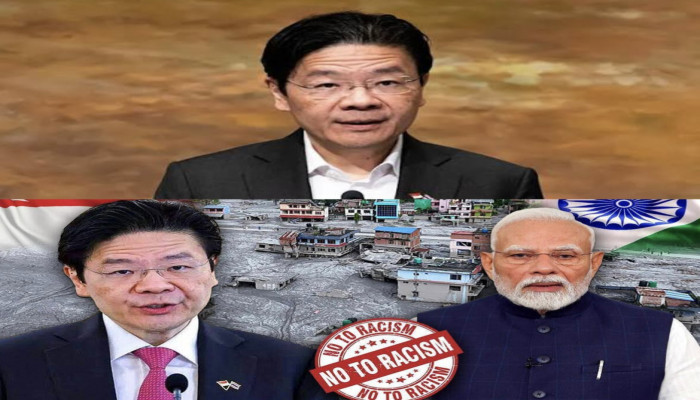
Singapore has launched an investigation into racist and xenophobic online comments targeting people of Indian origin. The comments surfaced during discussions on the recent floods in Nepal and Tibet and a debate over Singapore Airlines Ltd.'s possible investment in Air India Ltd. Prime Minister Lawrence Wong warned that such prejudice must not be allowed to become normal in Singapore, a country known for its multiracial population.
In a Facebook post on Sunday, Wong said recent online discussions had exposed “an uglier side” of Singapore. Channel News Asia quoted him as saying: “We can and should have robust debates. But we should never use seemingly legitimate arguments as a cover to fuel prejudice against any community or hostility towards foreigners.” Wong said he had discussed the issue with his Cabinet colleagues. He said this was why Senior Minister K Shanmugam had spoken publicly about the matter. Wong stressed that the views seen online did not represent Singapore as a whole. He also warned that they should not be dismissed as harmless online comments.
“If such behaviour goes unchecked, it can become normalised, deepen mistrust between communities, and pull us apart,” Wong said. His remarks came after Shanmugam said on Saturday that police had been asked to investigate the posts. He also said social media platforms would be asked to remove comments that violate Singapore's rules. Authorities had taken similar action in June, when they ordered platforms to block access to 14 posts that targeted Singapore's Indian community.
The latest controversy partly followed flash floods in Tibet and Nepal. Nine Singaporeans remain uncontactable after the floods swept through parts of the two regions. The missing Singaporeans were identified as Rengarajan Prabu, Shalinny Deavy Elan Sozan, Subramaniam Diraviam, Rajesvaran Ayyavoo, Estee Loeh, Ghosh Aditi, Ng Kit Kuen, Shubakshi Rawla and Sumit Rawla. Shanmugam said some online comments following the tragedy suggested that the missing people were “not our own”.
One of the posts used “ABNN”, a slur directed at Indians. Singapore's Ministry of Home Affairs later pointed to around 20 racist comments. Most of them appeared in comment sections under social media posts by local news organisations. Some users also used the term “CECA faces”. The phrase is a slur linked to the Singapore-India Comprehensive Economic Cooperation Agreement, or CECA. India and Singapore signed the agreement in June 2005. Opponents of immigration have used the term as a grievance for years.
Another wave of anti-Indian comments emerged during discussions over Singapore Airlines' possible investment in Air India. Shanmugam said the online debate had also included racist and anti-Indian abuse. He said police had been asked to examine the comments. Social media platforms would also be asked to remove posts that breach Singapore's rules. Shanmugam described the remarks as “shameful” and “totally unacceptable”.
Shanmugam also said the Singapore government would not interfere in any decision involving an investment in Air India. He said such decisions should be based on commercial considerations. Temasek Holdings Pte., the state-owned investment company and majority owner of Singapore Airlines, does not report to the government on its individual investment decisions, he added.
People familiar with the matter told Bloomberg that Air India is close to receiving 100 billion rupees ($1.06 billion) in financial support from Tata Sons Pvt. and Singapore Airlines. The airline is dealing with the impact of a difficult year. The proposed funding would depend on performance milestones and would be released in instalments, the people said. The contribution would follow the shareholders' ownership levels. Tata Sons owns 74.9 per cent of Air India, while Singapore Airlines holds the remaining 25.1 per cent.
The controversy comes amid wider concerns over racial and social tensions in Singapore. The city-state has a population of more than six million. Around 75 per cent are Chinese, 15 per cent are Malays, and roughly nine per cent are Indians. The remaining population comes from other communities. Singapore also depends on foreign talent to support its economy as it deals with a shrinking population and a low birth rate. A diplomatic observer told PTI that the country is managing these demographic pressures while the wider global economy has also faced disruption from the conflict in the Middle East.
Wong said Singapore had faced similar tensions in the past. He referred to the Covid-19 period, when “anti-foreigner” and “racial sentiments” were stirred. He also pointed to earlier debates over CECA. Similar sentiments appeared during the 2025 general election, when Wong warned against bringing race and religion into political debates.
“There will always be people who seek to exploit our differences,” Wong said. He acknowledged that authorities cannot stop every hateful comment from appearing online. However, he said Singaporeans can choose how they respond to such content. “We can reject such views and refuse to give them more space or legitimacy...Singapore has held together because we have consistently rejected attempts to divide us along racial or religious lines, and chosen instead to recognise one another as fellow Singaporeans,” said the prime minister.
Shanmugam said racist attacks against Indians had increased recently. Some of the comments targeted senior executives at Temasek over their ethnicity. Temasek chief executive Dilhan Pillay Sandrasegara, who is of Indian origin, has also faced cyberbullying. Temasek is the majority shareholder in Singapore Airlines, which owns a 25.1 per cent stake in Tata-owned Air India. The comments referred to a Reuters report from last month that said Air India had sought around $1.5 billion in fresh equity from both shareholders. Some social media users claimed Sandrasegara would favour Air India due to his Indian heritage. Shanmugam called the attacks “vile”, “nasty” and “libellous”.



 Loading...please wait
Comments