



Singapore forms new committee to strengthen Indian community identity
- In Reports
- 05:42 PM, Mar 06, 2026
- Myind Staff
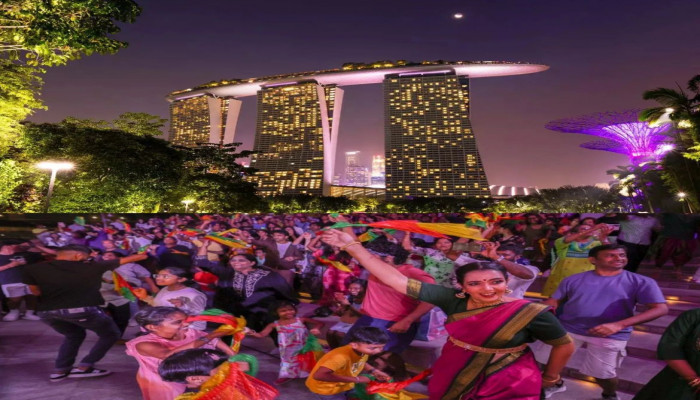
The Singapore government has announced the formation of a new committee aimed at strengthening the identity of the Indian community in the country and supporting its long-term development. The initiative is called the Indian Engagement and Development Initiative (INEI) and will work over the next five years to bring together community organisations, encourage youth leadership and support community upliftment.
The decision comes after several engagement sessions and focus group discussions with different stakeholders from the Indian community. These discussions included representatives from more than 150 Singapore-Indian organisations and over 240 youth leaders aged 35 and below. The consultations helped the government understand the needs and expectations of the community and shaped the plan for the new initiative.
The INEI committee will be jointly chaired by Senior Minister of State for Transport and Law Murali Pillai and Minister of State for Culture, Community and Youth Dinesh Vasu Dash, both of whom are of Indian origin. The committee will also include leaders and representatives from Indian community organisations, along with promising young leaders. According to Singapore’s Ministry of Culture, Community and Youth (MCCY), the committee aims to coordinate various community efforts and create stronger links between organisations already working within the Indian community.
Explaining the purpose of the committee, Dinesh Vasu Dash said, “This will be a committee by the community, and for the community.” He added that the goal is to create stronger networks among different groups working in the Indian community. “Its aim is to build strong networks across the Indian community, bringing together partners who are already doing good work on the ground,” he said.
As part of the initiative, an annual INEI forum will also be launched to provide a platform for discussion and collaboration among community members. Dinesh said the first dialogue under this forum will take place next month. The forum will allow community leaders, organisations and youth to share their views and discuss ideas on strengthening the Singapore-Indian community.
Apart from the committee, the government also announced a separate initiative to support multicultural arts in Singapore. Baey Yam Keng, Minister of State at the Ministry of Culture, Community and Youth, said that a new Multicultural Arts Programme Grant will be introduced. Under this programme, SGD 20 million will be provided over the next five years to support artists and organisations that work on traditional and multicultural art forms.
The grant will help practitioners who are developing traditional cultural art forms or working on projects that combine different cultural traditions. It will also support cross-cultural engagement through the arts in Singapore’s diverse society. According to reports, the grant could benefit artists who mix elements from different cultures and those who want to develop skills in art forms beyond their own cultural backgrounds.
The programme will also help build a stronger ecosystem for multicultural arts in Singapore. It aims to support projects that connect different communities and strengthen understanding between cultures. Singapore is a multi-ethnic country where Chinese make up the majority, accounting for about 75 per cent of the population of around six million people. Malays form about 15 per cent, while Indians account for more than seven per cent of the population, with the remaining population coming from various other parts of the world.
During discussions in Parliament, Acting Minister for Culture, Community and Youth David Neo expressed concern about declining interest among young people in traditional arts and cultural activities. He said that some practitioners from arts and culture groups have observed a drop in youth participation in traditional art forms.
Neo said, “When I speak with practitioners from our arts and culture groups, they tell me they are starting to notice declining interest among the young to engage in traditional arts.” He added that some young people are now choosing modern dance styles instead of traditional activities. “Some youths are trading traditional dance co-curricular activities for contemporary dance styles such as K-pop,” he said.
While acknowledging the popularity of modern entertainment, Neo stressed the importance of preserving cultural traditions. “While I understand the allure of K-pop and K-drama, we also need to retain our diverse traditional art forms and culture that form the foundation of our multicultural identity, and we need to pass these on to the next generation,” he said.
In line with this effort to strengthen multiculturalism, the National Arts Council (NAC), with support from the Ministry of Education, will introduce a new Ethnic Fusion Dance Programme for secondary schools. The programme will run from March 2026 to August 2027 and will encourage students to explore different cultural dance traditions.
A recent example of cultural fusion in Singapore was seen during a Chinese New Year celebration at the Sri Vairavimada Kaliamman Temple in the Toa Payoh housing estate. During the event, lion dance performers entered the temple while drums and cymbals played. The dancers performed before the deities, after which a ceremonial abhishekam was conducted for the statue of Bhagwan Murugan. A performer dressed as Caishen, the Chinese God of Wealth, also appeared and distributed sweets to children.
The event was organised by the temple together with the Lian Shan Shuang Lin Buddhist Monastery, the Toa Payoh East Community Club’s Indian Activity Executive Committee (IAEC) and the Harmony Circle, showing how different communities can come together in multicultural Singapore.
Singapore has spent decades promoting multiculturalism as a core part of its national identity. After 60 years of nationhood, the country continues to encourage cooperation between communities while maintaining cultural traditions. The new INEI committee and multicultural arts programmes are part of these efforts to strengthen community identity and social harmony.



 Loading...please wait
Comments