




Shakti, Devotion, and Empowerment through Mithila’s Jhijhiya
- In History & Culture
- 12:53 PM, Oct 20, 2026
- Dr. Pinku Jha
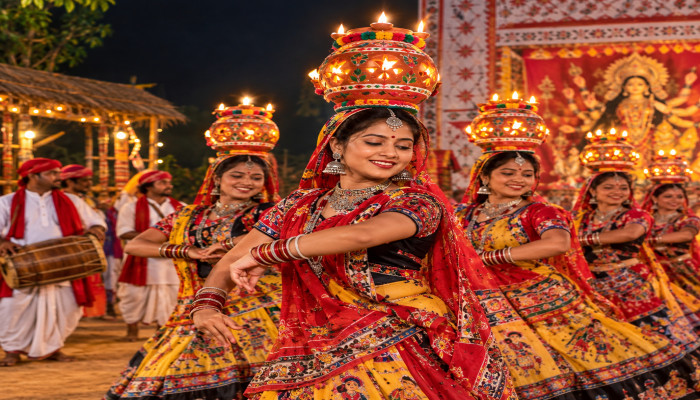
While scrolling Instagram reels, I came across an intriguing folk performance of Jhijhiya from Mithila. Amid numerous reels featuring Garba, a vibrant expression of the interrelationship between culture, performance, and devotion, an unexpected encounter with Jhijhiya inspired me to reflect on its cultural significance and share a brief account of this folk tradition.
This moment also prompted me to consider how folk performances serve as living expressions of collective memory, regional identity, and devotional practices, preserving cultural traditions through movement, music, and community participation.
Within the vibrant tapestry of Navaratri, the illuminated earthen vessel serves as a profound universal symbol of the Divine Feminine, anchoring traditions across diverse landscapes. While Gujarat’s Garba has evolved into a globally celebrated phenomenon of ecstatic, communal joy, Mithila’s Jhijhiya remains a deeply localised, essential ritual of spiritual vigilance in North Bihar and the Nepal Terai. Far from being a lesser counterpart, Jhijhiya exists in a beautifully complementary relationship with Garba. Where Garba represents Ullas - the expansive, creative celebration of cosmic renewal - Jhijhiya embodies protective stewardship, scaling inward to shield the immediate community from vulnerability and historical anxieties. Together, they illustrate the dual nature of Shakti: one celebratory and outward-facing, the other defensive and nurturing. By looking at Jhijhiya alongside Garba, we see how the same sacred tradition can hold both a grand festival of life and an intense, non-negotiable rite of culture.
Let us examine Jhijhiya through the lens of a compelling folk song traditionally performed to celebrate Navratri. While Mithila is globally renowned for its vibrant, intricate paintings, its performance arts carry an equally profound cultural weight. Jhijhiya is performed exclusively by women during the auspicious nine nights of Navratri and Durga Puja (Kumar, 2021). It is a set of complex threads of maternal protectiveness, community solidarity and spiritual devotion.
The Ritual and the Song: "Mach Mara Gele Ge Dayeniya"
To fully understand Jhijhiya and its famous accompanying song, “Mach Mara Gele Ge Dayeniya”—one must look beyond the surface nature of the dance. It demands an examination through a dual lens: one that honours its positive, empowering role as a sanctuary for female solidarity and spiritual strength, and another that critically addresses the rigid historical superstitions reflected in its lyrics. By analysing these interlocking dimensions, one can appreciate Jhijhiya not as a static relic of the past, but as a living, evolving expression of rural womanhood.
The visual performance of Jhijhiya is hypnotic. Each dancer balances an earthen pot, known as a jhijhari, precariously on her head. This pot is unique; its surface has numerous small holes, and inside sits a single, burning oil lamp (diyas). As the women move in synchronised, rhythmic circles, the flickering light filters through the perforations, creating a swirling constellation of shadows and illumination. The physical demands of the dance are immense, requiring absolute focus, core stability, and grace to ensure the flaming pot never tilts or falls.
The acoustic backdrop to this dance is a repertoire of traditional Maithili folk songs, passed down orally through generations. A central piece in this musical tradition is the song “Machh Mara Gale Ge Dayeniya”. On a literal level, the song depicts a slice of traditional agrarian village life. The lyrics describe the men of the village heading outside, specifically to the local ponds (pokharia) associated with the village deity, Brahma Baba, to collect fish (machh marna).
However, the song is not merely a pastoral description of fishing. It serves as a narrative anchor for the ritual itself. While the men are out navigating the vulnerabilities of the public world, the women remain in the sacred collective space, dancing and singing. The lyrics quickly transition from the mundane act of fishing to a powerful spiritual invocation, calling upon local deities and Goddess Durga to protect these men, their children, and their households from harm.
When viewed through a contemporary sociological lens, the themes embedded within Jhijhiya and its accompanying lyrics inevitably raise questions regarding gender bias and historical systemic inequalities. These problematic elements generally manifest in two core areas: the reinforcement of rigid division of labour and the implicit validation of historical superstitions surrounding witch-hunting.
The narrative structure of traditional Jhijhiya folk songs like Machh Mara Gale Ge Dayeniya clearly reflects a highly segregated, traditional division of labour framed by spiritual vulnerability. The public sphere associated with economic production, physical labour, and mobility is depicted as the exclusive domain of men, who leave the domestic perimeter to fish, farm, or travel for trade. Crucially, their absence leaves the private domain vulnerable. The song directly addresses the feared external threat, the Dain (the witch), stating that the men have gone away, thereby establishing the home as a vulnerable spiritual perimeter that women must aggressively protect.
In oral history, the dance was performed to confuse and ward off malicious sorcerers or witches who were believed to cast an evil eye on happy families, cause crop failures, or bring sudden illnesses to infants. The perforated holes in the jhijhari pot were structurally central to this belief. According to a widely held belief, a witch would be compelled to count the holes in the spinning pot; if she failed to count them all before the dance ended, her malevolent spell would be broken. Thus, rather than a passive domestic role, women’s agency in these rituals is framed as an active, cosmic defence system designed to safeguard the family during male absence.
While the dance acts as a shield against this perceived evil, the underlying cultural anxiety points to a tragic historical reality in rural India, particularly in Northern regions. For centuries, ‘witch-branding’ was a social evil weaponised primarily against vulnerable women such as widows, destitute women, or those from marginalised communities. If a village suffered an unexpected tragedy, an outbreak of disease, or a bad harvest, these defenceless women were frequently scapegoated, branded as witches, and subjected to horrific violence or social ostracisation, often as a pretext to seize their property or punish their independence. Therefore, a modern reading of the tradition must acknowledge that the lyrics carry the possibilities of a dark historical assumption that disproportionately demonised and endangered marginalised women.
What significance does Jhijhiya hold for Women?
Despite these problematic historical undertones, dismissing Jhijhiya as merely an artefact of gender bias would be an oversimplification that ignores the deeply empowering reality experienced by the women who perform it. For the women of Mithila, Jhijhiya historically provided and continues to provide a significant, positive space of agency, resilience, and profound spiritual authority.
The first major argument for the ritual lies in the concept of communal sisterhood. In historical rural societies, women lived highly insulated lives, often restricted by customs of domestic seclusion. The festival of Navratri offered a socially sanctioned, unyielding exception to this rule. For ten consecutive nights, women took complete ownership of the public village square. It became a rare, women-only sanctuary where rigid household hierarchies dissolved. Young girls danced alongside elderly matrons, and women from various socio-economic backgrounds, including highly marginalised communities like the Musahar community and bonded over shared artistry (Shah, 2019). It functioned as a vital support network, a space for oral mentorship, and a platform for collective joy away from the watchful eyes of a patriarchal domestic structure. In other words, Jhijhiya flips the narrative of female vulnerability by positioning women as the ultimate protectors of society.
This role as an active protector is directly tied to the invocation of Shakti (feminine cosmic power). Jhijhiya is fundamentally dedicated to Goddess Durga Bhairavi, the supreme matriarchal deity who defeats demons and restores cosmic order. By aligning themselves with Durga, the dancers are not enacting submission; they are channelising the highest form of power recognised in Hindu philosophy. The act of balancing a burning flame amid a dark autumn night is a brilliant metaphor for the woman herself: a resilient source of light, life, and stability holding firm against the chaotic, dark forces of the world. The physical mastery required to execute the dance is a public demonstration of discipline, physical stamina, and mental grit.
Today, cultural practitioners, youth groups, and academic institutions view Jhijhiya primarily through an artistic and preservationist lens (Mottin, 2023). When contemporary Maithili artists perform "Mach Mara Gele Ge Dayeniya" or execute the Jhijhiya dance on the national stage, the focus is squarely on celebrating Mithila’s rich heritage, musical complexity, and the historical resilience of its women. The regressive superstitious elements regarding witch-hunting are increasingly contextualised as historical relics or consciously omitted, while the core values of sisterhood, physical grace, and artistic devotion are pushed to the forefront.
A Living Heritage
Ultimately, Jhijhiya represents the beautiful, contradictory complexity of ancient folk traditions. It is a cultural phenomenon born out of a specific historical landscape, carrying both the limitations of the gender roles of the time and the magnificent strength of the women who lived then.
By understanding the story behind the song "Mach Mara Gele Ge Dayeniya" and the dance that accompanies it, we gain a profound appreciation for the women of Mithila. They took the tools available to them - clay pots, fire, song, and community and constructed a space of absolute sovereignty, physical beauty, and spiritual power. As Jhijhiya steps into the modern world, it stands as a glowing testament to the enduring capacity of women to preserve their heritage while continuously reshaping its meaning to reflect a more enlightened future.
References
Kumar, A. (2021). Jhijhiya in Nepal: A sacred folk dance of Mithila’s living tradition. ShodhKosh: Journal of Visual and Performing Arts, 2(2), 145–158. Doi.org
Mottin, M. (2023). The revival of Jhijhiya dance in Janakpurdham: Heritage-making and Maithil identity. Heritage as Placemaking Project. https://heritageasplacemaking.com/events/revival
Shah, A. (2019, December 10). In Janakpur, a traditional Mithila folk dance is helping shape women’s identities. The Kathmandu Post. Kathmandupost.com



 Loading...please wait
Comments